
Types of Antagonism: Competitive, Irreversible, Chemical and Physiological
An antagonist is any drug that opposes another — but there is more than one way to say no. One competes for the same seat and can be shouted down by more agonist; another locks the door for good and no amount of agonist will reopen it; a third never touches the receptor at all, neutralising its rival by chemistry, by clearance, or by pushing the opposite lever through a different pathway. Sort these four families and you can predict every dose–response curve on the exam — and rescue a patient in anaphylaxis.
A young woman collapses minutes after a bee sting. Her airway is swelling shut, her blood pressure is falling through the floor, hives spread across her skin — this is anaphylaxis, and the culprit is a flood of histamine acting on its receptors. The nurse reaches not for an antihistamine but for adrenaline, and drives it into her thigh. Adrenaline does NOT block histamine's receptors. It works on entirely DIFFERENT receptors: it constricts vessels to lift the pressure, relaxes the airway to open it, and steadies the heart. Every effect histamine is causing, adrenaline opposes through a separate pathway. Two drugs, opposite effects, different receptors — the patient lives. That is physiological antagonism, and it is only one of four ways a drug can say no.
The big split: at the receptor, or away from it
Antagonism divides first into two great families. RECEPTOR antagonism, where a drug binds the same receptor as the agonist and blocks its signal, and NON-RECEPTOR antagonism, where the two drugs never meet at a receptor at all. Almost every antagonist you will name — naloxone, atropine, propranolol — is a receptor antagonist. But the non-receptor mechanisms (chemical, pharmacokinetic, physiological) are exactly the ones students forget, and they explain some of medicine's most dramatic saves. We will take the receptor family first, because that is where the exam's favourite distinction lives.
Competitive (reversible): a surmountable rival
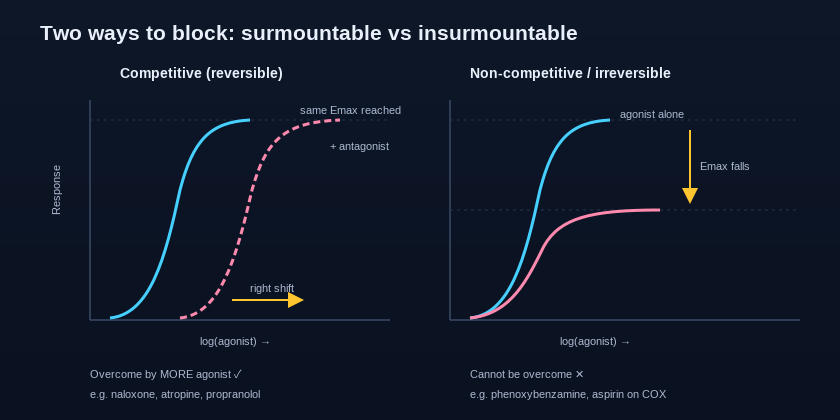
A competitive antagonist sits in the agonist's own seat — reversibly. It binds the SAME site as the agonist, but weakly enough to come off again. The two molecules jostle for the receptor, and whoever is more abundant tends to win. So the block is SURMOUNTABLE: raise the agonist concentration high enough and it out-competes the antagonist, displacing it and restoring the full response. On the dose–response curve this has a signature look — the whole curve shifts to the RIGHT, in PARALLEL, and the maximum effect (Emax) is fully PRESERVED. You simply need more agonist to reach the same ceiling. Potency falls; efficacy does not.
Naloxone reverses opioid overdose by competing at the opioid receptor (its emergency use links to the CNS chapter). Atropine competitively blocks muscarinic receptors (the autonomic story lives in the ANS chapter). Propranolol competes at β-adrenoceptors; losartan blocks the angiotensin AT1 receptor; flumazenil competes at the benzodiazepine site. Every one of them shifts the agonist's curve right while leaving Emax intact — give enough agonist and, in principle, you climb back to the same peak.
"Right shift, same ceiling" is the fingerprint of competitive antagonism — and it is why doctors can sometimes outdose a reversible block. In a partial opioid overdose, more agonist could overwhelm naloxone; that is also why naloxone (short-acting) can wear off before a long opioid does, letting the patient re-sedate. Surmountable cuts both ways.
Non-competitive (irreversible / allosteric): an insurmountable wall
The second receptor type refuses to be shouted down. A non-competitive antagonist either binds IRREVERSIBLY (often a covalent bond) to the receptor, or binds at a DIFFERENT (allosteric) site and changes the receptor's shape so the agonist can no longer signal. Either way, adding more agonist does NOT rescue the response — the block is INSURMOUNTABLE. The functional receptors are effectively removed from the pool. On the curve the signature flips: the maximum effect (Emax) is LOWERED, because even a saturating dose of agonist cannot recruit receptors that are permanently disabled. This is the mirror image of the competitive picture — and confusing the two is the classic exam slip.
Phenoxybenzamine binds α-adrenoceptors irreversibly — used before surgery in phaeochromocytoma to hold catecholamine surges in check; no amount of released adrenaline can fully overcome it. Aspirin irreversibly acetylates cyclo-oxygenase (COX), so the enzyme is dead until the cell makes new protein (why a single dose blocks platelets for their lifetime). Ketamine and PCP block the NMDA receptor by acting within its channel (an allosteric / channel block). Their common tell: a depressed Emax.
- Competitive = same site, reversible, SURMOUNTABLE — curve shifts right in parallel, Emax preserved.
- Non-competitive = irreversible or allosteric, INSURMOUNTABLE — Emax is lowered.
- More agonist beats a competitive block; it cannot beat a non-competitive one.
- Competitive lowers potency (right shift); non-competitive lowers efficacy (max effect).
- Examples: competitive — naloxone, atropine, propranolol, losartan; non-competitive — phenoxybenzamine, aspirin on COX, ketamine on NMDA.
Chemical antagonism: neutralised on contact
Now we leave the receptor entirely. In chemical antagonism, one drug binds the OTHER DRUG directly — molecule to molecule — and inactivates it. No receptor is involved at all; the antagonist simply mops the offender out of solution. It is the most literal form of "neutralising" a drug.
Protamine (a positively charged protein) binds and neutralises heparin (strongly negative) to reverse anticoagulation — a bedside save that connects to the Cardiovascular chapter. Chelators grab toxic metals: dimercaprol binds arsenic/lead/mercury, desferrioxamine binds iron, and the metal is carried out inert. Activated charcoal adsorbs many swallowed poisons in the gut before they can be absorbed. In each case the antagonist's target is the poison itself, not a receptor.
Pharmacokinetic antagonism: lowering the effective dose
Some drugs oppose others without ever touching them. In pharmacokinetic antagonism, one drug reduces the effective CONCENTRATION of another by altering its absorption, distribution, metabolism, or excretion. The classic mechanism is enzyme INDUCTION: a drug that ramps up hepatic cytochrome-P450 enzymes speeds the breakdown of a second drug, so its plasma level — and its effect — falls. Nothing happens at the second drug's receptor; there is simply less of it around.
Rifampicin and carbamazepine are strong P450 inducers: they can drop the levels of warfarin, oral contraceptives, and many other drugs enough to cause treatment failure (a famously dangerous cause of unintended pregnancy on the pill). This is the mechanism explored fully in the Metabolism (CYP) chapter here — pharmacokinetic antagonism is really a drug interaction wearing an antagonism label.
Physiological (functional) antagonism: opposite levers
Return to the woman in anaphylaxis. Physiological (functional) antagonism is when two drugs produce OPPOSITE effects through DIFFERENT receptors or pathways, so the net result is cancellation — even though neither drug touches the other's receptor. Adrenaline does not block histamine; it drives the vessels, airway, and heart the opposite way through its own adrenoceptors, undoing histamine's damage from the other side. This is why adrenaline, not an antihistamine, is the life-saving first drug in anaphylaxis (the emergency itself is covered in the Respiratory / anaphylaxis chapter).
Glucagon and insulin are physiological antagonists of blood glucose: insulin lowers it, glucagon raises it, each through its own receptor and pathway. That is why glucagon can be used to treat severe insulin-induced hypoglycaemia — it opposes insulin functionally, not by blocking the insulin receptor.
- Chemical antagonism: the antagonist binds the OTHER DRUG directly (protamine–heparin, chelators, charcoal).
- Pharmacokinetic antagonism: one drug lowers another's concentration (enzyme induction by rifampicin, carbamazepine).
- Physiological antagonism: opposite effects via DIFFERENT receptors (adrenaline vs histamine; glucagon vs insulin).
- None of the three non-receptor types acts at the target drug's receptor.
- Physiological antagonism is functional opposition, NOT receptor blockade — a frequent mix-up.
- Confusing competitive with non-competitive: competitive shifts the curve right with Emax UNCHANGED; non-competitive LOWERS Emax. Mixing these up is the single most common error.
- Calling physiological antagonism "competitive". Functional opposition uses DIFFERENT receptors — nobody is competing for one site.
- Forgetting the non-receptor mechanisms exist at all. Chemical, pharmacokinetic and physiological antagonism are examined precisely because students default to "receptor blocker".
- Assuming irreversible always means covalent. Some insurmountable antagonists bind very tightly at an allosteric site without a covalent bond — the functional result (lowered Emax) is what matters.
A competitive antagonist is added to an agonist dose–response experiment. Compared with the agonist alone, the new curve will:
- Competitive (reversible): same site, surmountable — curve shifts right in parallel, Emax preserved.
- Non-competitive (irreversible/allosteric): insurmountable — Emax is lowered.
- Chemical: binds the other drug directly (protamine–heparin, chelators, charcoal).
- Pharmacokinetic: lowers the other drug's level (enzyme induction — rifampicin, carbamazepine).
- Physiological: opposite effects via different receptors (adrenaline vs histamine; glucagon vs insulin).
- Rang HP, Dale MM, et al. Rang & Dale's Pharmacology — Antagonism: competitive, non-competitive, chemical, pharmacokinetic & physiological.
- Katzung BG. Basic & Clinical Pharmacology — Drug antagonism, dose–response curves & surmountable vs insurmountable block.
- Brunton LL, et al. Goodman & Gilman's The Pharmacological Basis of Therapeutics — Receptor antagonists & mechanisms of drug antagonism.
- Whalen K. Lippincott Illustrated Reviews: Pharmacology — Agonists, antagonists & functional antagonism.
- Bertram G. Katzung & Trevor's Pharmacology Examination & Board Review — Competitive vs irreversible antagonists.