
Antifungals Part 1: Polyenes & Azoles
Killing a fungus is far harder than killing a bacterium — because a fungus is built almost like us. Both are complex cells with a nucleus, so there are precious few differences to exploit, and the drugs that do exist often border on toxic. Yet fungi make one telltale molecule we don't, and nearly every antifungal aims straight at it. Find that molecule, and the whole field snaps into focus.
A patient with a severe, invasive fungal infection is started on amphotericin B — and the infusion itself is an ordeal: fevers, shaking chills, and rigors, followed over the days ahead by falling kidney function and dropping potassium. Clinicians have long nicknamed it 'ampho-terrible.' Why is the drug so harsh? Because a fungus, unlike a bacterium, is a complex cell much like our own, leaving few safe targets — so the antifungals that work are often the ones that tread closest to harming us too. Understanding that is the key to the whole subject.
Ergosterol: the one big difference
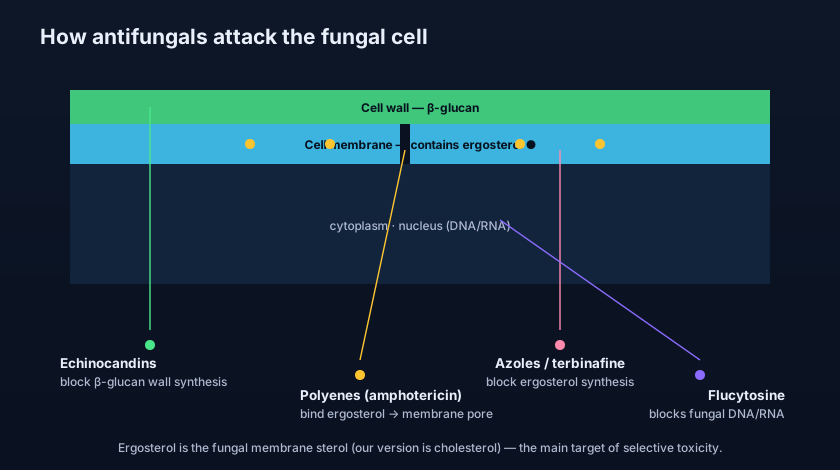
Fungi build their membranes with ergosterol; we use cholesterol. The single most useful difference between fungal and human cells is the sterol in the cell membrane. Fungi use ergosterol; our cells use cholesterol. That distinction is the target of almost every important antifungal — either by attacking ergosterol directly, or by blocking the fungus from making it. Because the difference is only partial, though, these drugs can still affect our cholesterol-containing cells, which is why antifungals tend to be more toxic than antibacterials. Ergosterol is the thread that ties the whole class together.
Polyenes: binding ergosterol
The polyenes bind ergosterol directly and punch pores in the fungal membrane, so the cell's contents leak out — fungicidal. Amphotericin B is the broadest and most powerful antifungal, reserved for severe, life-threatening systemic infections, but it lives up to 'ampho-terrible': given intravenously, it causes fevers and rigors during infusion, and, over time, kidney damage with wasting of potassium and magnesium. Newer lipid formulations wrap the drug to make it much less toxic. Its cousin nystatin is too toxic to give into the body at all, so it survives only as a topical and oral agent — for oral thrush and skin or vaginal candida, acting right on the surface without being absorbed.
Azoles: blocking ergosterol synthesis
The azoles take the other route: they block a fungal enzyme that makes ergosterol, starving the membrane of it (fungistatic). They're the workhorses of antifungal therapy. Fluconazole penetrates well into the brain and is a mainstay for Candida and cryptococcal infections; voriconazole is a key drug for the mould Aspergillus; itraconazole and posaconazole broaden the reach further and are used to prevent mould infections in high-risk patients. Their catch is a familiar one: the enzyme they block is a CYP enzyme, so the azoles are potent CYP inhibitors and interact with many other drugs — raising the levels of statins, warfarin, and more (the same interaction principle from the metabolism chapter). They can also be hepatotoxic and prolong the QT, and older ketoconazole additionally blocked human steroid hormone synthesis. Powerful, oral, but interaction-heavy.
- Fungi are eukaryotes like us → few targets → antifungals tend to be more toxic.
- Ergosterol (fungal membrane sterol; ours is cholesterol) is the central target.
- Polyenes (amphotericin B) bind ergosterol → membrane pore (fungicidal); nystatin is topical/oral only.
- Amphotericin B: infusion fevers/rigors, nephrotoxicity, low K/Mg; lipid forms are safer.
- Azoles (fluconazole, voriconazole) block ergosterol synthesis (fungistatic); potent CYP inhibitors.
The azoles' CYP inhibition is the grapefruit-juice interaction wearing an antifungal hat. Because they block the same family of liver enzymes, adding an azole to a patient's regimen can spike the levels of a statin (muscle damage), warfarin (bleeding), or many other drugs — exactly the mechanism you learned in metabolism. So starting fluconazole or voriconazole in a patient on multiple medicines demands a check of what else they're taking. The same principle keeps reappearing: whenever a drug inhibits CYP, ask what it will do to everything else on the list.
- Giving nystatin systemically. It's too toxic — it's for topical/oral surface use only.
- Starting an azole without checking CYP-mediated drug interactions (statins, warfarin).
- Forgetting amphotericin's nephrotoxicity and electrolyte wasting — hydrate and monitor.
- Using azoles in pregnancy at higher doses — potential teratogenicity.
What is the main target that most antifungal drugs exploit?
- Fungi resemble our cells, so antifungals are harder and more toxic; ergosterol is the key target.
- Polyenes (amphotericin B) bind ergosterol → pore (fungicidal); 'ampho-terrible' nephrotoxicity.
- Azoles (fluconazole, voriconazole) block ergosterol synthesis (fungistatic) — potent CYP inhibitors.
- Nystatin is topical/oral only (too toxic systemically).
- Katzung BG. Basic & Clinical Pharmacology — Antifungal Agents (polyenes & azoles).
- Brunton LL, et al. Goodman & Gilman's The Pharmacological Basis of Therapeutics — Antifungal agents.
- Rang HP, Dale MM, et al. Rang & Dale's Pharmacology — Antifungal drugs.
- IDSA guidelines — Candidiasis, aspergillosis & cryptococcal disease treatment.
- Whalen K. Lippincott Illustrated Reviews: Pharmacology — Antifungal drugs.

