
Anti-Tuberculosis Drugs: The RIPE Regimen
Why does a single infection need FOUR drugs taken faithfully for SIX months, when a sore throat is cured in a week with one? Tuberculosis is a uniquely stubborn foe — slow, armoured, and hiding — and the strange, demanding regimen we use against it is the product of hard-won lessons. Master why it's built the way it is, and the four drugs and their toxicities fall neatly into place (and yes — the orange urine is normal).
A patient diagnosed with tuberculosis is handed a daunting prescription: four different antibiotics, to be taken together every day for months, and warned — almost as an afterthought — that his urine, tears, and sweat will turn orange. Why such an ordeal for one infection? The answer lies in the peculiar biology of the tuberculosis bacterium: it grows painfully slowly, shields itself behind a waxy wall, hides inside our own cells, and lurks in a dormant form that most drugs can't touch. Beating it demands the regimen you're about to learn.
Why four drugs, why so long
TB's biology dictates the strategy. Two facts about tuberculosis shape everything. First, the bacterial load is huge, and in any such large population a few organisms already carry a mutation resistant to any single drug — so using ONE drug would simply select those resistant few and fail (the resistance lesson made vivid). Using several drugs at once means a bacterium would need to be simultaneously resistant to all of them, which is vanishingly unlikely — so combination therapy prevents resistance. Second, the bacterium grows extremely slowly and can lie dormant, and drugs only kill actively-metabolizing cells — so treatment must continue for MONTHS to catch the bacteria as they slowly wake and divide. Four drugs, taken together, for a long time: that's the logic of every anti-TB regimen.
The RIPE regimen
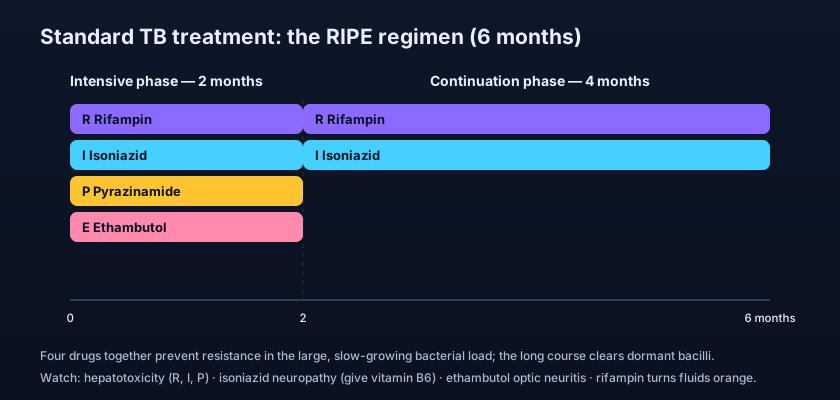
The standard six-month course is remembered by the initials RIPE. For the first two months (the intensive phase) all four drugs are given; then for four more months (the continuation phase) just two — rifampin and isoniazid — finish the job. Each drug has a distinct mechanism and a signature toxicity. Rifampin blocks the bacterial RNA polymerase; it's a powerful liver-enzyme INDUCER (so it weakens many other drugs, from contraceptives to warfarin to HIV medicines) and it stains body fluids harmlessly orange-red. Isoniazid blocks synthesis of the waxy mycolic acid wall; it can damage peripheral nerves by depleting vitamin B6, so B6 (pyridoxine) is given alongside to prevent it. Pyrazinamide works inside the acidic environment of infected cells and raises uric acid (gout). Ethambutol blocks another wall enzyme and can cause optic neuritis, disturbing colour vision and acuity, so vision is monitored. A crucial shared danger runs through three of the four — rifampin, isoniazid, and pyrazinamide are all hepatotoxic — so liver function is watched throughout.
- TB needs multiple drugs (prevent resistance) for months (kill slow/dormant bacilli).
- RIPE: Rifampin, Isoniazid, Pyrazinamide, Ethambutol — 2 months, then R+I for 4 more.
- Rifampin: RNA polymerase; strong CYP inducer; orange body fluids.
- Isoniazid: mycolic acid; neuropathy (give vitamin B6); acetylator variation.
- Pyrazinamide → hyperuricemia; Ethambutol → optic neuritis; R/I/P are hepatotoxic.
The anti-TB drugs are a museum of earlier lessons. Rifampin's enzyme INDUCTION is the flip side of the macrolides' inhibition — it speeds up the metabolism of other drugs, silently weakening contraceptives, warfarin, and (critically) HIV medicines. Isoniazid's neuropathy comes from depleting vitamin B6, which is why B6 is co-prescribed — and its clearance depends on whether the patient is a fast or slow acetylator, the pharmacogenetics you met in metabolism. And its hepatotoxicity, shared with two of its companions, is why the whole regimen is shadowed by liver monitoring. Every drug here is a familiar principle wearing a new name.
- Treating TB with a single drug. It selects resistant mutants and fails — always combine.
- Forgetting rifampin induces CYP — it weakens contraceptives, warfarin, and HIV drugs.
- Giving isoniazid without vitamin B6 — risk of peripheral neuropathy.
- Not monitoring the liver (R/I/P) and vision (ethambutol).
Why is tuberculosis treated with four drugs rather than one?
- TB needs multiple drugs (prevent resistance) for months (kill slow/dormant bacilli).
- RIPE: rifampin, isoniazid, pyrazinamide, ethambutol — 2 months, then R+I for 4 more.
- Rifampin (CYP inducer, orange fluids); isoniazid (neuropathy, give B6); ethambutol (optic neuritis).
- R, I, and P are hepatotoxic — monitor the liver throughout; latent TB uses fewer drugs.
- Katzung BG. Basic & Clinical Pharmacology — Antimycobacterial Drugs.
- Brunton LL, et al. Goodman & Gilman's The Pharmacological Basis of Therapeutics — Chemotherapy of tuberculosis.
- WHO — Consolidated guidelines on tuberculosis treatment.
- Rang HP, Dale MM, et al. Rang & Dale's Pharmacology — Antimycobacterial agents.
- Whalen K. Lippincott Illustrated Reviews: Pharmacology — Antimycobacterial drugs.