
HIV Antiretrovirals: From Death Sentence to Daily Pill
In one generation, HIV went from an almost certain death sentence to a manageable chronic condition controlled by a single daily pill — one of the greatest triumphs in the history of medicine. The secret wasn't a single wonder drug, but a strategy: attack the virus at several stages of its life cycle at once. Understand that life cycle, and every class of HIV drug falls into place.
In the 1980s, a diagnosis of HIV was a slow death sentence — the virus relentlessly destroyed the immune system until ordinary infections became fatal. Today, a person diagnosed with HIV can take a single daily tablet, keep the virus completely suppressed, live a normal lifespan, and — when the virus is undetectable — cannot even transmit it to others. This transformation is one of medicine's proudest achievements, and it was built on a simple, powerful idea: hit the virus at multiple points in its life cycle simultaneously.
The life cycle is the drug map
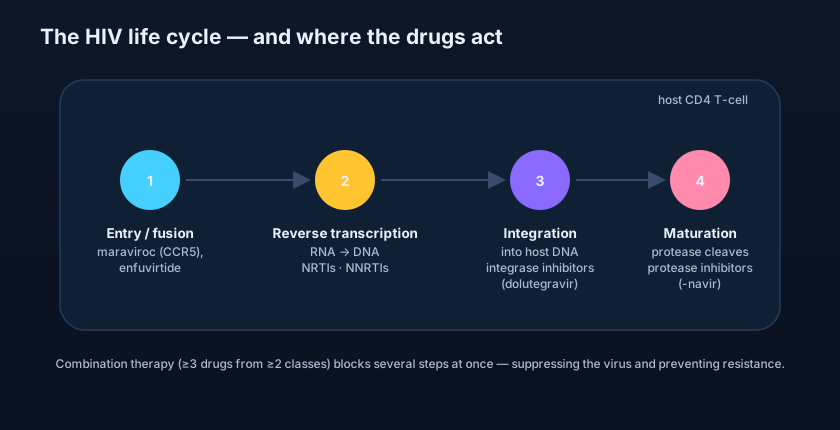
Each stage of HIV's life cycle is a drug target. HIV infects immune cells through a fixed sequence of steps, and each step is a place a drug can strike. First it ENTERS the cell by binding receptors and fusing with the membrane. Then, being an RNA virus, it must REVERSE-TRANSCRIBE its RNA into DNA using a unique enzyme (reverse transcriptase). That viral DNA is then INTEGRATED into the host's own genome by the integrase enzyme. Finally, when new virus is assembled, the protease enzyme cuts its proteins into their working shapes to MATURE it into an infectious particle. Every class of antiretroviral drug is named for the step it blocks — so the life cycle IS the classification.
The drug classes
There are five main classes, one for each vulnerable step. Reverse transcriptase inhibitors come in two flavours: the nucleoside type (NRTIs — tenofovir, emtricitabine, abacavir, lamivudine) act as false building blocks that terminate the growing viral DNA and form the backbone of therapy, and the non-nucleoside type (NNRTIs — efavirenz, rilpivirine) block the same enzyme differently. Integrase strand-transfer inhibitors (INSTIs — dolutegravir, bictegravir) stop the viral DNA integrating and are now the preferred first-line drugs, being potent and well-tolerated. Protease inhibitors (the '-navirs' — darunavir, atazanavir, often boosted by ritonavir) block maturation but carry metabolic side effects and many CYP interactions. And entry/fusion inhibitors (maraviroc, enfuvirtide) block the virus getting in — used in special cases. A couple of memorable cautions: abacavir can cause a dangerous hypersensitivity reaction in people with a specific gene (HLA-B*5701, so patients are tested first), and tenofovir can affect the kidneys and bones.
The strategy: combination, for life
The breakthrough that turned HIV around was never a single drug — it was combination antiretroviral therapy (often called HAART or cART): at least three drugs from at least two classes, taken together. Attacking several steps at once suppresses the virus far more completely and, crucially, makes resistance almost impossible — the virus would have to mutate against all the drugs simultaneously. Treatment is lifelong and keeps the virus undetectable rather than curing it, but that is enough for a normal life. The same drugs also PREVENT infection: pre-exposure prophylaxis (PrEP, usually tenofovir with emtricitabine) protects high-risk people, and post-exposure prophylaxis can prevent infection after a needlestick or exposure. And a landmark public-health fact — 'undetectable equals untransmittable' — means a person on effective treatment cannot pass HIV to a sexual partner.
- HIV life cycle: entry → reverse transcription → integration → maturation; each is a drug target.
- Classes: NRTIs, NNRTIs, integrase inhibitors (INSTIs), protease inhibitors, entry/fusion inhibitors.
- Integrase inhibitors (dolutegravir) are now preferred first-line — potent, well-tolerated.
- Combination therapy (≥3 drugs, ≥2 classes) suppresses the virus and prevents resistance; lifelong.
- PrEP prevents HIV in high-risk people; 'undetectable = untransmittable'.
The combination strategy in HIV is the resistance lesson perfected. A single antiretroviral would quickly fail, because HIV mutates so fast that resistant virus emerges within weeks — exactly the pre-existing-mutant problem from the resistance chapter. Hitting three targets at once means the virus would need three simultaneous mutations to survive, which is vanishingly unlikely. It's the same principle behind combination therapy for tuberculosis, applied to a virus that mutates even faster: more targets, no escape.
- Using a single antiretroviral. HIV mutates fast — always combine ≥3 drugs.
- Giving abacavir without testing for HLA-B*5701 — risk of severe hypersensitivity.
- Ignoring protease inhibitors' CYP interactions and metabolic effects.
- Interrupting therapy. Stopping lets the virus rebound and can select resistance.
Why is HIV treated with a combination of at least three drugs?
- HIV drug classes map to its life cycle: entry, reverse transcription (NRTI/NNRTI), integration (INSTI), maturation (PI).
- Integrase inhibitors (dolutegravir) are preferred first-line; NRTIs form the backbone.
- Combination therapy (≥3 drugs) suppresses the virus and prevents resistance — lifelong, not curative.
- PrEP prevents HIV in high-risk people; undetectable = untransmittable.
- Katzung BG. Basic & Clinical Pharmacology — Antiviral Agents (antiretroviral drugs).
- Brunton LL, et al. Goodman & Gilman's The Pharmacological Basis of Therapeutics — Antiretroviral agents.
- DHHS / WHO — Guidelines for antiretroviral therapy & PrEP.
- Rang HP, Dale MM, et al. Rang & Dale's Pharmacology — Antiretroviral drugs.
- Whalen K. Lippincott Illustrated Reviews: Pharmacology — Antiretroviral drugs.