
Penicillins: The First and Still the Greatest
A mould spore drifting onto a forgotten dish gave humanity its first true miracle drug — one that kills bacteria by making them tear themselves apart, yet is so harmless to us that we give it to newborns. Nearly a century on, penicillins remain a cornerstone of medicine. But a single ring of atoms is both their genius and their weakness, and bacteria have spent decades learning to snip it.
In 1928, Alexander Fleming returned from holiday to find a stray mould had contaminated one of his bacterial plates — and, strangely, the bacteria around the mould had dissolved away. That mould was producing penicillin, and its discovery would go on to save more lives than perhaps any drug in history. What makes it so remarkable isn't just that it kills bacteria, but HOW: it turns the bacterium's own wall-building against it, so the microbe bursts under its own internal pressure. To see the mechanism is to understand the entire β-lactam family.
How they kill: turning the wall against itself
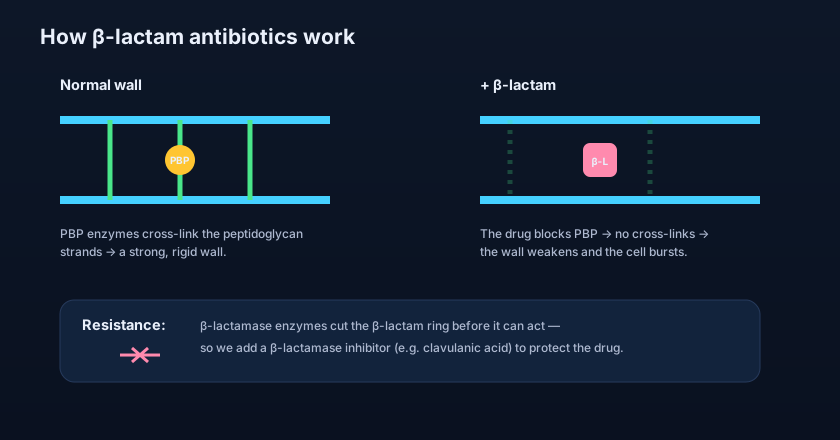
Penicillins block the enzymes that build the cell wall. A bacterium's rigid cell wall is a mesh of peptidoglycan, and it's held together by cross-links stitched in place by enzymes called penicillin-binding proteins (PBPs). Penicillin — thanks to its β-lactam ring — jams these PBPs, so the cross-links can't form. As the bacterium keeps growing and remodelling its wall, the wall gets weaker and weaker until it can no longer contain the high internal pressure, and the cell simply bursts. This is why penicillins are bactericidal, and why they only kill bacteria that are actively growing and building wall. Because human cells have no wall and no PBPs, the drug has essentially no target in us — the reason penicillins are so extraordinarily safe.
The penicillin family
Penicillins were bred over time to cover more organisms. The natural penicillins (penicillin G, penicillin V) are narrow — excellent against streptococci, syphilis, and some others, but easily destroyed by the β-lactamase enzyme. The aminopenicillins (amoxicillin, ampicillin) reach a bit further, into some Gram-negative bacteria. The anti-staphylococcal penicillins (flucloxacillin, nafcillin, oxacillin) were designed with a bulky shape that resists staph's β-lactamase — the drugs of choice for ordinary Staph aureus (though not MRSA). And the anti-pseudomonal penicillins (piperacillin) stretch to cover the tough hospital organism Pseudomonas. A recurring fix threads through the family: pairing a penicillin with a β-lactamase inhibitor (as in amoxicillin-clavulanate or piperacillin-tazobactam) to shield it from the destroying enzyme.
The allergy question
Penicillin allergy is the most-reported drug allergy in the world — but most of it isn't real. Many people labelled 'penicillin-allergic' as children actually had a viral rash or a mild upset, not a true allergy, and carry the label needlessly for life, missing out on the best, safest antibiotics. A genuine allergy ranges from a delayed rash to, rarely, immediate anaphylaxis — the dangerous, IgE-driven reaction with swelling and airway compromise. The crucial skill is distinguishing a serious immediate allergy (which means avoiding all β-lactams and using adrenaline for anaphylaxis) from a vague or minor history (which often can be safely clarified or challenged). Mislabelling costs patients real harm.
- Penicillins (β-lactams) block PBP enzymes → no wall cross-links → the bacterium bursts (bactericidal).
- Human cells lack a wall/PBPs, so penicillins are extremely safe.
- Types: natural, amino- (amoxicillin), anti-staph (flucloxacillin), anti-pseudomonal (piperacillin).
- β-lactamase destroys them; add a β-lactamase inhibitor (clavulanate, tazobactam) to protect.
- Penicillin allergy is over-reported; distinguish true anaphylaxis from a vague label.
Penicillins connect to the excretion story from pharmacokinetics. They're cleared so rapidly by the kidney's tubular secretion pumps that, in the days when penicillin was scarce and precious, doctors gave it alongside probenecid — a drug that blocks those pumps — to make each dose last longer. It's a lovely example of how the same excretion mechanism you learned about earlier is exploited to stretch a life-saving antibiotic.
- Using a plain penicillin against a β-lactamase producer. Add an inhibitor or pick another drug.
- Treating MRSA with an anti-staph penicillin. MRSA's altered PBP defeats all β-lactams.
- Accepting a vague 'penicillin allergy' label without clarifying — it denies patients the best drugs.
- Forgetting penicillins only kill growing bacteria — pairing with a drug that halts growth can blunt them.
How do penicillins kill bacteria?
- Penicillins block PBPs → the wall can't cross-link → the bacterium bursts (bactericidal, very safe).
- Types: natural, amino- (amoxicillin), anti-staph (flucloxacillin), anti-pseudomonal (piperacillin).
- β-lactamase destroys them; add clavulanate/tazobactam to protect the drug.
- Penicillin allergy is over-labelled — distinguish true anaphylaxis from a vague history.
- Katzung BG. Basic & Clinical Pharmacology — Beta-Lactam Antibiotics (penicillins).
- Brunton LL, et al. Goodman & Gilman's The Pharmacological Basis of Therapeutics — Penicillins.
- Rang HP, Dale MM, et al. Rang & Dale's Pharmacology — Beta-lactam antibiotics.
- Murray PR, et al. Medical Microbiology — Cell-wall-active agents.
- Whalen K. Lippincott Illustrated Reviews: Pharmacology — Penicillins & beta-lactamase inhibitors.

