
How Antibiotics Work: Targets, Spectrum & Selective Toxicity
You swallow a pill that kills billions of bacteria inside you — yet leaves your own cells completely unharmed. How can one drug tell the invader from the host so precisely? That single question, 'selective toxicity,' is the foundation of every antibiotic ever made. Answer it, and the whole bewildering list of drug classes collapses into a simple map of just six targets.
A child with a raging ear infection takes a spoonful of amoxicillin. Over the next days the bacteria multiplying in her ear are slaughtered in their billions, and she recovers — while every one of her own cells carries on untouched. This is the quiet miracle we take for granted: a poison so precise it destroys the microbe and spares the patient. It isn't magic; it's that bacteria are built differently from us, and antibiotics attack the very parts they don't share with our cells.
Selective toxicity: the founding idea
An antibiotic must hurt the microbe, not the host. The whole art of antibiotics rests on one principle: selective toxicity — harming the invader while sparing us. It works because bacteria possess structures and enzymes that human cells simply don't have, or have in a different form. They build a rigid external cell wall (we have none). Their protein-making machinery, the ribosome, is a different size from ours. They manufacture their own folate from scratch, whereas we get it from food. Every antibiotic exploits one of these differences — striking a target that exists in the bacterium but not, or barely, in us. The bigger the difference, the safer the drug.
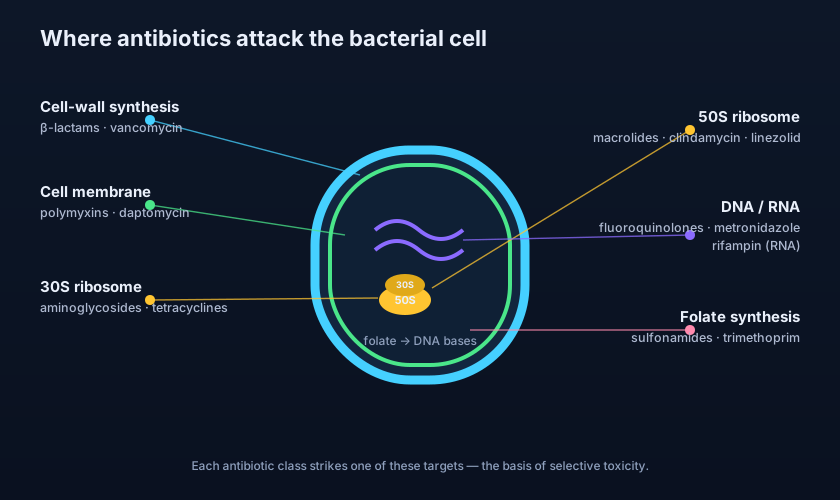
Six targets, and nothing more
Almost every antibacterial you will ever learn hits one of just six targets, shown above. Cell-wall synthesis — the β-lactams (penicillins, cephalosporins, carbapenems) and vancomycin, which crumble the wall so the bacterium bursts. The cell membrane — polymyxins and daptomycin, which punch holes in it. The 30S ribosomal subunit — aminoglycosides and tetracyclines, which jam protein-making. The 50S subunit — macrolides, clindamycin, linezolid, and chloramphenicol, which jam it from the other side. DNA and RNA — fluoroquinolones and metronidazole (DNA), and rifampin (RNA). And folate synthesis — sulfonamides and trimethoprim, which starve the bacterium of the building blocks for its DNA. Learn a new antibiotic, and your first question is simply: which of these six does it hit?
Gram-positive or Gram-negative?
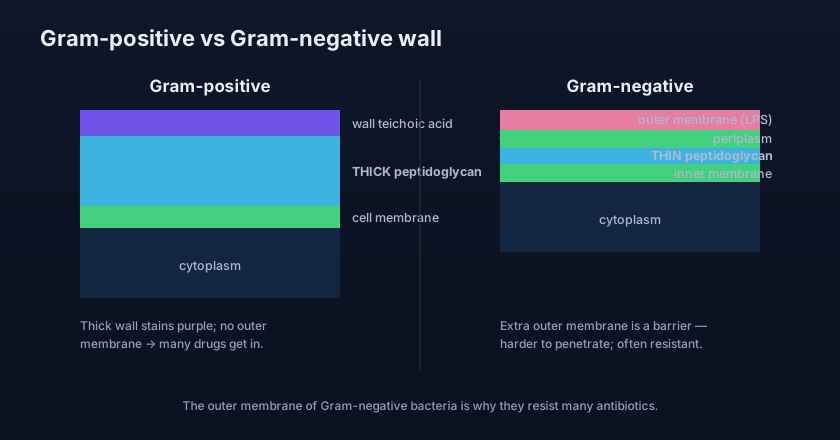
Hitting the target is not enough — the drug first has to reach it, and that depends on the bacterium's wall. A century-old stain sorts bacteria into two great families. Gram-positive bacteria have a thick outer layer of peptidoglycan that traps the purple dye; Gram-negative bacteria have only a thin peptidoglycan layer but wrap it in an extra outer membrane. That outer membrane is a formidable barrier: it keeps many antibiotics out, which is a major reason Gram-negative infections are harder to treat and more often resistant. So 'which of the six targets' is only half the question; the other half is 'can the drug even get in?'
- Selective toxicity: antibiotics attack structures bacteria have and we don't.
- Six targets: cell wall, cell membrane, 30S, 50S, DNA/RNA, folate synthesis.
- Bacterial ribosomes (70S: 30S+50S) differ from ours (80S) — the basis for ribosome drugs.
- Gram-negatives have an outer membrane that blocks many drugs → harder to treat.
- Spectrum = the range of bacteria a drug covers (narrow vs broad).
Selective toxicity has a hierarchy. The safest antibiotics target something with NO human counterpart at all — the cell wall (β-lactams) is the classic example, which is why penicillins are so remarkably non-toxic. Drugs that target the ribosome are a little riskier, because our mitochondria carry a bacteria-like ribosome that these drugs can occasionally hit (part of why aminoglycosides and linezolid have their particular toxicities). The closer a drug's target is to something we also possess, the narrower its safety margin.
- Thinking antibiotics work against viruses. They target bacterial structures only.
- Ignoring the Gram type. It decides whether a drug can even reach its target.
- Assuming 'broad-spectrum' is always better. It also wipes out protective normal flora.
- Forgetting the target must be reachable AND absent (or different) in human cells.
Why are penicillins (which block cell-wall synthesis) among the safest antibiotics for humans?
- Antibiotics work by selective toxicity — hitting bacterial parts we don't share.
- Six targets: cell wall, membrane, 30S, 50S, DNA/RNA, folate synthesis.
- The Gram stain (± an outer membrane) decides whether a drug can reach its target.
- Ask of any antibiotic: which target, and can it get in?
- Katzung BG. Basic & Clinical Pharmacology — Basic Principles of Antimicrobial Therapy.
- Brunton LL, et al. Goodman & Gilman's The Pharmacological Basis of Therapeutics — General principles of antimicrobial therapy.
- Rang HP, Dale MM, et al. Rang & Dale's Pharmacology — Basis of antimicrobial chemotherapy.
- Murray PR, et al. Medical Microbiology — Bacterial structure & antimicrobial targets.
- Whalen K. Lippincott Illustrated Reviews: Pharmacology — Principles of antimicrobial therapy.

