
Topical Acne Therapy: Hitting the Four Pathogenic Steps
Acne looks like a cosmetic nuisance and is treated like a disease — because it is one, with a mechanism you can draw. Four things go wrong in a single pore: it clogs, it oils, it grows bacteria, and it inflames. Almost every topical acne drug earns its place by hitting one or more of those four steps, and the reason we combine them is not habit but logic — pair agents that attack different steps and you cover the whole pathway. Understand the four steps and the entire shelf of creams and gels stops being a jumble and becomes a map.
A 17-year-old comes in embarrassed, hood up, avoiding eye contact. Across the forehead and cheeks sit blackheads, whiteheads, a scatter of red papules and one tender, angry cyst near the jaw. She has already tried "everything" from the pharmacy — a face wash here, a spot cream there — for two weeks each, then abandoned them because "nothing worked." She is not wrong that nothing worked; she is wrong about why. She was hitting one step of a four-step disease, and quitting before any topical could possibly show its effect. The prescription that helps her is not a stronger single cream — it is a small, rational combination aimed at several steps at once, plus one honest sentence about time: this takes weeks, not days.
The four things that go wrong in a pore
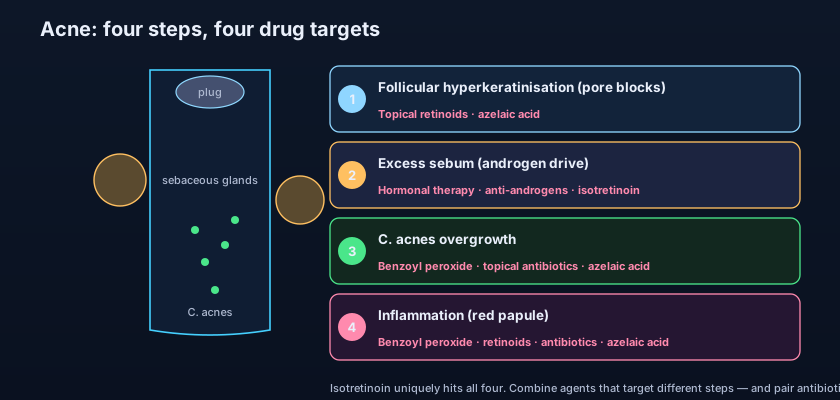
Acne is not one problem; it is four, stacked inside a single pilosebaceous unit. Every hair follicle on the face drains a sebaceous (oil) gland — together the pilosebaceous unit. Acne begins when four events collide there. First, follicular hyperkeratinisation: the cells lining the pore stop shedding cleanly and instead stick together into a plug, forming the microcomedone — the seed of every lesson. Second, excess sebum: androgens (which is why acne flares at puberty) drive the oil gland into overproduction, feeding the plug and the bacteria. Third, Cutibacterium acnes (the organism formerly called Propionibacterium acnes) — a normal skin commensal that overgrows in this oily, blocked, oxygen-poor pocket. Fourth, inflammation: C. acnes and the trapped debris trigger the immune system, turning a quiet blackhead into a red papule, a pustule, or a deep nodule. Read those four in order and every drug that follows has an obvious target.
Think of the pore as a kitchen drain. First it clogs with congealed grease (hyperkeratinisation). Then the tap is left running oil (excess sebum), feeding the clog. In the warm, wet, blocked pipe, bacteria bloom (C. acnes). Finally the whole thing turns foul and swollen (inflammation). Pouring one product down the drain rarely fixes it — you want to dissolve the plug, cut the grease, kill the bacteria, and calm the swelling. That is exactly why acne treatment is a combination and not a single bottle.
Topical retinoids: the cornerstone
If you learn one acne drug class, learn this one — it is the backbone of almost every regimen. Topical retinoids are vitamin-A derivatives that bind nuclear retinoic-acid receptors and reprogram how keratinocytes mature and shed. That single action hits step one directly: they normalise follicular keratinisation, unstick the plug, and are comedolytic — they empty existing comedones and, crucially, prevent new microcomedones from forming. They are also anti-inflammatory, which reaches step four. The family runs tretinoin (the original), adapalene (better tolerated, more photostable, so it can be layered with benzoyl peroxide), tazarotene (the most potent and most irritating), and trifarotene (a newer, selective agent studied for the trunk as well as the face). Because they stop the seed lesion forming, retinoids are the drug you keep using for maintenance long after the visible spots clear — the foundation, not the finishing touch.
The price is tolerability. Retinoids reliably cause a retinoid reaction early on — dryness, redness, peeling and stinging — worst in the first few weeks before the skin adapts. The fix is technique, not abandonment: a pea-sized amount, at night, on dry skin, a bland moisturiser over it, and starting every other night if needed. They increase photosensitivity, so a daily sunscreen is part of the prescription, not an optional extra. And one point students must never blur: this is where topical acne care touches the Isotretinoin chapter and the wider retinoid story in Foundations. Oral isotretinoin is famously and powerfully teratogenic, demanding strict pregnancy prevention. The topical agents are not absorbed in remotely the same way, but the profession is deliberately cautious — topical retinoids are conventionally avoided in pregnancy, and "retinoid" should immediately make you ask about pregnancy in any woman of child-bearing potential.
The most common reason acne treatment "fails" is not a weak drug — it is stopping too soon. Comedones take six to eight weeks to respond, and inflammatory lesions longer; retinoids often make the skin look worse before better. Telling a patient this at the first visit does more for their outcome than reaching for a stronger prescription. Adherence, not potency, is the limiting factor in most cases.
Benzoyl peroxide: the resistance-proof antibacterial
Benzoyl peroxide (BPO) attacks steps three and four. It releases reactive oxygen radicals inside the follicle that are directly bactericidal to C. acnes, and it is mildly keratolytic, helping unblock the pore. Its single most important property is one word: no resistance. Because it kills bacteria by non-specific oxidation rather than a precise molecular target, C. acnes cannot evolve around it — unlike antibiotics. That is exactly why BPO is the essential partner drug: whenever a topical (or oral) antibiotic is used for acne, benzoyl peroxide is added alongside it to suppress the emergence of resistant organisms. The main nuisance is that BPO bleaches — it will lighten coloured towels, pillowcases and clothing on contact, a genuinely useful thing to warn patients about — plus dryness and irritation, and rarely a true allergic contact dermatitis.
Topical antibiotics: never fly solo
Clindamycin and erythromycin work — but the way we use them is dictated entirely by resistance. Topical antibiotics — chiefly clindamycin, and older erythromycin — target steps three and four: they suppress C. acnes and have a genuine anti-inflammatory effect independent of killing bacteria. The problem is the same one that haunts all of antimicrobial therapy: used alone and repeatedly, they breed resistant C. acnes, and resistance to topical acne antibiotics is now widespread. This is why the modern rule is that a topical antibiotic is never prescribed as monotherapy for acne. It is always combined — most often with benzoyl peroxide (which shields it from resistance) and frequently with a retinoid (which adds step-one comedolytic action). This is the same antimicrobial-stewardship logic taught in the Antimicrobials chapter, applied to a cream: use the narrowest effective approach, protect the drug from resistance, and never deploy an antibiotic where it can select for resistance unopposed.
Follicular hyperkeratinisation (step 1): retinoids (tretinoin, adapalene, tazarotene, trifarotene), azelaic acid, and partly benzoyl peroxide. Excess sebum (step 2): no topical shuts sebum off cleanly — this is where hormonal therapy and oral isotretinoin, covered in the Systemic Acne chapter, take over. C. acnes (step 3): benzoyl peroxide, topical antibiotics, azelaic acid. Inflammation (step 4): retinoids, azelaic acid, topical antibiotics (anti-inflammatory action), and benzoyl peroxide. Notice how no single agent covers all four — which is the whole argument for rational combination therapy.
- Acne = four steps: hyperkeratinisation, excess sebum, C. acnes overgrowth, inflammation.
- Topical retinoids are the cornerstone — normalise keratinisation, comedolytic, anti-inflammatory, and used for maintenance.
- Benzoyl peroxide is bactericidal to C. acnes with NO resistance — the essential partner for any antibiotic.
- Topical antibiotics (clindamycin, erythromycin) must never be used alone — always combined to prevent resistance.
- No topical meaningfully lowers sebum — step 2 belongs to hormonal therapy and oral isotretinoin.
- Combine agents that hit different steps; treatment is a regimen, not a single cream.
Azelaic acid: the quiet all-rounder
Azelaic acid is the underrated multitasker of topical acne care, touching three of the four steps at once. It is antibacterial against C. acnes, comedolytic (helping normalise keratinisation), and anti-inflammatory. It carries two extra advantages that make it especially valuable. First, it is generally well tolerated and considered acceptable in pregnancy, making it a go-to when retinoids are being avoided. Second, it lightens post-inflammatory hyperpigmentation — the brown marks acne leaves behind — by inhibiting tyrosinase in overactive melanocytes. That makes it particularly useful in skin of colour, where those dark marks often distress patients more than the active spots did. Azelaic acid also reappears in the Rosacea chapter, where the same anti-inflammatory action is exploited for a different disease.
Combination products and the rung above topicals
The best regimens pair drugs that attack different steps in one convenient tube. The whole strategy of topical acne care crystallises into fixed-dose combination gels: adapalene plus benzoyl peroxide (step 1 + steps 3/4, with BPO shielding nothing to shield but adding bactericidal cover), clindamycin plus benzoyl peroxide (antibiotic protected against resistance), and clindamycin plus a retinoid. Combining into a single once-daily product also solves the adherence problem that quietly sinks so many regimens. But topicals have a ceiling. When the acne is severe, nodulocystic, scarring, or simply refractory to a well-followed topical regimen, treatment steps up to systemic therapy — oral antibiotics, hormonal agents such as combined oral contraceptives or spironolactone, and ultimately oral isotretinoin. Those belong to the Systemic Acne chapter, and knowing when a topical regimen has genuinely failed — rather than merely been abandoned early — is the clinical judgement that decides when to climb that ladder.
- Azelaic acid hits three steps (antibacterial, comedolytic, anti-inflammatory) and fades post-inflammatory hyperpigmentation.
- Azelaic acid and benzoyl peroxide are the usual choices when retinoids are avoided in pregnancy.
- Fixed-dose combinations (adapalene+BPO, clindamycin+BPO) hit multiple steps and improve adherence.
- Topical retinoids increase photosensitivity — daily sunscreen is part of the prescription.
- Severe, scarring, or truly refractory acne steps up to systemic therapy (oral antibiotics, hormonal agents, isotretinoin).
- Prescribing a topical antibiotic alone. It breeds resistant C. acnes — always pair it with benzoyl peroxide (and usually a retinoid).
- Declaring treatment a failure at two weeks. Comedones need six to eight weeks; judging too early wastes an effective regimen.
- Expecting a topical to control sebum or cure severe cystic acne — step 2 and severe disease need systemic therapy, not a stronger cream.
A clinician plans to treat a teenager's inflammatory acne with topical clindamycin. To reduce the risk of driving Cutibacterium acnes resistance, which agent should be co-prescribed?
- Acne is a four-step disease: follicular hyperkeratinisation, excess sebum (androgen-driven), C. acnes overgrowth, and inflammation — map each drug to the step it hits.
- Topical retinoids (tretinoin, adapalene, tazarotene, trifarotene) are the cornerstone — comedolytic, anti-inflammatory, used for maintenance; expect irritation and photosensitivity, and treat pregnancy with caution.
- Benzoyl peroxide is bactericidal with no resistance and is the mandatory partner for any acne antibiotic; topical antibiotics (clindamycin, erythromycin) must never be used alone.
- Azelaic acid covers three steps and fades hyperpigmentation; combine agents across different steps, be patient for weeks, and step up to systemic therapy when topicals genuinely fail.
- Rook's Textbook of Dermatology — Acne and its topical management.
- Wolverton SE. Comprehensive Dermatologic Drug Therapy — Topical retinoids, benzoyl peroxide, and topical antibacterials.
- Katzung Basic & Clinical Pharmacology — Dermatologic pharmacology: acne agents.
- Zaenglein AL, et al. Guidelines of care for the management of acne vulgaris. Journal of the American Academy of Dermatology (AAD).
- NICE guideline NG198: Acne vulgaris — management.
- British National Formulary (BNF) — Topical preparations for acne.

