
Systemic Eczema Therapy: Dupilumab and the Type-2 Revolution
For most people with atopic dermatitis, a good emollient and a topical steroid are enough. But for a minority the disease is relentless — skin that cracks and weeps, an itch that shreds sleep, a life quietly ruled by scratching. For decades the only systemic options were blunt instruments: ciclosporin, methotrexate, azathioprine, drugs that suppressed the whole immune system and demanded blood tests forever. Then biology caught up with the disease. Once we understood that atopic dermatitis is driven by a specific set of immune signals — the type-2 axis — we could design drugs that silence just those signals and leave the rest of the immune system standing. This chapter is that story.
A 24-year-old man has had eczema since infancy. His arms and neck are thickened, lichenified, weeping in the creases; he has not slept a full night in months. He has climbed the whole topical ladder covered in the Atopic Dermatitis chapter — generous emollients, potent corticosteroids, tacrolimus ointment — and still more than half his skin is inflamed. His forearms are laced with excoriations from scratching in his sleep. He has stopped swimming, avoids short sleeves, and his mood has flattened under the exhaustion. Twenty years ago his next step would have been ciclosporin and a lifetime of monitoring blood pressure and kidney function. Today he is offered a fortnightly injection that blocks two specific cytokines — and within a month the itch, the symptom that ruled his life, begins to lift. His skin follows more slowly. He has become one of the patients for whom the type-2 revolution was built.
When the topical ladder runs out
Systemic therapy is not the next rung — it is a different staircase. The Atopic Dermatitis chapter laid out the topical ladder: emollients as the foundation, topical corticosteroids by potency, and the calcineurin inhibitors (tacrolimus, pimecrolimus) for delicate sites. That ladder controls most disease. But when eczema is moderate-to-severe and stays uncontrolled despite correct, well-applied topical therapy — or when the surface area is simply too large for creams to be practical — the question changes from "which cream?" to "how do I quiet the immune signal driving this from the inside?" That is the province of systemic therapy. To use it well you first have to understand the specific inflammation you are trying to switch off.
The type-2 axis: the engine of atopic disease
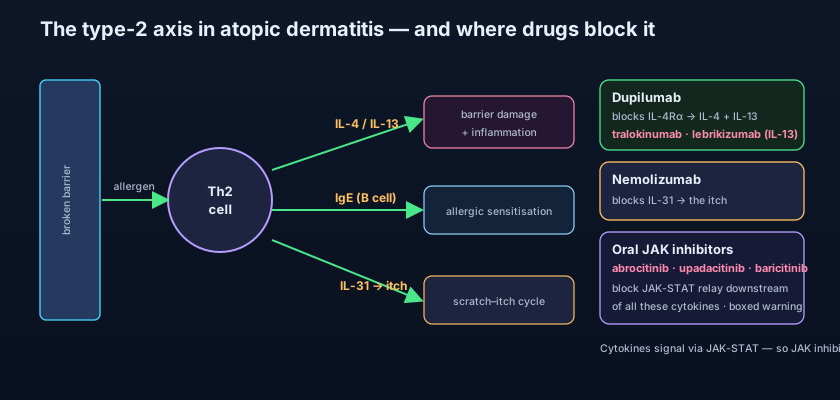
Atopic dermatitis is not random inflammation — it is a specific immune program running too hot. When the skin barrier is breached, dendritic cells present allergens to naïve T cells and push them down one particular path — into T-helper-2 (Th2) cells. These Th2 cells pour out a signature set of cytokines, and two of them, interleukin-4 (IL-4) and interleukin-13 (IL-13), are the twin engines of the whole disease. IL-4 and IL-13 do three destructive things at once. First, they sabotage the skin barrier: they suppress the structural proteins (filaggrin, loricrin) and the lipids that hold the outer layer watertight, so the barrier leaks and lets more allergen in — a self-feeding loop. Second, they drive B cells to class-switch and manufacture immunoglobulin E (IgE), the antibody of allergy. Third — and this is what patients feel — they sensitise the itch nerves directly. On top of this the Th2 program releases interleukin-31 (IL-31), a cytokine whose near-sole job is to scream "itch" to the sensory nerves in the skin. Understand these four players — IL-4, IL-13, IL-31, IgE — and every modern eczema drug falls into place, because each one is aimed at a specific node on this axis.
Think of the type-2 axis as a factory with two identical foremen — IL-4 and IL-13 — shouting the same orders down the same intercom (a shared receptor part called IL-4Rα). The orders are: "stop maintaining the walls, print more allergy antibodies, and turn up the itch alarm." The old systemics were like cutting the factory's main power — everything stops, including the departments you needed. Dupilumab is cleverer: it doesn't cut the power, it silences the one intercom both foremen shout through, so those specific orders never arrive while the rest of the factory keeps running. A JAK inhibitor works one step further in: it jams the machine inside each worker that translates the shouted order into action.
Dupilumab: the landmark biologic
One antibody, both foremen silenced. Dupilumab is a monoclonal antibody against IL-4Rα, the receptor subunit that IL-4 and IL-13 share. Because it blocks the common docking point, a single drug shuts down the signalling of both master cytokines at once — that is the whole reason it works so broadly. Clinically it does exactly what the biology predicts: it heals the barrier, calms the redness, and — most valued by patients — it takes the itch down, often before the visible skin has fully cleared. It was the first biologic licensed for atopic dermatitis and it reset expectations for the whole field. Its safety profile is a large part of its appeal: because it targets one narrow immune axis rather than suppressing immunity broadly, there is no routine blood monitoring required — a striking contrast to every older systemic. Its signature adverse effect is conjunctivitis: a proportion of patients develop red, gritty, inflamed eyes, a class quirk of IL-4Rα blockade that is usually manageable with lubricants or topical treatment and rarely forces the drug to be stopped. Injection-site reactions and, less commonly, a facial/head-and-neck redness are also seen. It is given by subcutaneous injection, is safe enough for long-term use, and can be used in children.
The single most examinable fact about dupilumab is what it does NOT require: no routine bloods. Ask why, and the answer teaches the whole concept of targeted biologics. Older systemics suppress broad swathes of immunity, so you must keep watching the liver, kidney and blood counts for collateral damage. Dupilumab silences one narrow cytokine channel and leaves the rest of the immune system intact — so there is little collateral to monitor. "Targeted" is not marketing; it is the reason the monitoring burden almost disappears. Remember its trademark trade-off too: the price of that clean profile is an oddly specific one — conjunctivitis.
The rest of the biologic bench: IL-13 and IL-31
If IL-4 and IL-13 are the twin engines, some drugs choose to block just one of them. Tralokinumab and lebrikizumab are monoclonal antibodies against IL-13 alone. The rationale is that IL-13 may be the more dominant driver in the skin itself, so neutralising it specifically can control disease while sparing IL-4's other roles. In practice they are effective systemic options with a similarly clean, monitoring-light profile, and they broaden the biologic menu for patients who do not respond to or tolerate dupilumab. Then there is a drug aimed squarely at the symptom rather than the disease: nemolizumab, a monoclonal antibody against the IL-31 receptor. Because IL-31 is the dedicated itch cytokine, blocking its receptor produces a rapid, powerful reduction in itch — particularly useful in the itch-dominant phenotype and in the intensely pruritic condition prurigo nodularis. It is a reminder that in atopic disease, controlling the itch is not a cosmetic goal; the scratch-itch cycle is part of what drives the inflammation.
Anti-IL-4Rα (blocks both IL-4 and IL-13): dupilumab (Dupixent) — the landmark, broad efficacy, conjunctivitis its signature side effect, no routine bloods. Anti-IL-13: tralokinumab (Adtralza/Adbry), lebrikizumab (Ebglyss) — narrower target, similarly monitoring-light. Anti-IL-31 receptor: nemolizumab (Nemluvio) — an itch-first agent, also used in prurigo nodularis. All are subcutaneous injections. The shared theme: each names a node on the type-2 axis and neutralises it, which is why none of them behaves like a broad immunosuppressant.
- Atopic dermatitis is driven by the type-2 axis: Th2 cells releasing IL-4, IL-13 (barrier damage + IgE) and IL-31 (itch).
- IL-4 and IL-13 share the IL-4Rα receptor subunit — the target that lets one antibody block both.
- Dupilumab (anti-IL-4Rα) is the landmark biologic: broad efficacy, no routine blood monitoring.
- Its signature adverse effect is conjunctivitis, usually manageable without stopping the drug.
- Tralokinumab and lebrikizumab target IL-13 alone; nemolizumab targets the IL-31 receptor for itch.
- Biologics silence a narrow cytokine channel rather than suppressing immunity broadly.
Oral JAK inhibitors: speed and potency, with strings attached
If biologics silence the messenger, JAK inhibitors jam the receiver inside the cell. A biologic mops up a cytokine outside the cell. A JAK inhibitor works from within. When a type-2 cytokine binds its receptor, the signal is carried inward by a relay of enzymes called Janus kinases (JAK1, JAK2, JAK3, TYK2) that in turn switch on STAT proteins — the JAK-STAT pathway. Many of the type-2 cytokines, including IL-4 and IL-13, funnel their signal through this pathway. An oral small molecule that blocks JAK1 therefore chokes off the intracellular message from several itch- and inflammation-driving cytokines at once. The clinical payoff is speed and potency: abrocitinib and upadacitinib (and, more modestly, baricitinib) can cut the itch within days and clear skin fast — often faster than a biologic. They are tablets, not injections, which some patients much prefer, and they are easy to start and stop, with the effect wearing off quickly once discontinued (their reversibility). This same JAK-STAT machinery is the shared engine behind the topical JAK inhibitors and the systemic JAK drugs used in Psoriasis (where the TYK2 inhibitor deucravacitinib features), so the pathway is worth learning once and reusing across chapters.
The catch is a class-wide boxed warning. The reach of JAK inhibition is also its danger: JAK-STAT signalling is used by many immune and haematopoietic cells, so blocking it broadly carries risks that biologics largely avoid. The whole oral JAK class carries a boxed warning — extrapolated in part from a large rheumatoid-arthritis safety study of an earlier JAK drug — flagging venous thromboembolism (VTE, i.e. clots), major adverse cardiovascular events (MACE), malignancy, serious infections, and reactivation of herpes zoster (shingles). This is not a reason never to use them; it is the reason they demand patient selection and monitoring. Before starting, you screen for latent infections (tuberculosis, hepatitis B and C) and assess cardiovascular and thrombotic risk, and consider zoster vaccination. During treatment you monitor blood counts (they can drop neutrophils, lymphocytes, platelets and haemoglobin) and lipids (they can raise cholesterol), and stay alert for infection. So the JAK inhibitors invert dupilumab's bargain: you buy greater speed and oral convenience at the cost of a real monitoring burden and a serious risk profile.
- JAK inhibitors block the JAK-STAT relay that carries type-2 cytokine signals (incl. IL-4/IL-13) inside the cell.
- Abrocitinib, upadacitinib, baricitinib are oral, fast-acting, potent, and quickly reversible.
- Class boxed warning: VTE, MACE, malignancy, serious infection, herpes zoster reactivation.
- Screen before starting (TB, hepatitis, CV/thrombotic risk; consider zoster vaccine) and monitor bloods + lipids.
- The trade-off vs biologics: more speed and oral dosing, but a heavier monitoring and risk burden.
The old guard: non-selective systemics
Before the targeted era, severe eczema was controlled with immunosuppressants borrowed from transplant medicine and rheumatology — the same agents taught in the Inflammation section. Ciclosporin, a calcineurin inhibitor, works fast and is genuinely effective, but it is a short-term rescue drug: prolonged use damages the kidneys and drives up blood pressure, so it is used to break a severe flare, not to maintain control for years. Methotrexate (an antifolate that dampens rapidly dividing immune cells) and azathioprine (a purine antimetabolite) are slower-onset options for longer-term control, each demanding regular blood monitoring for marrow suppression and liver toxicity — and azathioprine's tolerance depends on the patient's TPMT enzyme activity, which is checked before starting. Mycophenolate mofetil is another antiproliferative sometimes used off-label. And systemic corticosteroids? They work dramatically and quickly — which is exactly the trap. In atopic dermatitis they are, at most, a very short rescue for a crisis, because stopping them reliably triggers a fierce rebound flare, often worse than the original, and because their long-term toxicities are unacceptable for a lifelong disease. Reaching repeatedly for oral steroids in eczema is one of the classic management errors.
Choosing: biologic or JAK?
Once you have decided a patient needs systemic therapy, the modern decision is usually between a biologic (dupilumab and its cousins) and an oral JAK inhibitor — and the two make opposite bargains. Favour a biologic when safety and simplicity lead: it has a clean profile, needs no routine bloods, and is the natural first choice in patients with cardiovascular or thrombotic risk factors, a history of malignancy, or where a long, low-maintenance course is the goal — the cost being slower onset and an injection. Favour a JAK inhibitor when speed and route matter most: it can rescue an intensely itchy patient within days, is oral, and is easily reversible for someone who wants an on/off option — the cost being the boxed-warning risk profile and a real screening-and-monitoring burden, which makes it less suitable in the older or comorbid patient. Comorbidity is often the deciding vote: a young patient drowning in itch who wants tablets and fast relief tilts toward a JAK; an older patient with cardiovascular risk tilts firmly toward a biologic. And this is not a one-way door — patients who fail or cannot tolerate one class frequently switch to the other. The type-2 axis has, at last, given dermatology a real menu.
The type-2 axis is not confined to skin. The very same IL-4/IL-13 biology drives allergic (type-2-high) asthma, which is why dupilumab is also a licensed asthma biologic, and why the Respiratory chapter's asthma biologics — targeting IL-5 (mepolizumab, benralizumab) and IgE (omalizumab) — are siblings of the eczema drugs here, each disabling a different node of the same allergic cascade. Atopic dermatitis, asthma and allergic rhinitis so often travel together (the "atopic march") precisely because they share this engine. Learn the axis once and you have a scaffold for all three.
- Reaching for oral corticosteroids to control chronic eczema — they work fast but cause a fierce rebound flare on stopping and are unacceptable long-term. Use them only as a very short rescue.
- Ordering routine blood monitoring "just in case" for dupilumab. Its whole point is that a targeted biologic needs none — unlike ciclosporin, methotrexate or a JAK inhibitor.
- Starting a JAK inhibitor without pre-treatment screening. The boxed warning (VTE, MACE, malignancy, infection, zoster) means you must screen for latent infection and assess cardiovascular/thrombotic risk first.
A 58-year-old with severe atopic dermatitis, a history of a provoked deep-vein thrombosis, and treated hypertension needs systemic therapy after failing optimised topicals. Which is the most appropriate first systemic choice?
- Atopic dermatitis is driven by the type-2 axis: Th2 cells release IL-4 and IL-13 (barrier damage + IgE) and IL-31 (itch) — the map behind every modern drug.
- Dupilumab (anti-IL-4Rα) blocks both IL-4 and IL-13 signalling: the landmark biologic — broad efficacy, no routine bloods, signature side effect conjunctivitis. Tralokinumab/lebrikizumab hit IL-13; nemolizumab hits the IL-31 itch receptor.
- Oral JAK inhibitors (abrocitinib, upadacitinib, baricitinib) block the JAK-STAT relay for fast, potent itch/skin control — but carry a class boxed warning (VTE, MACE, malignancy, infection, zoster) and need screening + monitoring.
- Older non-selective systemics remain: ciclosporin (short-term rescue), methotrexate/azathioprine/mycophenolate (monitored maintenance), and systemic steroids only as brief rescue because of rebound. Biologic vs JAK = safety/simplicity vs speed/reversibility, decided largely by comorbidity.
- Rook's Textbook of Dermatology — Atopic dermatitis: pathophysiology and systemic therapy.
- Wolverton SE. Comprehensive Dermatologic Drug Therapy — Biologics and immunomodulators in atopic dermatitis.
- Simpson EL, et al. Two Phase 3 Trials of Dupilumab versus Placebo in Atopic Dermatitis (SOLO 1 and SOLO 2). New England Journal of Medicine.
- Guttman-Yassky E, et al. Once-daily upadacitinib versus placebo in adolescents and adults with moderate-to-severe atopic dermatitis (Measure Up 1 and 2). The Lancet.
- National Institute for Health and Care Excellence (NICE) — Technology appraisals for dupilumab, tralokinumab, abrocitinib, upadacitinib and baricitinib in atopic dermatitis.
- British Association of Dermatologists (BAD) — Guidelines on the safe and effective prescribing of systemic therapies and JAK inhibitors.