
The Skin as a Drug Target: Why Topical Pharmacology Is Different
You can swallow a tablet and trust it will be absorbed. Smear the same drug on the skin and, most of the time, almost nothing gets in. The skin is not a passive wrapping — it is a chemical fortress, evolved over hundreds of millions of years to keep water in and the world out. That fortress is exactly what a topical drug must cross, and understanding its architecture is the difference between a cream that works and one that just sits on the surface. Every later dermatology chapter — steroids, retinoids, antifungals — is really a story about getting a molecule past this one wall.
A pharmacist watches two patients leave the counter with the same active drug. The first has a fungal nail infection and has been prescribed a topical lacquer; she will paint it on faithfully for a year and it may still fail, because the drug cannot reach the fungus buried under a thick nail plate. The second has an itchy eyelid rash and dabs on a mild hydrocortisone cream; within two days the redness is gone — almost too effective, because eyelid skin is astonishingly permeable. Same idea, opposite outcomes. Neither result is about the drug's potency in a test tube. Both are about a wall: how thick it is, how greasy, how intact, and where on the body it sits. That wall is the stratum corneum, and it quietly decides the fate of every cream, ointment and gel in dermatology.
The three layers — and which one matters for drugs
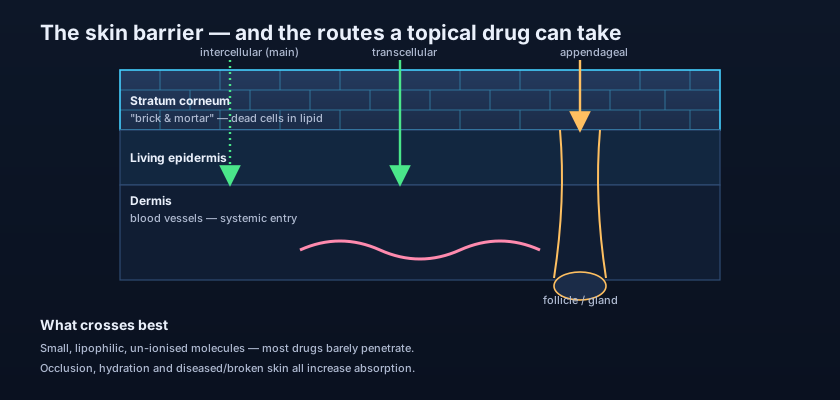
The skin is built in tiers, but only the outermost sliver behaves like a barrier. From the surface down there are three compartments. The epidermis is the thin outer sheet of tightly packed keratinocytes, constantly renewing itself as cells push up from the base, flatten, die, and are shed. Beneath it lies the dermis, a thick bed of collagen and elastin carrying the blood vessels, nerves, and immune cells — this is where the circulation runs, so a drug that reaches the dermis can be swept into the bloodstream. Deepest is the subcutis, a layer of fat and anchoring tissue. But for topical pharmacology, almost the entire drama plays out in the top few micrometres: the outermost band of the epidermis, the stratum corneum, is the true rate-limiting barrier. Everything below it is comparatively easy to cross.
Brick-and-mortar: the barrier's architecture
The stratum corneum is often no thicker than a sheet of paper, yet it is the most important structure in all of topical drug delivery. Its design is captured by one enduring metaphor: brick-and-mortar. The "bricks" are corneocytes — flattened, dead keratinocytes packed with tough keratin protein, essentially waterproof, protein-rich boxes. The "mortar" filling every gap between them is a highly ordered lipid matrix: ceramides, cholesterol, and free fatty acids arranged in tight, water-repelling sheets. This mortar is the real gatekeeper. Because it is continuous and lipid-rich, a molecule cannot simply slip between the cells unless it can dissolve into fat. The barrier is not a sieve with holes; it is a greasy wall.
Think of the stratum corneum as a brick wall where the bricks are waterproof but the mortar between them is thick grease. A water-loving molecule is like a droplet of water flicked at that wall — it beads up and runs off, unable to enter the greasy seams. A fat-loving (lipophilic) molecule is like a drop of oil: it soaks straight into the grease and works its way through. That single picture explains most of percutaneous absorption. To get through the wall, a drug must first be willing to dissolve into fat — but then, to travel onward into the watery tissue below, it must not be so greasy that it refuses to leave. The best-absorbed drugs are the ones comfortable in both worlds.
Percutaneous absorption: the routes across
There are three doors through the skin, and one carries almost all the traffic. A drug can cross the stratum corneum by three paths. The transcellular route goes straight through the corneocytes and the mortar in turn — a punishing zig-zag through alternating protein and lipid that few molecules manage. The intercellular route weaves through the lipid mortar alone, snaking around the bricks; this tortuous, fat-filled channel is the dominant pathway for the vast majority of drugs, which is exactly why lipophilicity matters so much. Together these are grouped as the transepidermal route. The third path is the appendageal (shunt) route: down the shafts of hair follicles and sweat glands, bypassing the wall entirely. These appendages make up only a tiny fraction of the surface area, so overall they contribute little — but they matter disproportionately in the first minutes of absorption and for large or charged molecules that cannot manage the lipid maze at all.
Three molecular properties decide whether a drug ever gets in. Whether a molecule crosses the barrier is governed by predictable physics, and it echoes the same absorption principles taught in the Principles of Pharmacology chapter on pharmacokinetics. First, lipophilicity: the drug must be lipid-soluble enough to partition into the greasy mortar — but if it is too lipophilic it lodges in the stratum corneum and never releases into the living tissue, so there is a sweet spot. Second, molecular size: penetration falls off steeply above roughly 500 daltons, the so-called "500-dalton rule" — small molecules cross, proteins and antibodies essentially cannot. Third, the partition coefficient between the vehicle and the skin: the drug must be willing to leave its cream or ointment and move into the stratum corneum, a balance the formulator tunes deliberately. A charged, water-loving, or very large molecule fails on one or more counts — which is why so many drugs simply cannot be given topically at all.
Here is the counter-intuitive heart of topical therapy: for most creams, the fraction of applied drug that actually enters the skin is tiny — often only a few percent. The rest evaporates, rubs off, or clings uselessly to the surface. This is usually a feature, not a bug. A poorly absorbed topical steroid delivers a high concentration exactly where the disease is — in the skin — while almost nothing reaches the bloodstream, so you get a powerful local effect while largely avoiding the systemic side effects an oral steroid would cause. Topical therapy is, at its best, a way of exploiting the barrier: high local dose, minimal systemic exposure, and near-total avoidance of first-pass metabolism in the liver.
- Three layers: epidermis (barrier), dermis (vessels/nerves — the route to the bloodstream), subcutis (fat).
- The stratum corneum is the true rate-limiting barrier — a paper-thin brick-and-mortar structure.
- Bricks = dead keratin-filled corneocytes; mortar = ordered ceramide/cholesterol/fatty-acid lipids.
- Dominant route is intercellular (through the lipid mortar); appendageal shunts add a minor early contribution.
- Penetration favours lipophilic, small (<~500 Da) molecules with a good vehicle-to-skin partition.
- Most applied drug never gets in — usually a benefit: high local effect, minimal systemic exposure, no first-pass.
When the wall breaks: disease and occlusion
The barrier is only as good as it is intact — and the diseases dermatologists treat are precisely the ones that damage it. In eczema (atopic dermatitis), a genetic and inflammatory defect in the barrier (including reduced filaggrin and disordered ceramides) leaves the mortar leaky; water escapes outward and drugs pour inward far more readily than through healthy skin. That is a double-edged truth: inflamed, broken, or ulcerated skin absorbs topical drugs dramatically better, which is why a potent steroid can clear a flare quickly — but also why the same steroid, over-applied to thin or broken skin, can be absorbed enough to cause local thinning or even systemic effects. This barrier dysfunction is the entire premise of the Eczema chapter, where restoring the barrier with emollients is as important as suppressing inflammation. Psoriasis behaves differently: the stratum corneum is thickened and disorganized (parakeratotic scale), which can both hinder and, through its abnormal structure, alter penetration — one reason psoriasis often needs more potent or occluded therapy.
You can also change the barrier deliberately — with occlusion and hydration. Absorption is not fixed; the clinician can turn it up. Occlusion — covering treated skin with a dressing, plastic wrap, or a greasy ointment that seals the surface — traps water in the stratum corneum, hydrating and swelling the corneocytes and loosening the lipid mortar. A well-hydrated barrier is a leakier barrier, so occlusion can multiply the penetration of a topical drug many-fold. This is powerful and dangerous in equal measure: occluding a potent steroid boosts its effect but also its risk of skin thinning and systemic absorption, which is why occlusion is used judiciously and rarely on the face or flexures. The choice of vehicle itself is a lever — an ointment occludes and enhances penetration, a cream or lotion less so — and that is exactly the machinery unpacked in the Topical Anti-inflammatories chapter, where vehicle and potency are chosen together.
Geography matters: body-site variation
The same drug absorbs at wildly different rates depending on where it is applied, because the stratum corneum's thickness varies enormously across the body. On the palms and soles it is thick and fortress-like — one reason drugs (and the disease itself) are so hard to treat there. On the eyelids, face, genitals and skin folds it is thin and highly permeable: eyelid and scrotal skin can absorb a topical drug many times more efficiently than the forearm, and the scrotum is often cited as the most permeable site of all. This is not a curiosity — it is a prescribing rule. A steroid potency that is safe on the back can cause visible thinning and telangiectasia on the face within weeks, so dermatologists reserve mild agents for thin-skinned regions and stronger ones for palms, soles and thickened plaques. Match the potency to the geography, or the barrier will punish the mismatch.
Nicotine, hormone and fentanyl patches exist precisely because those drugs are small and lipophilic enough to cross intact skin steadily — a deliberate use of the barrier for slow systemic delivery, avoiding first-pass metabolism (the same logic as the Principles of Pharmacology chapter). By contrast, insulin and monoclonal antibodies can never be creams: far too large to cross the stratum corneum. And the reservoir effect is a clinical gift — a topical corticosteroid deposited in the stratum corneum forms a depot that keeps releasing for a day or more after application, which is the pharmacological basis for once-daily dosing of many potent steroids despite their short intrinsic half-life.
- Broken/inflamed skin (eczema, ulcers) absorbs far more — helpful for effect, risky for systemic side effects.
- Occlusion and hydration loosen the barrier and can multiply penetration many-fold.
- Barrier thickness varies by site: thick on palms/soles, thin and permeable on eyelids/face/genitals.
- Scrotal and eyelid skin are among the most permeable — match steroid potency to the site.
- Vehicle is a lever: ointments occlude and enhance penetration more than creams or lotions.
- The reservoir effect lets the stratum corneum act as a depot, enabling once-daily dosing.
- Assuming a topical drug's strength equals its clinical effect — penetration through the barrier, not potency alone, decides.
- Using the same steroid potency everywhere — a face or flexure needs a milder agent than a palm or thick plaque.
- Forgetting that broken or occluded skin absorbs far more — over-applying a potent steroid there risks systemic effects.
A mother applies a potent topical corticosteroid to her infant's inflamed, weepy eczema in the skin folds, then covers it with a tight plastic wrap. Why is this combination especially likely to cause systemic absorption?
- The stratum corneum — a paper-thin brick-and-mortar of dead corneocytes in a lipid matrix — is the rate-limiting barrier for every topical drug.
- Drugs cross mainly by the transepidermal (intercellular) route through the lipid mortar; penetration favours small, lipophilic molecules with a good vehicle partition.
- Most applied drug never gets in — usually a benefit: high local effect, low systemic exposure, no first-pass metabolism.
- Disease (eczema/psoriasis), occlusion, hydration and body site all reshape absorption — so potency, vehicle and site must be matched, the foundation for every later derm chapter.
- Rook's Textbook of Dermatology — Structure and function of the skin; the epidermal barrier.
- Wolverton SE. Comprehensive Dermatologic Drug Therapy — Principles of topical therapy and percutaneous absorption.
- Katzung BG. Basic & Clinical Pharmacology — Dermatologic pharmacology.
- Bolognia JL, Schaffer JV, Cerroni L. Dermatology — Basic principles of dermatologic therapy and topical drug delivery.
- Bos JD, Meinardi MMHM. The 500 Dalton rule for the skin penetration of chemical compounds and drugs. Experimental Dermatology.
- British National Formulary (BNF) — Topical corticosteroids: potency, vehicles and site of application.