
Topical Vehicles & Potency: Ointment, Cream, Gel — and Why the Base Is a Drug Decision
In dermatology you never prescribe a molecule alone — you prescribe it dissolved in something. That something, the vehicle, decides how much of the drug ever reaches living skin. Choose an ointment and a steroid behaves as if it were a step stronger; choose a lotion and the same molecule barely gets in. The vehicle also decides whether the patient will actually use it: a greasy ointment on the face at 8 a.m. is a prescription that never gets filled twice. Getting the base right is not a cosmetic afterthought. It is half the pharmacology.
A 30-year-old man returns to clinic, frustrated. His chronic hand eczema is no better after a month of a potent topical steroid. "I've been using it exactly as told — a thin smear of the cream, twice a day." The prescription was correct; the molecule was strong enough. But the skin on a working man's palms is thick and dry, the fissures deep, and a light cream sank in and evaporated before much drug crossed the barrier. The dermatologist changes one thing — not the steroid, not the strength — only the vehicle: the same-class drug in an ointment, applied at night, occluded under a cotton glove. Two weeks later the fissures have healed. Nothing about the drug molecule changed. Everything about how much of it reached the target did.
What a vehicle actually is
A topical drug is an active molecule plus the base that carries it — and the base is never inert. The vehicle is the formulation the active drug is dispersed in: the balance of oil and water, the emulsifiers, alcohols and preservatives around the molecule. It does three pharmacological jobs at once. First, it governs how readily the drug partitions out of the base and into the stratum corneum — the dead, waxy outer layer that is the rate-limiting barrier of the skin, as covered in the Skin barrier chapter. Second, it changes the skin itself: an oily base seals in water and hydrates the barrier, a drying base does the opposite. Third, it decides the cosmetic experience — greasy versus elegant, visible versus invisible — which quietly determines whether the patient keeps using it. Choosing a vehicle is therefore a pharmacokinetic decision dressed up as a texture preference.
The spectrum: from ointment to solution
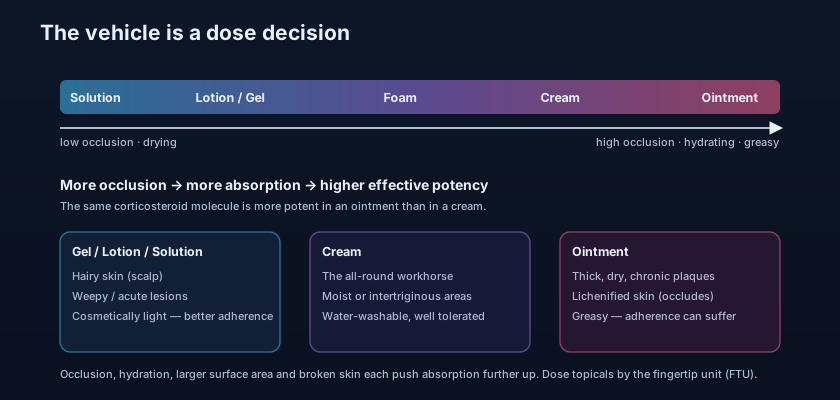
Line the vehicles up by their oil-to-water ratio and everything else falls into place. Ointments are mostly oil (e.g. white soft paraffin) with little or no water. They are occlusive — they seal the surface, trap water, and hydrate the stratum corneum, and that hydration is itself what drives the strongest drug penetration. They are ideal for thick, dry, scaly, lichenified skin, but greasy and cosmetically poor. Creams are oil-and-water emulsions held together by an emulsifier; they spread easily, feel elegant, rub in without residue, and suit most body sites and weeping or intertriginous (flexural) areas. Lotions and solutions are largely water- or alcohol-based, thin and drying; they cover large or hairy areas (scalp) and wet, oozing lesions where you want evaporation, not occlusion. Gels are semisolid, often alcohol-based, transparent and non-greasy — excellent for the face, scalp and acne-prone skin, though the alcohol can sting fissured or eczematous skin. Foams and sprays are pressurised, quick-drying, patient-friendly vehicles that spread over hair-bearing skin with almost no residue — their whole reason to exist is adherence.
Think of the stratum corneum as a dry brick wall and the drug as ink you want to soak into it. Paint the wall with a watery lotion and it beads up and evaporates — little ink gets in. Coat it with a greasy ointment and you do two things: you deliver ink dissolved in oil that clings, and you seal the wall so its own trapped moisture softens the bricks and lets the ink wick deep. Same ink, radically different soak-in. That is why the vehicle, not just the dose, sets how much drug crosses.
The same molecule, more potent in an ointment
This is the single most exam-relevant idea in the topic, and it surprises students every time: an identical corticosteroid molecule at the same concentration can sit in different potency classes depending only on its vehicle. Betamethasone or hydrocortisone in an occlusive ointment delivers more drug across the barrier than the same percentage in a cream or lotion, so the ointment behaves as if it were a stronger preparation — often effectively a rung higher on the potency ladder detailed in the Topical Corticosteroids chapter. The mechanism is pure percutaneous pharmacokinetics: occlusion plus hydration raises the fraction of drug that partitions into and diffuses through the stratum corneum. It is the topical equivalent of a bioavailability change — the same principle taught in the Principles of Pharmacology chapter, where formulation alters how much of a fixed dose actually reaches its site of action. The corollary is practical: switching a patient from cream to ointment can intensify therapy without ever changing the drug or its labelled strength — and, on thin facial or flexural skin, can also tip a "safe" steroid into causing atrophy.
"Wet on wet, dry on dry." Weeping, acute, oozing lesions want a drying, water-based vehicle (lotion, solution, or cream) — occlusion on macerated skin worsens it. Thick, dry, scaly, lichenified plaques want an occlusive, hydrating ointment. Match the vehicle's water content to the state of the lesion, and you are already halfway to the right prescription before you have even chosen the active drug.
What else changes how much drug gets in
The vehicle is one lever; percutaneous absorption has several others the prescriber controls. Occlusion — sealing the treated skin under a dressing, gloves, or the natural occlusion of a skin fold — can multiply penetration many-fold by hydrating the barrier and blocking evaporation; it is deliberately used to boost potent steroids on stubborn plaques, and inadvertently created by nappies or intertriginous areas. Hydration of the stratum corneum itself increases flux, which is why emollients applied first can enhance a later active. Surface area and regional variation matter enormously: absorption through thin eyelid, scrotal or flexural skin can be an order of magnitude greater than through thick palms or soles, so the same tube is high-risk on the face and barely effective on the heel. Skin integrity is the sleeper: inflamed, eroded, fissured or barrier-defective skin — precisely the skin being treated — has lost its rate-limiting layer, so systemic absorption climbs, and treating a large inflamed body-surface area in an infant is a genuine route to systemic steroid effects. Finally, chemical penetration enhancers such as propylene glycol, and keratolytics like salicylic acid or urea that dissolve the horny layer, are sometimes formulated in on purpose to open the barrier.
- The vehicle controls oil/water balance, occlusion and hydration — and therefore how much drug crosses the barrier.
- Vehicle spectrum by drying-to-occlusive: solution/lotion → gel → cream → ointment.
- The SAME steroid is more potent in an ointment than in a cream or lotion — a bioavailability effect, not a new molecule.
- Occlusion + hydration boost penetration; thin/eroded/flexural/facial skin absorbs far more than palms or soles.
- Wet on wet, dry on dry: drying vehicles for oozing lesions, occlusive ointments for dry scaly plaques.
- Broken skin and large surface area raise systemic absorption — a real risk in infants and children.
The fingertip unit: dosing something you smear
A topical can be under-dosed (no effect, blamed on the drug) or over-dosed (atrophy, systemic absorption) just as easily as a tablet — but "apply a thin layer" gives the patient no real quantity. The fingertip unit (FTU) fixes that: it is the amount of ointment or cream squeezed from a standard 5 mm nozzle along an adult's fingertip, from the tip to the first crease — roughly half a gram. One FTU covers an area about the size of two flat adult hands. From there, whole regions are counted in FTUs: a hand or foot takes about one, an arm about three, a leg about six, the trunk (front or back) about seven each. The FTU turns a vague smear into a reproducible dose, lets you estimate how long a tube should last (and thus spot both under-use and dangerous over-use), and is the practical bridge between potency theory and what the patient actually applies at home.
Thick, dry, lichenified plaque psoriasis on an elbow → potent steroid in an OINTMENT (occlusion and hydration where you want maximum penetration). Acute, weeping, vesicular contact dermatitis → CREAM or LOTION (you want drying, not sealing). Seborrhoeic dermatitis or psoriasis of the hairy scalp → GEL, LOTION, SOLUTION or FOAM (spreads through hair, dries fast, no greasy residue). Steroid on the face or in a flexure (thin, high-absorption skin) → a mild steroid in a CREAM, never a potent one in an ointment, to avoid atrophy. A teenager who will not tolerate anything greasy on acne-prone skin → a GEL or foam, chosen as much for adherence as for pharmacology.
Adherence: the vehicle patients will actually use
The most potent, best-matched preparation does nothing sitting unused in the bathroom cupboard. Cosmetic acceptability is not vanity — it is a hard determinant of outcome, and topical adherence is notoriously poor. A greasy ointment that stains clothing, ruins make-up, or shines on the face at work will be quietly abandoned, whatever its pharmacological superiority; a non-greasy gel, foam or lotion that the patient is willing to apply twice daily beats a theoretically stronger ointment used twice a week. Simplicity helps too: once-daily regimens and combined preparations are used more reliably than complex multi-step routines. This is why modern formulation science invests so heavily in foams, sprays and elegant creams — matching the vehicle to the patient's life is often the difference between a treatment that works and one that only should. The emollient (moisturiser) base deserves the same respect: bland emollients in ointment, cream or lotion form are first-line therapy in eczema and ichthyosis in their own right, restoring the barrier discussed in the Skin barrier chapter, and their success too rests on choosing a texture the patient will apply generously and often.
- The fingertip unit (~0.5 g) standardises dosing: one FTU covers two adult handfuls of skin.
- Region FTU rules of thumb: hand/foot ~1, arm ~3, leg ~6, front or back of trunk ~7 each.
- Match the vehicle to the site: ointment for dry plaques, cream for most sites, gel/lotion/foam for scalp and face.
- Adherence and cosmetic acceptability are real efficacy variables — the base patients will use beats the "stronger" one they won't.
- Emollient bases are first-line therapy in their own right, restoring the barrier in eczema and ichthyosis.
- Keratolytics (salicylic acid, urea) and penetration enhancers (propylene glycol) are built into vehicles to open the barrier deliberately.
- Blaming the drug for treatment failure when the real problem is the vehicle — a light cream on thick, dry, fissured skin that a hydrating ointment would have penetrated.
- Putting a potent steroid ointment on the face or a flexure: thin, occluded, high-absorption skin can develop atrophy and striae from what seemed a modest strength.
- Occluding an acute, weeping, macerated lesion with a greasy ointment instead of drying it — sealing wet skin worsens maceration and can promote infection.
A man with thick, dry, lichenified chronic hand eczema shows no improvement after a month of a potent topical steroid CREAM used correctly. Without changing the steroid molecule or its strength, which single change is most likely to improve penetration and response?
- The vehicle is not inert: its oil/water balance, occlusion and hydration decide how much drug crosses the stratum corneum — a pharmacokinetic, bioavailability-style effect.
- The same steroid is effectively more potent in an occlusive ointment than in a cream or lotion; run vehicles from drying (solution/lotion) to occlusive (ointment) and match them wet-on-wet, dry-on-dry.
- Absorption also rises with occlusion, hydration, broken skin and thin/flexural/facial sites, and large surface area — key to systemic risk in children.
- Dose with fingertip units, and treat cosmetic acceptability and adherence as real efficacy factors — the base the patient will actually use is the one that works.
- Rook's Textbook of Dermatology — Topical therapy: vehicles, percutaneous absorption and formulation.
- Wolverton SE. Comprehensive Dermatologic Drug Therapy — Principles of topical therapy and vehicle selection.
- Katzung BG. Basic & Clinical Pharmacology — Dermatologic pharmacology: percutaneous absorption.
- British National Formulary (BNF) — Topical corticosteroids: preparations, potency and the fingertip unit.
- Long CC, Finlay AY. The finger-tip unit — a new practical measure. Clinical and Experimental Dermatology.
- Primary Care Dermatology Society / British Association of Dermatologists — Emollients and topical steroid guidance.