
Alopecia: Regrowing Hair by Its Biology
Hair loss looks like a single complaint but is really a dozen different diseases wearing the same face. The trick to treating it — and the reason so many patients are handed the wrong remedy — is that none of these conditions is truly about hair. They are about the follicle's clock: a rhythm of growth, regression, and rest that hormones, immune cells, stress, and inflammation each disrupt in their own way. Get the clock right and the drug almost chooses itself.
A 32-year-old man sits down and says he has been "going bald since university." The temples have receded and the crown has thinned, but the hairline at the back of his scalp is untouched. Beside him in the waiting room is a woman his mother's age who noticed a single smooth, coin-sized bald patch appear over two weeks — not thinned, but completely bare, with a few short hairs at the edge that taper to a point like tiny exclamation marks. And that morning the clinic had already seen a new mother, four months after delivery, alarmed by handfuls of hair in the shower drain. Three people, three utterly different diseases — and the only way to help any of them is to work out where, in the life cycle of a hair, each process has struck.
The follicle's clock: anagen, catagen, telogen
Every hair on the body is not growing continuously — it is cycling. A follicle spends its life moving through three phases. Anagen is the long growth phase, lasting years on the scalp; the follicle is deep, active, and pumping out a hair shaft. Catagen is a brief regression — a couple of weeks in which growth stops and the follicle shrinks upward. Telogen is the resting phase, a few months during which the club hair sits quietly before it is shed and a new anagen hair pushes it out from below. At any moment a healthy scalp keeps roughly 85–90% of its follicles in anagen and only around 10% in telogen — which is why you normally lose a modest, unremarkable number of hairs a day. Almost every disease of hair loss, and almost every drug that treats it, is really an intervention on this cycle: lengthening anagen, forcing follicles prematurely into telogen, or protecting them from an attack that shortens their life.
Think of the scalp as a vast orchard where each tree fruits for years, drops its leaves briefly, rests over a short winter, then buds again — all the trees out of step with one another, so the orchard as a whole always looks full. Androgenetic alopecia is a slow blight that shrinks the trees a little more each cycle until they bear only wisps. Telogen effluvium is a hard frost that sends far too many trees into winter at once, so months later you see a startling, synchronized leaf-fall. Alopecia areata is a swarm of pests attacking the growing trees directly. And scarring alopecia is the ground itself being paved over, so nothing can ever grow there again. Different disasters, different remedies — and only the last one is permanent.
Androgenetic alopecia: when DHT shrinks the follicle
The commonest hair loss on earth is a hormone problem playing out one follicle at a time. In pattern hair loss — androgenetic alopecia — genetically susceptible follicles on the top of the scalp are exquisitely sensitive to dihydrotestosterone (DHT), a potent androgen made from testosterone by the enzyme 5-alpha-reductase. DHT does not kill these follicles; it miniaturises them. With each successive cycle the anagen phase gets shorter and the follicle smaller, so a thick terminal hair is gradually replaced by a fine, short, barely-pigmented vellus hair — and eventually by nothing visible at all. This is why the pattern is so characteristic: temporal recession and crown thinning in men, a widening central part in women, and — crucially — sparing of the occipital fringe, whose follicles lack that androgen sensitivity. That same DHT-and-5-alpha-reductase axis drives prostate growth, which is why this chapter links directly to the Endocrine section: the identical enzyme, blocked by the identical drugs, is a target in benign prostatic hyperplasia.
Topical minoxidil: keeping the follicle in anagen
Minoxidil began life as an oral antihypertensive — a potassium-channel opener that relaxes vascular smooth muscle and lowers blood pressure, and whose most striking "side effect" was unwanted hair growth all over the body. Dermatology repurposed that side effect into a treatment. Applied to the scalp, minoxidil widens the follicle's blood supply and, more importantly, prolongs the anagen phase and nudges resting follicles back into growth. Two facts decide whether a patient succeeds with it. First, the paradoxical early shed: in the first weeks, old telogen hairs are pushed out as new anagen hairs form beneath them, so the scalp seems to get worse before it gets better — a patient who is not warned will quit exactly when the drug is starting to work. Second, it is suppressive, not curative: stop applying it and, within months, the follicles resume their genetically programmed decline and the gained hair is lost. Its vasodilator, potassium-channel-opener origin is worth remembering — the Cardiovascular chapter meets the very same molecule wearing its original hat.
5-alpha-reductase inhibitors: cutting off the DHT supply
If DHT is the culprit, the logical countermove is to stop making it. Finasteride blocks the type II 5-alpha-reductase isoenzyme; dutasteride blocks both type I and II and lowers DHT more completely. By cutting scalp DHT, they halt miniaturisation and let many follicles thicken again — the closest thing to a disease-modifying oral therapy in pattern hair loss. But the trade-offs define their use. A minority of men report sexual side effects — reduced libido, erectile difficulty, ejaculatory changes — usually reversible on stopping, and the subject of much debate about persistence. Both drugs lower serum PSA by roughly half, so any PSA result must be interpreted knowing the patient is on the drug, or an early prostate cancer can be masked. And the hardest rule of all: these are teratogens. They can feminise a male fetus, so women who are or could become pregnant must not take them — and should not even handle crushed or broken tablets. This pregnancy hazard and the shared enzyme are exactly why the drug reappears in the Endocrine chapter on androgens.
A newer twist: the old blood-pressure pill, taken as a tiny oral dose. The fastest-growing option of the last few years is low-dose oral minoxidil. Given as a small daily tablet — a fraction of the old antihypertensive dose — it delivers minoxidil's anagen-prolonging effect from the inside, sparing patients the daily mess and scalp irritation of the topical solution and often improving adherence. Because it is still a vasodilator, clinicians watch for dose-related unwanted body-hair growth (hypertrichosis), fluid retention, and, rarely, a fast heartbeat or ankle swelling. It is not yet a formally licensed indication in many places, but it has quietly become a mainstream off-label choice — a neat example of a drug's original pharmacology being rediscovered at a new dose.
- Hair cycles through anagen (growth, years), catagen (brief regression), and telogen (rest, months); ~85–90% is normally in anagen.
- Androgenetic alopecia = DHT-driven miniaturisation of genetically sensitive follicles; the occipital fringe is spared.
- Topical minoxidil prolongs anagen; warn about early shedding, and it must be continued or gains are lost.
- Finasteride (type II) and dutasteride (types I+II) block testosterone→DHT; sexual side effects, PSA halving, teratogenic.
- 5-alpha-reductase inhibitors must never be taken or handled by pregnant women (male-fetus feminisation).
- Low-dose oral minoxidil is an emerging, adherence-friendly systemic option; watch hypertrichosis and fluid retention.
Alopecia areata: an immune attack, and the JAK-inhibitor revolution
Here the follicle is not shrinking with age — it is being ambushed by the immune system. Alopecia areata is an autoimmune disease. The anagen follicle normally enjoys a degree of "immune privilege" — it hides its identity from patrolling T cells. In alopecia areata that privilege collapses: cytotoxic T cells swarm the follicle bulb, driven by interferon-gamma (IFN-γ) signalling, and force the hair abruptly out of anagen. The result is the classic smooth, round patch of complete hair loss, often with tell-tale "exclamation-mark" hairs — short broken hairs that taper toward the scalp — at the advancing edge. Because the follicle itself is not destroyed, the hair can regrow fully if the attack is called off; alopecia areata is non-scarring. Traditional treatments aim to suppress that local attack: intralesional corticosteroids injected into a patch, potent topical corticosteroids, and — for extensive disease — topical immunotherapy with diphenylcyclopropenone (DPCP), which deliberately provokes a mild contact dermatitis to distract and redirect the immune response.
The transformation of the last few years is the arrival of oral JAK inhibitors. The IFN-γ signal that drives the follicular attack works through the JAK-STAT pathway inside cells; block the Janus kinases and you interrupt the attack at its source. Baricitinib (a JAK1/2 inhibitor) and ritlecitinib (a JAK3/TEC-family inhibitor) are now approved for severe alopecia areata and can regrow scalp — and even eyebrow and eyelash — hair in patients who had lost nearly everything, the first systemic drugs ever licensed for this disease. The catch is that they are broad immunomodulators and carry the JAK-class boxed warnings — a caution about serious infections, blood clots, major cardiovascular events, and malignancy that runs across the whole class. That same JAK-STAT biology and the identical class-safety conversation appear in the Eczema chapter, where topical and oral JAK inhibitors (and the aryl-hydrocarbon-receptor agent tapinarof) treat atopic dermatitis and psoriasis. It is worth appreciating how one intracellular pathway now links hair loss, eczema, and psoriasis under a single pharmacological idea.
The single most useful bedside distinction in all of hair loss is scarring versus non-scarring — because it decides whether the follicles can be saved. In androgenetic alopecia, alopecia areata, and telogen effluvium the follicle survives, so regrowth is possible and the goal is to change the cycle. In scarring (cicatricial) alopecia the follicle's stem-cell niche is being destroyed and replaced by fibrosis; every follicle lost is lost forever. That is why a smooth patch with visible follicular openings is reassuring, while a shiny patch where the tiny pores have vanished is an emergency for the hair — treat the inflammation now or the window closes.
Telogen effluvium and scarring alopecia: two very different resets
Telogen effluvium is the follicle's clock being knocked out of phase. A shock to the system — childbirth, a high fever, major surgery, rapid weight loss, a thyroid derangement, or certain drugs — pushes an abnormally large fraction of anagen follicles simultaneously into telogen. Because telogen lasts a few months, the shedding does not appear until two to four months after the trigger, which is why patients rarely connect the two. The key clinical fact is that it is self-limiting and reversible: identify and remove the trigger, reassure the patient, and the follicles re-enter anagen on their own. Countless medications can precipitate it, so a careful drug history is essential; this dovetails with the Endocrine section, since thyroid disease is a classic reversible cause. Contrast this entirely with scarring (cicatricial) alopecias — such as lichen planopilaris or discoid lupus of the scalp — where inflammation is destroying the follicular stem cells. Here the priority is not cosmetic regrowth but urgent anti-inflammatory therapy — potent topical or intralesional corticosteroids, and systemic immunomodulators such as hydroxychloroquine — to quench the inflammation and rescue whatever follicles remain before scarring makes the loss permanent.
Androgenetic alopecia: topical minoxidil ± oral finasteride/dutasteride, or low-dose oral minoxidil — a lifelong, suppressive commitment. Alopecia areata (limited): intralesional or potent topical corticosteroids; (extensive/severe): oral JAK inhibitors baricitinib or ritlecitinib, or topical immunotherapy with DPCP. Telogen effluvium: no hair drug at all — find and fix the trigger (postpartum, thyroid, iron, a new medication, crash dieting) and wait. Scarring alopecia: anti-inflammatory rescue (corticosteroids, hydroxychloroquine) started early. The commonest clinical error is giving the androgenetic-alopecia toolkit to a patient whose real problem is a reversible telogen trigger — or, worse, waiting on minoxidil while a scarring alopecia quietly burns the follicles down.
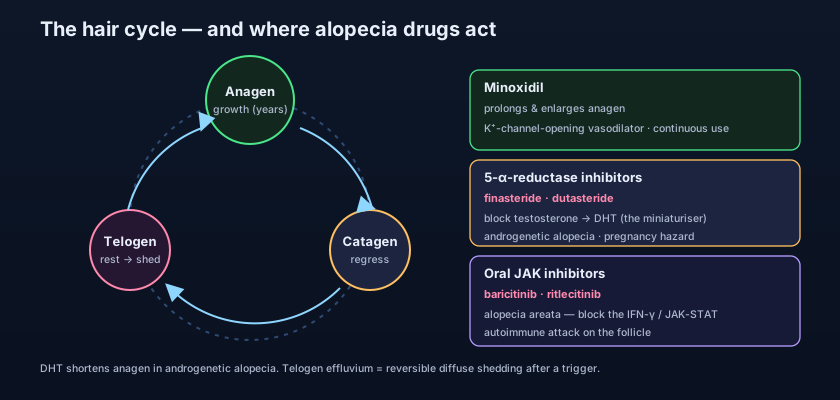
- Alopecia areata is a non-scarring autoimmune attack (IFN-γ, cytotoxic T cells) on the anagen bulb; exclamation-mark hairs mark the edge.
- Oral JAK inhibitors (baricitinib, ritlecitinib) are the breakthrough for severe alopecia areata; class boxed warnings apply.
- Telogen effluvium is diffuse, reversible shedding 2–4 months after a trigger; treat the cause, not the hair.
- Scarring alopecia destroys follicular stem cells — permanent; needs urgent anti-inflammatory therapy to save what remains.
- Scarring vs non-scarring is the decisive distinction: it tells you whether regrowth is even possible.
- Realistic expectations and adherence matter — most therapies are suppressive and slow, and stopping reverses the gains.
- Treating every diffuse shed as androgenetic alopecia and missing a reversible telogen effluvium trigger — thyroid disease, iron deficiency, postpartum, or a new drug.
- Prescribing finasteride or dutasteride to a woman of childbearing potential — or letting her handle the tablets — given the male-fetus teratogenicity.
- Stopping minoxidil at the first "shed" — that early shedding is the drug working, and quitting loses everything; also, all gains reverse if it is ever stopped.
A 28-year-old woman with pattern hair loss asks about oral finasteride after reading it works well in men. Which single fact most changes your prescribing decision?
- Every alopecia is an intervention on the hair cycle — anagen (growth), catagen (regression), telogen (rest); name the phase disrupted and the drug follows.
- Androgenetic alopecia = DHT miniaturisation: treat with minoxidil (prolongs anagen, must be continued), finasteride/dutasteride (block DHT; teratogenic, lower PSA), or low-dose oral minoxidil.
- Alopecia areata = autoimmune, non-scarring; oral JAK inhibitors (baricitinib, ritlecitinib) are the breakthrough, alongside intralesional/topical steroids and DPCP; mind the class boxed warnings.
- Telogen effluvium is reversible — fix the trigger; scarring alopecia is permanent — start anti-inflammatory therapy urgently to save the follicles.
- Rook's Textbook of Dermatology — Disorders of hair: androgenetic alopecia, alopecia areata, and cicatricial alopecias.
- Wolverton SE. Comprehensive Dermatologic Drug Therapy — Minoxidil, antiandrogens, and immunomodulatory therapy of hair loss.
- Katzung BG. Basic & Clinical Pharmacology — Androgens, 5-alpha-reductase inhibitors, and JAK-STAT signalling inhibitors.
- King B, et al. Two Phase 3 Trials of Baricitinib for Alopecia Areata (BRAVE-AA1/AA2). New England Journal of Medicine.
- King B, et al. Efficacy and safety of ritlecitinib in alopecia areata (ALLEGRO). The Lancet.
- British Association of Dermatologists / American Academy of Dermatology guidelines on the management of alopecia.