
The Biologic Revolution I: TNF and IL-12/23 Blockade
For most of the twentieth century, severe psoriasis was fought with blunt, whole-body weapons — methotrexate, ciclosporin, tar, ultraviolet light — that suppressed the immune system wholesale and taxed the liver, kidney and marrow for the privilege. Then immunology learned the actual language of the disease: a single inflammatory conversation, running from a cytokine called IL-23 through a T-helper cell to a molecule called IL-17. Once you can name the wire, you can cut it. The biologics are monoclonal antibodies that snip one wire of that circuit and leave the rest of the immune system standing — trading blanket immunosuppression for a scalpel. This chapter tells the first half of that story.
A 38-year-old man has lived under his psoriasis for fifteen years — thick, scaling plaques over his elbows, knees, scalp and lower back, and lately a swollen, painful right knee and sausage-shaped fingers. Methotrexate helped for a while, then his liver enzymes climbed; ciclosporin worked faster but his blood pressure and creatinine rose. He is tired of choosing which organ to sacrifice. His dermatologist proposes something different: an injection every two weeks that targets not the whole immune system but a single cytokine driving both his skin and his joints. Before the first dose, though, comes a ritual — a chest X-ray, an interferon-gamma release assay for latent tuberculosis, hepatitis B and C serology. Only once those are clear does treatment begin. Six weeks later his skin is nearly clear and his knee no longer aches. The disease was never really in his skin alone; it was in a conversation between his immune cells, and for the first time a drug is speaking their language.
The engine of the disease: the IL-23 → Th17 → IL-17 axis
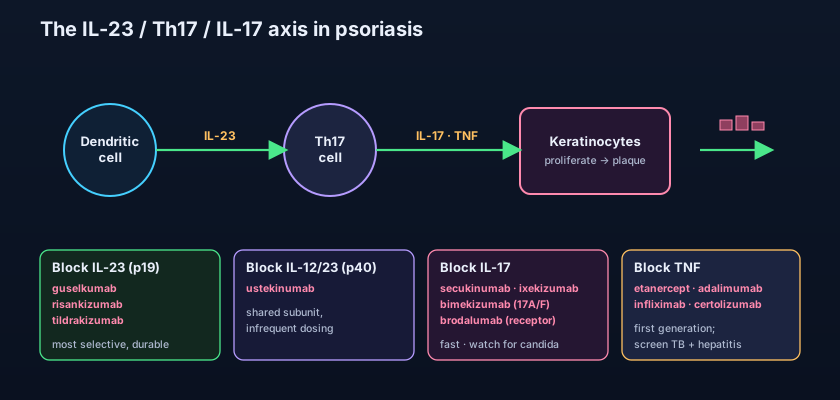
Psoriasis is not a disorder of fast-growing skin. It is a disorder of a single immune conversation that happens to end in fast-growing skin. Deep in the plaque, a dendritic cell releases a cytokine called IL-23. IL-23 is the survival and maturation signal for a particular T-helper cell — the Th17 cell. Once instructed, the Th17 cell pours out its own signature cytokine, IL-17 (chiefly IL-17A). IL-17 lands on the keratinocytes — the ordinary cells of the epidermis — and orders them to do two things: proliferate at a furious pace, and shout for reinforcements by releasing chemokines that pull neutrophils and more immune cells into the skin. The result is the visible disease: a thickened epidermis that turns over in days instead of weeks, topped with silvery scale, riddled with inflammation. This is the IL-23 / Th17 / IL-17 axis, and it is the spine of everything that follows. Every biologic in this two-part story is best understood as an antibody aimed at one named point along it.
Why does naming the axis matter so much? Because the older systemic drugs never knew it. Methotrexate and ciclosporin are covered in the Conventional systemic therapy chapter; they work, but they suppress lymphocytes and dividing cells broadly, which is why they demand liver, kidney and marrow monitoring. A biologic instead intercepts a single messenger. Block IL-23, and you starve the Th17 cell of its survival signal. Block IL-17 itself, and the keratinocytes never receive the order to proliferate. Block the shared subunit of IL-12 and IL-23, and you dampen the axis one step further upstream. And block TNF-alpha, an amplifying cytokine that feeds the whole inflammatory loop, and the circuit loses its accelerator. Four targets, four drug classes — and the first two of them are the subject of this chapter.
Think of the old systemic drugs as cutting the power to the whole building to silence one noisy room — the lights go out everywhere, and the wiring overheats. A biologic is an electrician who has read the circuit diagram: instead of pulling the mains, she snips the single wire feeding that one room. TNF inhibitors clip the amplifier that makes the alarm louder; IL-12/23 blockade cuts the wire one junction upstream, where the signal for the whole Th17 room originates. The rest of the building keeps its lights — which is exactly why targeted therapy spares the liver and marrow that broad immunosuppression punishes.
First-generation biologics: TNF-alpha inhibitors
TNF-alpha is not psoriasis-specific — it is a master amplifier of inflammation — which is both the strength and the risk of blocking it. The first biologics to reach psoriasis were borrowed from rheumatology, where TNF inhibitors had already transformed rheumatoid arthritis (covered in full in the Inflammation & Joints section). TNF-alpha (tumour necrosis factor alpha) sits high in the inflammatory hierarchy: it drives the release of other cytokines, activates dendritic cells that feed the IL-23/Th17 axis, and sustains the inflammatory loop in both skin and synovium. Neutralize it and you calm the whole cascade. There are two molecular ways to do this. The first is a receptor decoy — etanercept — a fusion protein that stitches the soluble TNF receptor onto an antibody backbone, creating a sponge that mops up circulating TNF before it can reach a real receptor. The second is a true monoclonal antibody that grips the TNF molecule directly — adalimumab and infliximab. The distinction is not academic: it predicts both potency and where each drug shines.
Etanercept, the soluble-receptor sponge, is dosed by subcutaneous injection and has the gentlest profile of the class, but it is generally the least potent for skin clearance and — importantly — it does not work in inflammatory bowel disease. Adalimumab is a fully human monoclonal given subcutaneously, a workhorse for both plaque psoriasis and psoriatic arthritis. Infliximab is a chimeric (part-mouse) monoclonal given by intravenous infusion; its infusion route delivers the fastest, most dramatic response, which makes it the classic choice for severe, unstable or erythrodermic disease when you need control quickly. Certolizumab pegol is the interesting outlier: it is a pegylated Fab fragment — an antibody stripped of its Fc tail and wrapped in polyethylene glycol. That missing Fc region means certolizumab crosses the placenta minimally, which is why it has become the TNF inhibitor of choice in women who are pregnant or planning pregnancy — a genuinely practice-changing property in a disease that often strikes young adults in their childbearing years.
If a patient with psoriasis also has swollen, painful joints, the choice of biologic shifts. TNF inhibitors were built for joints — they are strongly disease-modifying in psoriatic arthritis, halting the erosive damage that plain painkillers only mask. So a patient with both skin and joint disease is often steered toward a TNF inhibitor (or an IL-17 blocker, in chapter II) rather than a skin-only agent. Always ask a psoriasis patient about their joints; the answer can redirect the entire treatment plan.
Etanercept (Enbrel) — soluble TNF-receptor fusion protein, subcutaneous, gentle but least potent, no benefit in IBD. Adalimumab (Humira) — fully human monoclonal, subcutaneous, workhorse for skin and joints. Infliximab (Remicade) — chimeric monoclonal, intravenous infusion, fastest and most potent, favoured for severe/unstable disease. Certolizumab pegol (Cimzia) — pegylated Fab fragment, minimal placental transfer, the TNF inhibitor of choice in pregnancy. All four are strongly effective in psoriatic arthritis, which is often the deciding factor in choosing them.
- Psoriasis is driven by the IL-23 → Th17 → IL-17 axis; biologics each block one named point on it.
- TNF-alpha is a master amplifier of inflammation, upstream of and feeding the psoriatic loop in skin and joints.
- Etanercept is a soluble-receptor decoy (a TNF sponge); adalimumab and infliximab are true anti-TNF monoclonals.
- Infliximab (IV) is fastest and most potent; certolizumab (pegylated, minimal placental transfer) is preferred in pregnancy.
- TNF inhibitors are strongly disease-modifying in psoriatic arthritis — joint involvement steers drug choice.
- The trade-off for potency is class-wide infection risk, headed by reactivation of latent tuberculosis.
The class risks — and why we screen before the first dose
TNF-alpha is not a nuisance cytokine to be discarded — it is one of the body's key defences against certain infections. Removing it has consequences. TNF-alpha is essential for holding tuberculosis in check. In a person who once caught TB and walled it off, the bacilli sit dormant inside granulomas that TNF actively maintains. Take TNF away and the granuloma can crumble — latent TB reactivates, often in dangerous extrapulmonary or disseminated forms. This is the single most important safety fact about the class, and the reason every patient is screened for latent TB (chest X-ray plus an interferon-gamma release assay or tuberculin skin test) before starting, with treatment of latent infection begun first if found. The same logic extends to hepatitis B, which can reactivate under TNF blockade — screen the surface antigen and core antibody, and co-manage with antivirals if positive. These principles are shared with the Antimicrobials section, where latent TB and hepatitis B reactivation are covered in full, and with the biologic-safety discussion in Inflammation & Joints.
Beyond reactivation, blocking TNF raises the risk of serious bacterial, fungal and opportunistic infections generally — patients should be up to date on vaccinations (including inactivated influenza and pneumococcal, and avoiding live vaccines once on the drug) before starting. There are class-specific cautions worth committing to memory. Demyelinating disease: TNF inhibitors can unmask or worsen multiple-sclerosis-like syndromes, so they are avoided in anyone with a demyelinating history. Heart failure: they can aggravate moderate-to-severe (NYHA III–IV) heart failure and are contraindicated there. Infusion and injection reactions: infliximab in particular can cause infusion reactions, and all can cause injection-site responses. Paradoxical psoriasis is a genuine curiosity — a minority of patients on a TNF inhibitor for another disease (or even for psoriasis itself) develop new psoriasiform or pustular eruptions, a paradox thought to arise from unopposed type-I interferon signalling. And, as with all long-term immunomodulation, there is a small, much-debated question mark over lymphoma and skin-cancer risk, which is why sun protection and skin surveillance are advised.
Ustekinumab: cutting the wire one junction upstream
If TNF blockade calms the amplifier, ustekinumab reaches back toward the source of the Th17 signal itself. Ustekinumab was the first biologic to target the axis itself rather than a downstream amplifier. Its target is a shared molecular building block: IL-12 and IL-23 are both two-chain cytokines, and they have one chain in common — the p40 subunit. Ustekinumab is a monoclonal antibody against p40, so a single drug neutralizes both IL-12 and IL-23 at once. Because IL-23 is the survival signal for the Th17 cell, blocking it starves the whole Th17/IL-17 arm at its root. In practice ustekinumab is prized for two things. First, its dosing is remarkably infrequent — after a loading dose, maintenance injections come only once every twelve weeks, a rhythm no TNF inhibitor can match. Second, its long-term safety and durability profile is favourable, with the same pre-treatment TB and hepatitis screening but a generally lower burden of monitoring than the older systemics. It became, for many years, the benchmark against which newer, more selective agents were measured.
There is a conceptual lesson hiding in ustekinumab that ties this whole chapter together. Blocking p40 hits two cytokines because it targets a shared part; the next generation, in chapter II, learned to spare IL-12 by aiming only at the p19 subunit unique to IL-23 — a more surgical cut that keeps IL-12's own defensive roles intact. That progression, from broad to precise, from p40 to p19, is the arc of the biologic revolution in miniature: each generation cuts a finer wire, hitting more of the disease and less of everything else. The story continues in Psoriasis biologics II, which covers the IL-23-specific antibodies (guselkumab, risankizumab, tildrakizumab), the IL-17 blockers (secukinumab, ixekizumab, brodalumab), and the oral small molecules that followed.
- Ustekinumab targets p40, the subunit shared by IL-12 and IL-23, blocking both cytokines at once.
- Blocking IL-23 starves the Th17/IL-17 arm at its root — it acts upstream of TNF amplification.
- Its selling points are infrequent dosing (maintenance roughly every 12 weeks) and a favourable durability/safety profile.
- The same pre-biologic TB and hepatitis screening still applies, but overall monitoring burden is lower than older systemics.
- Aiming at the p40 shared subunit foreshadows the more selective IL-23-only (p19) antibodies of chapter II.
- Starting a biologic without first screening for latent tuberculosis and hepatitis B — the single most dangerous shortcut, risking reactivation.
- Reaching for a TNF inhibitor in a patient with moderate-to-severe heart failure or a demyelinating history — both are class cautions/contraindications.
- Treating psoriasis as a skin-only disease and ignoring the joints — untreated psoriatic arthritis erodes joints and often changes which biologic is chosen.
A 34-year-old woman with severe plaque psoriasis and psoriatic arthritis is planning a pregnancy within the year. Screening for latent TB and hepatitis is negative. Which biologic mechanism makes the best first choice given her plan to conceive?
- Psoriasis is driven by the IL-23 → Th17 → IL-17 axis (amplified by TNF-alpha); each biologic blocks one named point on that circuit.
- TNF inhibitors: etanercept (receptor decoy/sponge), adalimumab and infliximab (true monoclonals), certolizumab (pegylated Fab, pregnancy-friendly) — all strong in psoriatic arthritis.
- Ustekinumab blocks the shared IL-12/23 p40 subunit — infrequent dosing (~every 12 weeks) and a favourable durability/safety profile.
- The class price is infection risk — screen for latent TB and hepatitis B before the first dose, mind heart failure and demyelination, and watch for paradoxical psoriasis; chapter II adds the IL-23-specific and IL-17 blockers plus orals.
- Rook's Textbook of Dermatology — Psoriasis: pathogenesis and biologic therapy.
- Wolverton SE. Comprehensive Dermatologic Drug Therapy — Biologic therapies: TNF inhibitors and IL-12/23 blockade.
- Katzung Basic & Clinical Pharmacology — Immunopharmacology: cytokine inhibitors and monoclonal antibodies.
- British Association of Dermatologists (BAD) guidelines for biologic therapy in psoriasis.
- Leonardi CL, et al. Ustekinumab (anti-IL-12/23 p40) in moderate-to-severe psoriasis (PHOENIX 1). Lancet.
- Griffiths CEM, Barker JNWN. Pathogenesis and clinical features of psoriasis. Lancet.