
Topical Corticosteroids: The Potency Ladder and the Art of Safe Use
No drug class has done more for dermatology than the topical corticosteroid — and none is more often used badly. Prescribe too weak an agent and the eczema smoulders on; prescribe too strong an agent to the wrong site and you thin the skin, stretch it with striae, or quietly suppress the adrenal axis. The whole craft lies not in knowing that steroids work, but in matching the right potency to the right skin for the right length of time — and then knowing when to step down.
A 4-year-old boy has had itchy, weeping eczema in the folds of his elbows and knees for months. His parents were given a tube of hydrocortisone 1% but barely used it — a neighbour warned them steroids "thin the skin and get into the blood." So they dabbed it on once, saw no change, and stopped. The child scratches until he bleeds. In clinic the flare is clearly moderate, so a mid-potency steroid is prescribed for the body, plain 1% hydrocortisone reserved for the face, and — just as important — the parents are shown how much to apply using the fingertip unit and told to keep going until the skin is smooth, then step down. Two weeks later the eczema is quiet. Nothing changed about the drug; what changed was using the right potency, in the right amount, on the right site, without fear.
What the drug actually does inside the cell
A topical steroid is a lipophilic key that slips into the cell and switches genes off — and on. Corticosteroids are small, fat-soluble molecules, so they cross the cell membrane freely and bind a glucocorticoid receptor waiting in the cytoplasm. The receptor–drug complex then travels into the nucleus and reprogrammes gene transcription. Two effects dominate. It transrepresses the master inflammatory switches (NF-κB and AP-1), shutting down production of cytokines, chemokines and adhesion molecules — so fewer inflammatory cells are recruited and activated. And it induces anti-inflammatory proteins such as lipocortin-1 (annexin A1), which blocks phospholipase A2 and starves the whole prostaglandin/leukotriene cascade of its arachidonic-acid substrate. The same receptor biology is taught in full in the Endocrine chapter on glucocorticoid pharmacology; here it is simply delivered to the skin instead of swallowed.
Those genomic changes produce the four clinical actions that define the class. Anti-inflammatory: the flare — redness, swelling, weeping — subsides. Immunosuppressive: Langerhans cells and T-lymphocyte activity in the skin are damped, which is why steroids calm immune-driven dermatoses. Antiproliferative: keratinocyte and fibroblast turnover slows — useful in the thickened, scaly plaques of psoriasis, but the same brake that thins a plaque will, given long enough, thin normal skin. Vasoconstrictive: superficial dermal vessels narrow, blanching the skin. That last effect is so reliable it became the basis of the Stoughton–McKenzie vasoconstrictor (blanching) assay, the classic laboratory method for ranking potency.
Think of a topical steroid like the volume knob on the skin's inflammation, not an on/off switch. A mild steroid turns the noise down a notch; a super-potent one slams it to silence. But a knob cranked to maximum and left there does more than quiet the noise — it eventually damages the speaker. The art is turning the knob up just far enough to silence the flare, then easing it back down before the skin itself pays the price.
The potency ladder: four rungs from mild to super-potent
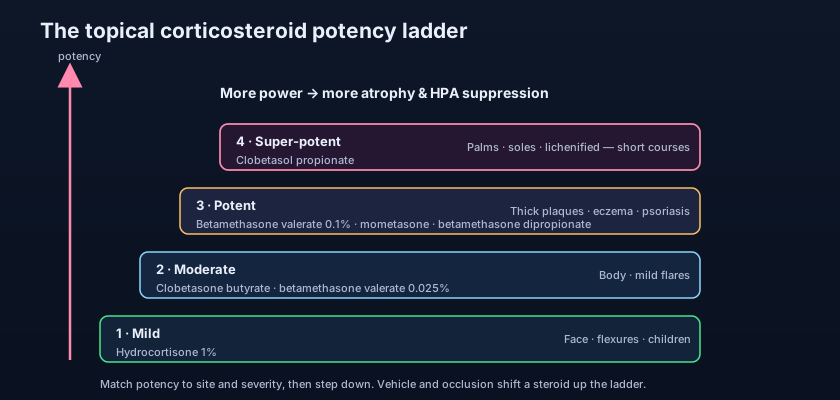
Every topical steroid sits somewhere on a ladder ranked by that blanching assay, not by the concentration on the label. Clinically the ladder is grouped into four bands (a 7-class system is used in the United States, but the four-tier scheme is easier to reason with). Mild: hydrocortisone 1% — the safe starting point, the only class routinely used on the face and in infants. Moderate: clobetasone butyrate and betamethasone valerate (a diluted 0.025% preparation) — for stubborn eczema on the trunk and limbs. Potent: mometasone furoate, betamethasone valerate 0.1%, and betamethasone dipropionate — for thick or resistant disease. Very potent (super-potent): clobetasol propionate — reserved for lichenified plaques, palms and soles, or scalp psoriasis, and used briefly. A crucial trap for students: potency is not the number on the tube. Betamethasone valerate at 0.1% is potent while at 0.025% it is only moderate, and hydrocortisone 1% (mild) is far weaker than clobetasol at 0.05% (super-potent) despite the higher percentage — because potency reflects the molecule and its formulation, not the concentration.
Potency on the skin is never the molecule alone — it is potency × vehicle × occlusion × body site × the disease itself. The very same clobetasol is a different drug on the thick, keratinised sole (where little penetrates) than on thin eyelid or scrotal skin (where it floods in), and different again under a nappy or a plastic wrap, which act like built-in occlusion and can multiply absorption several-fold. Read the whole equation, not just the tube.
Vehicle, occlusion and body site: the other half of the dose
The vehicle a steroid is dissolved in changes how much reaches the target and where it can go. Ointments are greasy and occlusive: they hydrate the stratum corneum, drive penetration up, and suit dry, lichenified, scaly skin. Creams are less potent milligram-for-milligram but cosmetically nicer and better for weeping or flexural areas. Lotions, gels and foams are designed for hairy sites like the scalp. Occlusion — deliberately covering treated skin with plastic wrap, or the accidental occlusion of skin folds and a baby's nappy area — traps moisture and can raise absorption dramatically, effectively promoting a steroid one or more rungs up the ladder. Body site matters just as much, because the barrier varies enormously: eyelids, face, genitals and flexures have thin skin and absorb many times more than the forearm, while palms and soles are so thick they absorb a tiny fraction. This is why the Foundations chapter on percutaneous absorption is worth revisiting — the same milligram behaves like a different dose depending on where it lands.
- Steroids bind the glucocorticoid receptor and reprogramme genes: anti-inflammatory, immunosuppressive, antiproliferative, vasoconstrictive.
- The ladder has four rungs: mild (hydrocortisone) → moderate (clobetasone, betamethasone valerate 0.025%) → potent (mometasone, betamethasone dipropionate) → super-potent (clobetasol).
- Potency is a property of the molecule and formulation — NOT the percentage on the label.
- Effective dose = potency × vehicle × occlusion × body site × disease, not the tube alone.
- Ointments penetrate more than creams; occlusion and thin skin (face, flexures, genitals) both amplify absorption.
Matching potency to site and severity — then stepping down
The prescribing decision is a triangle: how bad is the disease, how thick is the skin, and for how long? The guiding rule is to use the lowest potency that will control the disease, for the shortest time needed, on the thinnest appropriate schedule — but not so timid a strength that the flare never clears, which only prolongs exposure. Practical matching: face, eyelids, flexures and genitals get mild agents (hydrocortisone); the trunk and limbs tolerate moderate-to-potent agents for eczema; thick, chronic, lichenified plaques, palms, soles and scalp psoriasis need potent or super-potent agents to penetrate at all. Then comes the step-down strategy that separates good prescribers from careless ones: gain control with an adequately strong steroid, and once the skin is smooth, taper — reduce the potency, reduce the frequency to alternate days or weekends, or hand over to a steroid-sparing agent. In eczema this dovetails with proactive, twice-weekly maintenance to hold remission, and in psoriasis with rotation onto vitamin-D analogues; both are covered in the Eczema and Psoriasis chapters, where topical steroids are the first-line topical anchor. Stopping a potent steroid abruptly after prolonged use invites a rebound flare, so the taper is not optional.
Mild — hydrocortisone 1% (Efcortelan): infant eczema, facial and flexural dermatitis. Moderate — clobetasone butyrate 0.05% (Eumovate), betamethasone valerate 0.025%: childhood body eczema, moderate flares. Potent — mometasone furoate 0.1% (Elocon), betamethasone valerate 0.1% (Betnovate), betamethasone dipropionate (Diprosone): resistant eczema, psoriasis on the body. Super-potent — clobetasol propionate 0.05% (Dermovate): lichen planus, discoid lupus, scalp and palmoplantar psoriasis, used in short bursts. Mometasone is worth singling out: it is potent yet designed for once-daily use with a comparatively favourable local side-effect profile — a good illustration that a modern molecule can be strong on inflammation while gentler on the skin.
The price of potency: local and systemic harm
Every adverse effect flows from the same antiproliferative, immunosuppressive and vasoactive actions that make the drug work. Local effects are the common ones and cluster where thin skin meets prolonged potent use. Skin atrophy — thinning, a shiny, crinkled, cigarette-paper surface — is the antiproliferative brake applied too long. Striae (stretch marks) follow the same dermal thinning and, unlike atrophy, are permanent, classically in flexures and the groin. Telangiectasia (visible fine vessels) and easy bruising reflect fragile dermal support. On the face, potent steroids can trigger perioral dermatitis and a rosacea-like eruption, and around the eye they risk glaucoma and cataract. Steroids also blunt local immunity, so they can mask or worsen infection — the classic tinea incognito, where a steroid partly quiets a fungal rash and disguises it. Two pharmacodynamic quirks matter: tachyphylaxis, a waning response with continuous use that tempts patients to climb the ladder; and rebound, the fierce flare when a potent steroid is stopped abruptly — the engine of the steroid-withdrawal or "red skin" syndrome.
Systemic effects are rarer but the ones that most frighten patients and examiners. Enough steroid absorbed through the skin can suppress the hypothalamic–pituitary–adrenal (HPA) axis exactly as oral steroids do, and in extreme cases produce iatrogenic Cushing's syndrome. The risk climbs with the very factors we have already met: a potent or super-potent agent, applied over a large body-surface area, under occlusion, on thin or broken skin, for a prolonged period. Children are especially vulnerable because their surface-area-to-weight ratio is high, so a given amount covers proportionally more skin. This is the topical face of the HPA-suppression story taught in the Endocrine chapter — the same axis that must never be stopped abruptly once suppressed. In practice, though, sensible potency-to-site matching and time-limited courses keep systemic absorption trivial for the vast majority of patients; the danger lies in unsupervised, long-term, high-potency use over wide areas.
- Local harms: atrophy (reversible), striae (permanent), telangiectasia, bruising, perioral dermatitis, masked infection (tinea incognito).
- Tachyphylaxis (waning response) and rebound (flare on abrupt stop) are pharmacodynamic traps — taper, don't stop dead.
- Systemic risk (HPA suppression, iatrogenic Cushing's) rises with potent agent + large area + occlusion + thin/broken skin + long duration + children.
- Rule of thumb: lowest effective potency, shortest effective course, then step down.
- Match the site: mild on face/flexures/genitals; potent–super-potent reserved for thick, lichenified, palmoplantar or scalp disease.
Steroid phobia, adherence and the fingertip unit
The commonest reason topical steroids fail is not the drug — it is fear of the drug. Corticophobia, an exaggerated dread of "skin thinning" and hidden systemic harm, drives patients (and parents) to under-apply, use a sub-therapeutic strength, or abandon treatment the moment the skin looks better, so the flare never truly clears and the eczema chronifies. The remedy is honest counselling: explain that appropriately chosen, time-limited steroids are safe, that under-treatment carries its own cost, and give a concrete measure of how much to use. That measure is the fingertip unit (FTU) — the amount of ointment squeezed from a standard nozzle along the pad of an adult index finger, from tip to first crease, roughly half a gram. One FTU covers an area about the size of two flat adult palms. Whole-body maps (a hand and genitals = about 1 FTU, a whole arm ≈ 3, a whole leg ≈ 6) turn a vague "apply thinly" into a number patients can follow, which is often the single change that makes the same prescription finally work.
- Judging potency by the percentage on the tube — hydrocortisone 1% is mild, clobetasol 0.05% is super-potent despite the smaller number.
- Putting a potent steroid on the face, eyelids or flexures — thin skin absorbs many times more, inviting atrophy, perioral dermatitis and even glaucoma.
- Stopping a potent steroid abruptly instead of tapering — triggering rebound, and mistaking a masked fungal infection (tinea incognito) for treatment failure.
A 6-month-old infant has widespread body eczema. The parents ask which preparation is safest to apply to the cheeks and skin folds. Which is the most appropriate choice for those sites?
- Topical steroids bind the glucocorticoid receptor to give four actions — anti-inflammatory, immunosuppressive, antiproliferative, vasoconstrictive — the last being the basis of potency ranking.
- The potency ladder runs mild (hydrocortisone) → moderate (clobetasone, betamethasone valerate) → potent (mometasone, betamethasone dipropionate) → super-potent (clobetasol); potency is the molecule and vehicle, not the label percentage.
- Effective dose = potency × vehicle × occlusion × body site × disease; match mild agents to face/flexures and reserve potent–super-potent for thick or resistant skin, then step down.
- Watch for atrophy, striae, telangiectasia, perioral dermatitis, tachyphylaxis and rebound locally, and HPA suppression systemically; counter corticophobia with honest counselling and the fingertip unit.
- Rook's Textbook of Dermatology — Topical corticosteroids: pharmacology, potency classification and adverse effects.
- Wolverton SE. Comprehensive Dermatologic Drug Therapy — Topical glucocorticosteroids.
- Katzung BG. Basic & Clinical Pharmacology — Adrenocorticosteroids and dermatologic pharmacology.
- British National Formulary (BNF) — Topical corticosteroids: potency table and quantities (fingertip unit).
- National Institute for Health and Care Excellence (NICE) / British Association of Dermatologists — Atopic eczema and psoriasis: topical corticosteroid use.
- Stoughton RB. Vasoconstrictor assay specificity and the ranking of topical corticosteroid potency. Archives of Dermatology.