
Corticosteroids: The Most Powerful Anti-inflammatory We Have
Corticosteroids appear in nearly every field of medicine, from asthma to arthritis to organ transplants, because they are the most powerful suppressors of inflammation we possess. They are copies of cortisol, the body's own stress hormone. Understanding what cortisol naturally does explains both why steroids work so brilliantly — and why their long list of side effects is completely predictable.
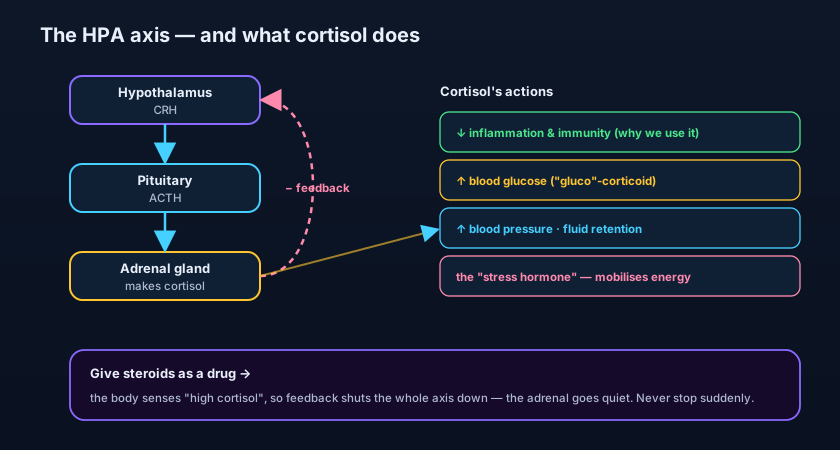
Cortisol is the body's own stress hormone, made by the adrenal glands and released in a daily rhythm and in times of stress. It does several big jobs: it damps down inflammation and the immune system, it raises blood glucose to fuel a stressed body (hence 'gluco-corticoid'), and it helps maintain blood pressure. Corticosteroid drugs — prednisolone, dexamethasone, hydrocortisone and the rest — are manufactured versions of this hormone, given at doses far higher than the body would ever make, specifically to exploit that anti-inflammatory power. And because a steroid is a fat-soluble hormone acting on genes in the nucleus (remember the foundations chapter), it changes which proteins cells make — which is exactly why it's so far-reaching, and why both its benefits and its harms unfold over time rather than instantly.
Why they work — and why the side effects are predictable
Every side effect is just cortisol's normal job, turned up too high. The therapeutic use is simple to state: steroids powerfully suppress inflammation and immune activity, so they treat an enormous range of conditions — asthma and COPD flares, severe allergic reactions, autoimmune and inflammatory diseases, and they prevent rejection after organ transplant. But here is the beautiful, exam-friendly logic: nearly every side effect of long-term steroids is simply one of cortisol's natural actions, dialled far too high. Cortisol raises glucose → steroids can cause or worsen diabetes. Cortisol supports blood pressure and retains salt and water → steroids cause hypertension and fluid retention. Cortisol mobilises energy and redistributes fat → long-term steroids cause weight gain, a round 'moon' face, central obesity and thin limbs (a Cushing's-like appearance). They also thin the skin and bones (causing osteoporosis), raise the risk of infection (from immune suppression), can cause mood changes and, in children, stunt growth. You don't have to memorise this list as random facts — you can derive it, because every item is cortisol being cortisol, only much more so.
Glucocorticoid vs mineralocorticoid
The adrenal actually makes two families of steroid, and telling them apart helps you choose the right drug. Glucocorticoids (like cortisol) are the anti-inflammatory, glucose-raising hormones — this is what we usually mean by 'steroids'. Mineralocorticoids (mainly aldosterone) instead control salt and water: aldosterone makes the kidney retain sodium and water and excrete potassium, supporting blood pressure. Most steroid drugs are chosen for their glucocorticoid (anti-inflammatory) effect, and the newer ones (like dexamethasone) are almost purely glucocorticoid with little salt-retaining action — useful when you want the anti-inflammatory punch without the fluid retention. Hydrocortisone, being closest to natural cortisol, has both actions and is used for true replacement when the adrenal fails (the subject of a later article). Keeping these two axes separate — 'gluco' for sugar and inflammation, 'mineralo' for salt and water — lets you predict what any given steroid will and won't do.
- Corticosteroids are synthetic cortisol — the most powerful anti-inflammatory/immunosuppressant drugs.
- Every long-term side effect = one of cortisol's normal actions turned up too high.
- Predictable harms: high glucose, hypertension/fluid retention, weight gain/Cushingoid look, osteoporosis, infection.
- Glucocorticoid = sugar + inflammation; mineralocorticoid (aldosterone) = salt + water.
- Dexamethasone ≈ pure glucocorticoid (little fluid retention); hydrocortisone has both actions.
The single most useful trick for steroids is to stop treating their side effects as a memorised list and start deriving them from one question: what does cortisol normally do? Cortisol raises sugar, holds up blood pressure, retains salt and water, mobilises and redistributes fat, and suppresses immunity. Now give a big dose of it for months, and each of those becomes a side effect: diabetes, hypertension, oedema, the moon-faced Cushingoid body, and serious infections. Even osteoporosis and thin skin fit — cortisol breaks down protein and bone matrix. Master this one idea and you never again have to memorise the steroid side-effect list; you can rebuild it from scratch every time.
- Treating a diabetic patient's steroids without expecting a rise in glucose.
- Choosing a salt-retaining steroid when you only want an anti-inflammatory effect.
- Forgetting infection risk — steroids can mask and worsen infections.
- Overlooking bone protection in patients on long-term steroids (osteoporosis).
A patient on long-term steroids develops high glucose, a round face, high blood pressure and thin skin. These effects are best explained as…
- Corticosteroids = synthetic cortisol; the most powerful anti-inflammatory/immunosuppressants.
- Their side effects are cortisol's normal actions turned up: high glucose/BP, weight gain, Cushingoid look, osteoporosis, infection.
- Glucocorticoid = sugar + inflammation; mineralocorticoid = salt + water.
- Dexamethasone ≈ pure glucocorticoid; hydrocortisone has both (used for replacement).
- Katzung BG. Basic & Clinical Pharmacology — Adrenocorticosteroids & Adrenocortical Antagonists.
- Brunton LL, et al. Goodman & Gilman's The Pharmacological Basis of Therapeutics — ACTH & adrenocortical steroids.
- Guyton & Hall. Textbook of Medical Physiology — Adrenocortical hormones.
- Whalen K. Lippincott Illustrated Reviews: Pharmacology — Corticosteroids.