
Calcium, Vitamin D & PTH: The Body's Calcium Thermostat
Blood calcium is held within an astonishingly narrow range, because too little makes nerves and muscles misfire and too much is toxic. Two hormones — parathyroid hormone and vitamin D — act on three organs to keep it exactly right. Learn that neat system and you'll understand calcium supplements, vitamin D, and a whole set of disorders at once.
Calcium isn't just for bones. The calcium dissolved in your blood is essential for nerves to fire, muscles to contract (including the heart), blood to clot, and countless cell signals. Because of this, the body guards blood calcium fiercely, holding it within a very tight range. If it drops too low, nerves and muscles become over-excitable — tingling, cramps, and in severe cases spasms and seizures. If it climbs too high, the opposite happens — sluggishness, confusion, kidney stones, and the old teaching phrase 'bones, stones, groans and psychic moans'. Keeping calcium in its narrow safe band is the job of a two-hormone control system, and understanding it unlocks a surprising amount of clinical medicine.
The two hormones, three organs
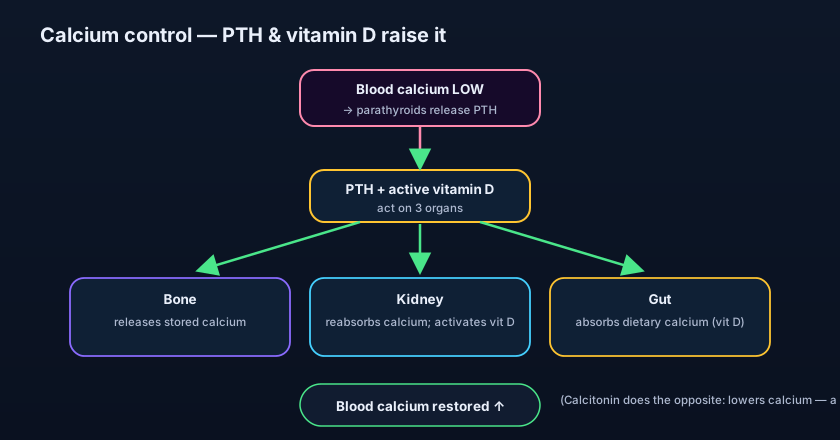
PTH and vitamin D raise calcium by acting on bone, kidney and gut. When blood calcium starts to fall, the parathyroid glands (four tiny glands behind the thyroid) release parathyroid hormone (PTH), the main calcium-raising hormone. PTH acts on three organs to pull calcium back up: it releases calcium from BONE, it makes the KIDNEY reabsorb more calcium (and stop wasting it in urine), and it activates vitamin D. Vitamin D is the second key player, and its most important job is in the GUT: active vitamin D is what lets you absorb calcium from your food — without enough of it, you simply can't take calcium in, no matter how much you eat. Note that vitamin D must be activated in two steps (in the liver, then the kidney) before it works, which is why kidney disease can cause vitamin D and calcium problems. A third, minor hormone, calcitonin, does the opposite of PTH and gently lowers calcium, but it plays little role in humans. So the everyday system is simple: calcium falls → PTH and vitamin D rise → bone, kidney and gut all act to bring calcium back to normal.
Why this matters in practice
This one system explains a lot of everyday medicine. Vitamin D deficiency is extremely common (from too little sunlight), and because vitamin D is needed to absorb calcium, a lack of it weakens bone — causing rickets in children and osteomalacia (soft bones) in adults, and worsening osteoporosis. That's why calcium and vitamin D supplements are the foundation beneath every osteoporosis drug from the last article. The system also explains its own disorders: an overactive parathyroid gland (hyperparathyroidism) pushes calcium too high, while low PTH or vitamin D deficiency pushes it too low. And it links neatly to the kidney: because the kidney both activates vitamin D and responds to PTH, chronic kidney disease disturbs the whole calcium balance, needing special forms of activated vitamin D. You don't need to memorise these as separate facts — each one is just the calcium thermostat working, failing, or being supported.
- Blood calcium is kept in a tight range; too low → excitable nerves/muscles, too high → sluggishness/stones.
- PTH raises calcium via 3 organs: releases it from bone, reabsorbs it in kidney, activates vitamin D.
- Vitamin D's key job is gut absorption of calcium; it needs activation in liver then kidney.
- Vitamin D deficiency → rickets (children)/osteomalacia (adults); worsens osteoporosis.
- Calcium + vitamin D are the foundation under all osteoporosis drugs; kidney disease disturbs the whole system.
The reason vitamin D deficiency and osteoporosis are so intertwined comes down to a supply-chain fact: you can take all the calcium in the world, but without vitamin D you can't absorb it from your gut. Vitamin D is the key that opens the door for dietary calcium to enter the body. So a person low in vitamin D is effectively calcium-starved no matter what they eat, their bones weaken, and any osteoporosis drug you give is trying to build a wall without bricks. That's why every osteoporosis regimen starts by fixing calcium and vitamin D first — get the raw materials and the absorption right, and only then do the bone-preserving drugs have something to work with.
- Giving calcium without checking vitamin D — without vitamin D it can't be absorbed.
- Forgetting that low calcium causes neuromuscular excitability (tingling, spasm, tetany).
- Using ordinary vitamin D in kidney failure — it can't be activated; needs an activated form.
- Overlooking hyperparathyroidism as a cause of unexplained high calcium.
What is vitamin D's most important role in calcium balance?
- Blood calcium is tightly controlled; low → excitable nerves/muscles, high → sluggishness/stones.
- PTH raises calcium via bone, kidney and (through vitamin D) gut.
- Vitamin D enables gut calcium absorption; deficiency → rickets/osteomalacia, worse osteoporosis.
- Calcium + vitamin D are the foundation for all bone treatment; kidney disease disturbs the system.
- Katzung BG. Basic & Clinical Pharmacology — Agents That Affect Bone Mineral Homeostasis.
- Brunton LL, et al. Goodman & Gilman's The Pharmacological Basis of Therapeutics — Agents affecting mineral ion homeostasis.
- Guyton & Hall. Textbook of Medical Physiology — Parathyroid hormone, calcitonin, calcium & vitamin D.
- Whalen K. Lippincott Illustrated Reviews: Pharmacology — Calcium & vitamin D.