
Insulin: Types, Curves, and How Regimens Are Built
There is only one insulin hormone, but a whole family of insulin drugs — and they differ in one thing: timing. Some act within minutes and vanish; others trickle steadily for a whole day. Once you can read the action curves, the way doctors build an insulin regimen stops being a mystery and becomes a simple matter of covering meals and covering the background.
A healthy pancreas does two jobs with insulin at once. It releases a small, steady background trickle all day and night to keep glucose controlled between meals and during sleep — the 'basal' supply. And every time you eat, it releases a quick, sharp burst to deal with the flood of glucose from that meal — the 'bolus'. When we give insulin as a drug, we are trying to imitate this two-part pattern using manufactured insulins that have been engineered to act at different speeds. So the entire subject comes down to one idea: match the right insulin's timing to the job you need it to do.
Reading the four curves
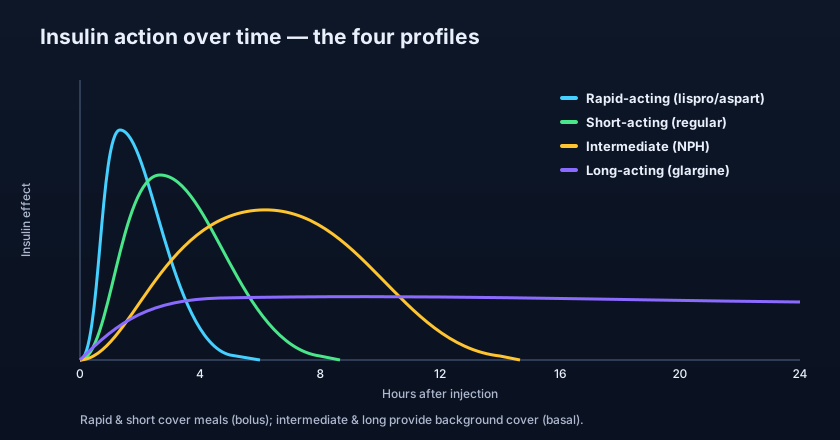
Insulins are grouped by how fast they start and how long they last. The action curve of an insulin — how its glucose-lowering effect rises and falls after injection — sorts every product into four groups. Rapid-acting insulins (lispro, aspart, glulisine) start within about 15 minutes, peak sharply, and are gone in a few hours; they're taken right at a meal to cover it. Short-acting 'regular' insulin is similar but a bit slower, taken about half an hour before eating. Intermediate-acting insulin (NPH) has a slow onset and a broad peak lasting most of a day, used to provide background cover. Long-acting insulins (glargine, detemir, degludec) are the modern basal workhorses: they give an almost flat, peakless level lasting around 24 hours (or more), mimicking the steady background trickle with little risk of a sudden dip. The rule of thumb: rapid and short insulins cover MEALS (bolus); intermediate and long insulins cover the BACKGROUND (basal).
Building a regimen — basal + bolus
The most physiological way to replace insulin, and the standard for type 1 diabetes, is the basal–bolus regimen. The patient takes one injection of a long-acting insulin once a day for steady background cover, plus an injection of a rapid-acting insulin with each meal, its dose matched to the carbohydrate about to be eaten. This mimics the healthy pancreas closely and gives flexibility around meal size and timing. Simpler alternatives exist for type 2 diabetes, where some of the body's own insulin remains: for example, a single daily long-acting insulin added to tablets, or twice-daily 'premixed' insulin (a fixed blend of intermediate and short in one pen) for patients who prefer fewer injections. Whatever the pattern, two safety essentials never change: the basal insulin must never be stopped in a type 1 patient (even when not eating, or DKA can follow), and every insulin regimen carries the risk of hypoglycaemia if a dose is too big or a meal is missed — the subject of the next article.
- The body needs basal (background) + bolus (mealtime) insulin — regimens copy both.
- Rapid (lispro/aspart) & short (regular) = mealtime cover; take with/before meals.
- Intermediate (NPH) & long-acting (glargine/detemir/degludec) = background (basal) cover.
- Basal–bolus is the standard for type 1; simpler regimens suit many type 2 patients.
- Never stop basal insulin in type 1 — and every insulin can cause hypoglycaemia.
The action curve is the entire personality of an insulin, and it explains its main danger. A rapid-acting insulin peaks fast, so its hypoglycaemia risk is soon after a meal if the food doesn't arrive as expected. NPH has a broad peak in the middle of its span, which is why it classically causes hypoglycaemia in the small hours of the night. A modern long-acting insulin is peakless by design — and that flatness is precisely why it's safer, giving steady cover without a sudden trough to fall into. So when you look at any insulin, don't just note how long it lasts; find its peak, because the peak is where the hypo hides.
- Stopping basal insulin in a type 1 patient who isn't eating — risks DKA.
- Giving rapid-acting insulin too early before food arrives — early hypoglycaemia.
- Mixing up basal and bolus roles — a long-acting insulin won't cover a meal spike.
- Ignoring the NPH night-time peak — a common cause of nocturnal hypoglycaemia.
Which insulin type best provides steady 24-hour background (basal) cover?
- The body needs basal + bolus insulin; regimens rebuild both from timed insulin products.
- Rapid/short = mealtime; intermediate/long = background. Find the peak to find the hypo risk.
- Basal–bolus is standard for type 1; simpler regimens fit many type 2 patients.
- Never stop basal insulin in type 1; every insulin can cause hypoglycaemia.
- Katzung BG. Basic & Clinical Pharmacology — Pancreatic Hormones & Antidiabetic Drugs (insulin).
- Brunton LL, et al. Goodman & Gilman's The Pharmacological Basis of Therapeutics — Insulin & insulin preparations.
- ADA — Standards of Care in Diabetes (insulin therapy).
- Whalen K. Lippincott Illustrated Reviews: Pharmacology — Insulin & insulin analogues.