
Feedback Loops: The Thermostat Behind Every Endocrine Drug
The body controls its hormones the way a thermostat controls a room: sense the level, and switch the heating off when there's enough. This single loop explains why giving a hormone as a drug can silence the patient's own gland, why stopping steroids suddenly is dangerous, and how a blood test can tell whether the problem lies in the gland or in the brain above it.
A thermostat does something beautifully simple: it measures the temperature and, once the room is warm enough, it shuts the heater off. It doesn't need to be told the target twice — it self-corrects. The endocrine system runs on exactly this principle. The brain drives a gland to make a hormone; the level of that hormone in the blood is constantly sensed; and when there's enough, the signal from the brain is switched off. This is negative feedback, and it is the master rule of endocrinology. Almost every hormone problem, and almost every endocrine drug's behaviour, is this thermostat working, broken, or being deliberately tricked.
The three-storey axis
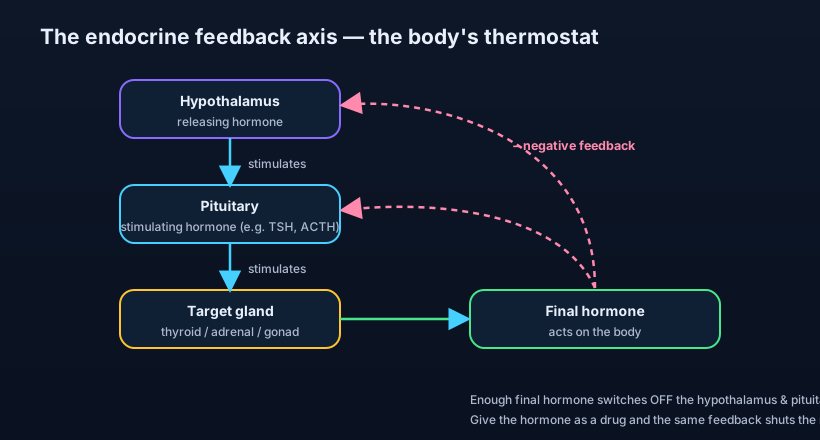
Brain on top, gland at the bottom, and a feedback wire running back up. Most hormone systems are built as a three-storey chain called an axis. At the top, the hypothalamus (the base of the brain) releases a small 'releasing hormone'. This tells the middle storey, the pituitary gland, to release a 'stimulating hormone' into the blood — for example TSH (which drives the thyroid) or ACTH (which drives the adrenal). That stimulating hormone travels to the bottom storey, the target gland, which finally makes the working hormone — thyroid hormone, or cortisol, or the sex hormones. Here's the elegant part: the final hormone doesn't just act on the body, it also travels back UP and switches off the hypothalamus and pituitary. So when there's plenty of cortisol, ACTH falls; when cortisol runs low, ACTH rises to push the adrenal harder. The two named examples you'll meet constantly are the HPT axis (hypothalamus–pituitary–thyroid) and the HPA axis (hypothalamus–pituitary–adrenal). Same architecture, different final hormone.
Why this matters for drugs
This loop turns three clinical mysteries into obvious consequences. First, giving a hormone as a drug tricks the thermostat. If a patient takes corticosteroids for months, the body senses high 'cortisol', so ACTH switches off and the patient's own adrenal glands, unused, shrink and go quiet. That's why long-term steroids must be tapered slowly, never stopped abruptly — the sleeping adrenal needs weeks to wake up, and a sudden stop can leave the patient dangerously short of cortisol (an adrenal crisis). Second, feedback lets a single blood test localise the fault. If the thyroid hormone is low but TSH is high, the pituitary is shouting at a failed gland — the problem is in the thyroid itself (primary). If both are low, the pituitary has gone silent — the problem is higher up (secondary). The pattern of 'stimulating hormone versus final hormone' pinpoints the broken storey. Third, some drugs work by exploiting feedback deliberately — giving a steady hormone signal to suppress a gland, or blocking feedback to spur one on. Once you see the thermostat, endocrine lab results and drug effects stop being memorised facts and become logic.
- Endocrine axes are three storeys: hypothalamus → pituitary → target gland (HPT, HPA).
- Negative feedback: enough final hormone switches off the levels above — self-correcting.
- Giving a hormone as a drug suppresses the patient's own gland via that feedback.
- Low final hormone + HIGH stimulating hormone = the gland itself has failed (primary).
- Low final hormone + LOW stimulating hormone = the pituitary/brain has failed (secondary).
The single most important safety fact in all of endocrine pharmacology falls straight out of feedback: never stop long-term steroids suddenly. When exogenous steroid has been suppressing the HPA axis for weeks, the adrenal glands have effectively gone into hibernation. Pull the drug away abruptly and there's no cortisol from either source — the drug is gone and the natural gland can't respond fast enough — which can precipitate a life-threatening adrenal crisis. The fix is to taper: reduce the dose gradually so the sleeping axis has time to reawaken. It's the same reason a thermostat-controlled boiler needs a moment to fire back up after being switched off — and here, that moment can take weeks.
- Stopping long-term corticosteroids abruptly — the suppressed adrenal can't respond; crisis risk.
- Reading a final hormone level alone — you need the stimulating hormone to localise the fault.
- Forgetting that any hormone given as a drug suppresses its own axis by feedback.
- Confusing primary (gland) with secondary (pituitary) failure — the TSH/ACTH pattern separates them.
A patient's thyroid hormone is low and their TSH is high. Where is the problem?
- Endocrine axes run brain → pituitary → gland, with the final hormone feeding back to switch the top off.
- Negative feedback keeps hormone levels steady — a biological thermostat.
- A hormone given as a drug suppresses the patient's own gland — so taper steroids, never stop abruptly.
- Final + stimulating hormone together localise the fault: primary (gland) vs secondary (pituitary).
- Katzung BG. Basic & Clinical Pharmacology — Hypothalamic & Pituitary Hormones.
- Brunton LL, et al. Goodman & Gilman's The Pharmacological Basis of Therapeutics — Pituitary & hypothalamic hormones.
- Guyton & Hall. Textbook of Medical Physiology — Hypothalamic–pituitary control & feedback.
- Rang HP, Dale MM, et al. Rang & Dale's Pharmacology — The pituitary and endocrine control.