
How Hormones — and Endocrine Drugs — Work
The nervous system sends fast, private messages down wires. The endocrine system does the opposite: it releases chemical messengers into the blood that travel everywhere, yet act only on the cells built to hear them. Grasp how a hormone delivers its order — and why some act in seconds while others take days — and every endocrine drug in this whole section suddenly makes sense.
Imagine two ways to run a country. One is the telephone: a direct line from the capital to a single office, an instant message that arrives and is gone. The other is a national broadcast: an announcement sent out to everyone at once, which only the departments concerned act upon, and whose instructions may reshape how they work for days. The nervous system is the telephone — fast, targeted, fleeting. The endocrine system is the broadcast — its hormones pour into the bloodstream and reach every cell, but only cells carrying the right receptor respond. Every drug in endocrinology works by joining this broadcast: adding to it, blocking it, or replacing a signal that's gone missing.
Two kinds of hormone, two speeds
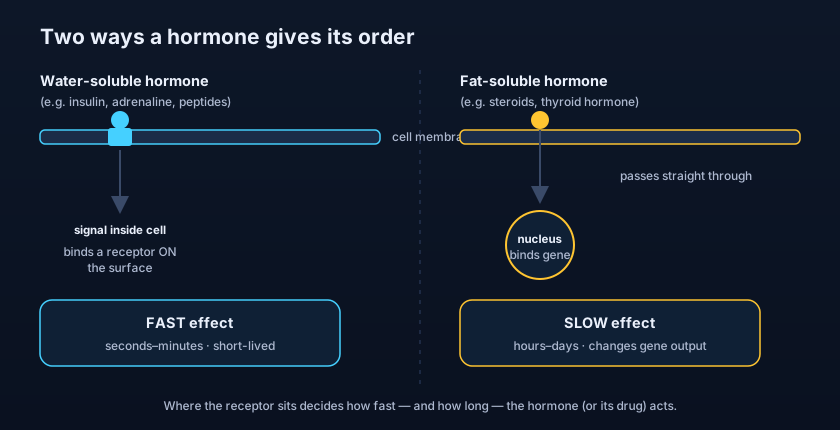
A hormone's chemistry decides where its receptor sits — and how fast it acts. Hormones split into two great families, and the split explains almost everything about how their drugs behave. Water-soluble hormones (the peptides and amines — insulin, adrenaline, most pituitary hormones) cannot cross the fatty cell membrane, so they bind a receptor ON the cell surface and trigger a rapid internal signal. Their effects come in seconds to minutes and fade quickly — which is why, for example, insulin acts fast and adrenaline even faster. Fat-soluble hormones (the steroids like cortisol and the sex hormones, plus thyroid hormone) do the opposite: they slip straight through the membrane, bind a receptor INSIDE the cell, travel to the nucleus, and switch genes on or off. Because they work by changing which proteins the cell makes, their effects take hours to days to appear and last far longer. This single distinction — surface receptor and fast, versus nuclear receptor and slow — predicts how quickly a hormone drug works and how long its action lingers.
The four things an endocrine drug can do
Almost every endocrine drug falls into one of four strategies, and naming them turns a huge, scattered field into a short list. First, REPLACE a missing hormone: give levothyroxine when the thyroid fails, or insulin when the pancreas can't — pure substitution. Second, SUPPLEMENT or mimic a hormone to exploit its effects: corticosteroids given in high doses to suppress inflammation, far beyond what the body would ever make. Third, BLOCK a hormone's receptor or its production: anti-thyroid drugs that stop the gland overproducing, or anti-androgens that block testosterone at the receptor. Fourth, MODULATE the control system itself — many endocrine drugs act not on the target gland but on the feedback loops that command it (the subject of the next article). Whenever you meet a new endocrine drug, ask which of these four it is; the answer tells you most of what it does, and most of its side effects.
- Hormones are chemical messengers in the blood; only cells with the matching receptor respond.
- Water-soluble hormones → surface receptor → fast, short effect (insulin, adrenaline).
- Fat-soluble hormones (steroids, thyroid) → nuclear receptor → slow, lasting gene effect.
- Endocrine drugs do one of four things: replace, mimic/supplement, block, or modulate control.
- A hormone's speed and duration follow directly from where its receptor sits.
The surface-versus-nuclear rule quietly predicts a drug's whole personality. A steroid works through the nucleus, changing gene expression — so it can't act instantly (there's a lag while new proteins are made) and it can't be switched off instantly either (those proteins linger). That's precisely why a corticosteroid doesn't relieve an asthma attack in seconds the way inhaled adrenaline does, and why you can't stop long-term steroids abruptly — the body's own machinery has been reprogrammed and needs time to recover. One fact about receptor location, and you've predicted both the onset and the withdrawal behaviour of an entire drug class.
- Expecting a steroid or thyroid hormone to act instantly — nuclear effects take hours to days.
- Thinking a hormone in the blood affects every cell — only cells with the receptor respond.
- Confusing replacement doses (physiological) with high 'pharmacological' doses used for effect.
- Forgetting that blocking a gland's output and blocking its receptor are different strategies.
A steroid hormone and adrenaline differ most in that the steroid…
- Hormones are blood-borne messengers; only cells with the matching receptor respond.
- Surface receptor → fast, short (peptides/amines); nuclear receptor → slow, lasting (steroids/thyroid).
- Endocrine drugs replace, mimic/supplement, block, or modulate the control system.
- Receptor location predicts a drug's onset, duration, and withdrawal behaviour.
- Katzung BG. Basic & Clinical Pharmacology — Introduction to Endocrine Pharmacology.
- Brunton LL, et al. Goodman & Gilman's The Pharmacological Basis of Therapeutics — Endocrine pharmacology (introduction).
- Guyton & Hall. Textbook of Medical Physiology — Introduction to Endocrinology.
- Rang HP, Dale MM, et al. Rang & Dale's Pharmacology — The endocrine system.