
Hypothyroidism: Replacing the Body's Thermostat
Thyroid hormone sets the speed of the entire body — when it runs low, everything slows down. The treatment is one of the simplest and most successful in all of medicine: a single daily tablet that exactly replaces the missing hormone. But the way we dose and monitor it is a perfect, real-world lesson in reading a feedback loop backwards.
Thyroid hormone is the body's accelerator pedal. It sets the resting metabolic rate — how fast cells burn energy, how warm you are, how quickly your heart beats, how alert your mind feels. When the thyroid is underactive and hormone levels fall, everything slows to a crawl: tiredness, weight gain, feeling cold, constipation, dry skin, a slow pulse, low mood, sluggish thinking. It's a common condition, especially in women, and most often caused by the immune system gradually damaging the gland. The remarkable thing is how completely treatable it is — because if the gland can no longer make enough hormone, we can simply give the hormone back.
The treatment: levothyroxine
One tablet exactly replaces the missing hormone. The treatment is levothyroxine — a manufactured copy of T4, the main hormone the thyroid makes. It is a pure replacement: you're simply giving back exactly what the failing gland can no longer produce, once a day, for life. A few practical points make it work well. Because it's a steroid-like nuclear-acting hormone, it works slowly — you don't feel better overnight, and its full effect takes weeks, which is why doses are adjusted only every 6–8 weeks. It's best absorbed on an empty stomach, so it's classically taken in the morning well before breakfast, and separated from things that block its absorption (calcium, iron, and certain antacids). And it must be started cautiously — at a low dose in the elderly or anyone with heart disease — because suddenly speeding up a body that has adapted to running slow can strain the heart and provoke angina. Start low and go slow in the vulnerable; otherwise, it's a straightforward, life-long, once-daily tablet.
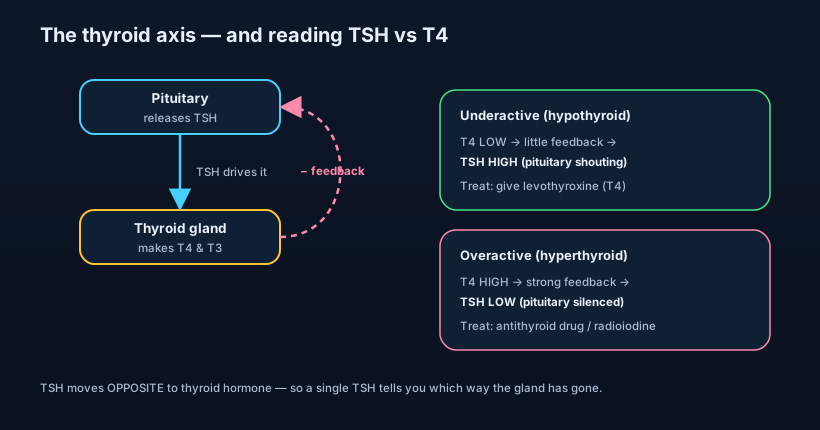
Monitoring: reading TSH backwards
Here's where the feedback loop from the foundations chapter becomes a daily tool. We don't usually chase the thyroid hormone level itself; we monitor TSH — the pituitary's signal — and read it backwards. Remember the loop: the pituitary raises TSH when thyroid hormone is too low, and lowers it when there's plenty. So in an untreated underactive thyroid, TSH is HIGH (the pituitary shouting at a failing gland). As you give the right amount of levothyroxine, thyroid hormone rises, the pituitary relaxes, and TSH falls back into the normal range — that's your target. If TSH is still high, the dose is too low; if TSH is pushed below normal, you've given too much (over-replacement, which risks the dangers of an overactive thyroid — palpitations, bone loss). The elegance is that one cheap blood test, interpreted through the feedback loop, tells you precisely whether the daily tablet is dosed just right. Read TSH as the mirror image of thyroid status, and monitoring becomes effortless.
- Hypothyroidism slows the whole body: tiredness, weight gain, cold, constipation, slow pulse.
- Treatment is levothyroxine (T4) — a pure once-daily replacement, for life.
- Take on an empty stomach; separate from calcium, iron and antacids that block absorption.
- Start low in the elderly/heart disease — over-fast correction can strain the heart.
- Monitor TSH: still HIGH = under-dosed; pushed LOW = over-dosed. Target is a normal TSH.
The counter-intuitive thing students trip over is that in an underactive thyroid, the TSH is HIGH — the opposite of what 'low thyroid' feels like it should mean. It clicks the moment you think in feedback: TSH isn't the thyroid hormone, it's the pituitary's demand for it. A failing thyroid makes too little hormone, so the pituitary cranks up TSH trying to flog the gland into working — a high TSH is the sign of a struggling thyroid, not an overactive one. Give enough levothyroxine and the pituitary, finally satisfied, lets TSH drop to normal. Once you read TSH as 'how hard the pituitary is having to push', the whole picture inverts correctly and never confuses you again.
- Reading a high TSH as an overactive thyroid — high TSH means UNDERactive (or under-treated).
- Starting a full dose in an elderly or cardiac patient — can provoke angina/arrhythmia.
- Taking levothyroxine with calcium/iron/food — reduced absorption, under-treatment.
- Rechecking TSH too soon — it takes ~6–8 weeks for a dose change to settle.
A patient on levothyroxine still has a HIGH TSH. What does this mean?
- Hypothyroidism slows the body; treat with once-daily levothyroxine (T4) for life.
- Take on an empty stomach, away from calcium/iron; start low in the elderly/cardiac.
- Monitor with TSH, read backwards: high TSH = under-dosed; low TSH = over-dosed.
- Adjust every 6–8 weeks — the hormone acts slowly (nuclear receptor).
- Katzung BG. Basic & Clinical Pharmacology — Thyroid & Antithyroid Drugs.
- Brunton LL, et al. Goodman & Gilman's The Pharmacological Basis of Therapeutics — Thyroid & antithyroid drugs.
- Guyton & Hall. Textbook of Medical Physiology — Thyroid metabolic hormones.
- Whalen K. Lippincott Illustrated Reviews: Pharmacology — Thyroid hormones.