
Laxatives: Four Ways to Treat Constipation
Constipation is one of the commonest complaints in medicine, and the laxative shelf can look bewildering. But there are really just four types, each working by a different simple mechanism — add bulk, draw in water, stimulate the muscle, or soften the stool. Learn the four, and choosing the right one becomes obvious.
Constipation — infrequent, hard, difficult-to-pass stools — is extremely common, and often the first steps aren't drugs at all: more fibre, more fluid, and more activity. When those aren't enough, laxatives help, and the pharmacy shelf offers a confusing array of them. The good news is that they all fall into just four groups, each with a distinct, easy-to-picture mechanism. Once you can see what each type physically does to the stool or the bowel, you can match it sensibly to the situation — and understand why some are gentle everyday choices and others are for short-term rescue.
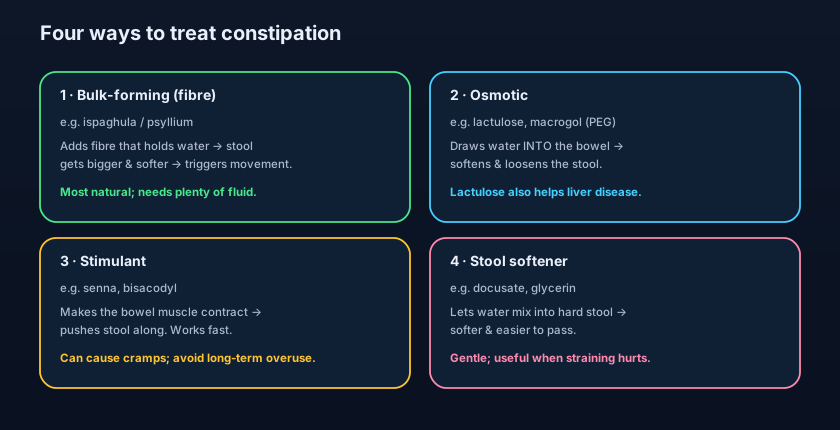
The four types
Each type acts on the stool or bowel in a different, simple way. Bulk-forming laxatives (like ispaghula/psyllium) are essentially concentrated fibre. They absorb water and swell, making the stool larger and softer, which stretches the bowel wall and naturally triggers it to move. They're the most 'physiological' choice and good for long-term use — but they must be taken with plenty of fluid (taken dry, they can make things worse or even cause an obstruction). Osmotic laxatives (like lactulose and macrogol/polyethylene glycol) work by drawing water into the bowel, softening and loosening the stool. Lactulose has a bonus use you'll meet in the liver chapter — it helps clear toxins in liver failure. Stimulant laxatives (like senna and bisacodyl) act directly on the bowel muscle, making it contract to push stool along; they work fast and are good for short-term relief, but can cause cramps and shouldn't be relied on long-term. Stool softeners (like docusate) let water penetrate hard stool to soften it, useful when passing stool is painful (for example with haemorrhoids or after surgery). Four mechanisms, four best uses — no need to memorise every brand.
Choosing wisely — and special cases
Sensible practice usually starts with the gentlest approach — lifestyle and a bulk-forming or osmotic laxative for ongoing constipation — and reserves stimulants for when a faster or stronger effect is needed, using them short-term. A few special situations are worth knowing. Constipation caused by opioids (a very common and predictable problem, since opioids slow the gut) often needs a stimulant laxative from the start, and there are even specific drugs that block opioids' effect in the gut for stubborn cases. In pregnancy, bulk-forming and osmotic laxatives are generally preferred as the safer options. For severe or resistant chronic constipation, newer prescription agents exist (such as prucalopride, which stimulates gut movement, and drugs like linaclotide) when the standard laxatives fail. And an important safety note: constipation that's new, persistent, or comes with alarming features (bleeding, weight loss, a change in bowel habit in an older person) needs proper assessment, not just a laxative — because it can occasionally signal something serious. But for the everyday problem, the four-type map makes laxatives one of the more logical corners of pharmacology.
- Try lifestyle first (fibre, fluid, activity); then four laxative types by mechanism.
- Bulk-forming (ispaghula): fibre that holds water — most natural; take with plenty of fluid.
- Osmotic (lactulose, macrogol): draw water into the bowel; lactulose also used in liver failure.
- Stimulant (senna, bisacodyl): make the bowel contract — fast, short-term; can cause cramps.
- Opioid constipation often needs a stimulant; new/persistent constipation with alarm features needs assessment.
The most practical pairing to remember is opioids and laxatives. Opioids cause constipation in almost everyone who takes them regularly, because slowing the gut is a direct, unavoidable consequence of how they work (from the CNS chapter) — not an occasional side effect but a near-certainty. So good practice is to prescribe a laxative alongside a regular opioid from the start, pre-empting the constipation rather than waiting for it. And because the problem is a sluggish, under-active bowel, a stimulant laxative (which makes the bowel muscle contract) is usually the right tool, rather than just a bulking agent. It's a small habit that prevents a lot of misery, and a reminder that the best time to treat a predictable side effect is before it happens.
- Taking a bulk-forming laxative without enough fluid — can worsen constipation or cause obstruction.
- Relying on stimulant laxatives long-term — they're for short-term rescue.
- Not prescribing a laxative alongside a regular opioid — constipation is near-inevitable.
- Treating new or alarming constipation with a laxative alone — it needs assessment.
How does an osmotic laxative (like macrogol) relieve constipation?
- Four laxative types: bulk-forming (fibre), osmotic (draw in water), stimulant (contract bowel), softener.
- Start with lifestyle + bulk/osmotic for ongoing use; stimulants for short-term rescue.
- Bulk-forming needs plenty of fluid; opioid constipation usually needs a stimulant (prescribe alongside opioids).
- New/persistent constipation with alarm features needs assessment, not just a laxative.
- Katzung BG. Basic & Clinical Pharmacology — Drugs Used to Treat Constipation.
- Brunton LL, et al. Goodman & Gilman's The Pharmacological Basis of Therapeutics — Laxatives & treatment of constipation.
- NICE CKS — Constipation management.
- Whalen K. Lippincott Illustrated Reviews: Pharmacology — Laxatives.