
How the Stomach Makes Acid — and Where the Drugs Act
The stomach deliberately fills itself with acid strong enough to dissolve metal, then protects its own wall from that acid. When this balance tips, you get ulcers and reflux — and almost every drug for them targets one point in a simple pathway. Learn how acid is made, and the whole acid-blocking section falls into place.
The stomach does something remarkable: it produces hydrochloric acid so strong it could damage skin, in order to digest food and kill swallowed microbes. To survive its own acid, the stomach lining coats itself in a protective layer of mucus and bicarbonate — a delicate truce between attack and defence. Most upper-gut diseases are this truce breaking down: either too much acid, or too little protection, letting acid burn the lining. The result is a peptic ulcer (a raw sore in the stomach or duodenum) or acid reflux (acid splashing up into the oesophagus, causing heartburn). And here's the good news for the pharmacology: the drugs that treat these all work by tipping the balance back — mostly by reducing acid, at one specific point in how it's made.
The parietal cell: three signals, one pump
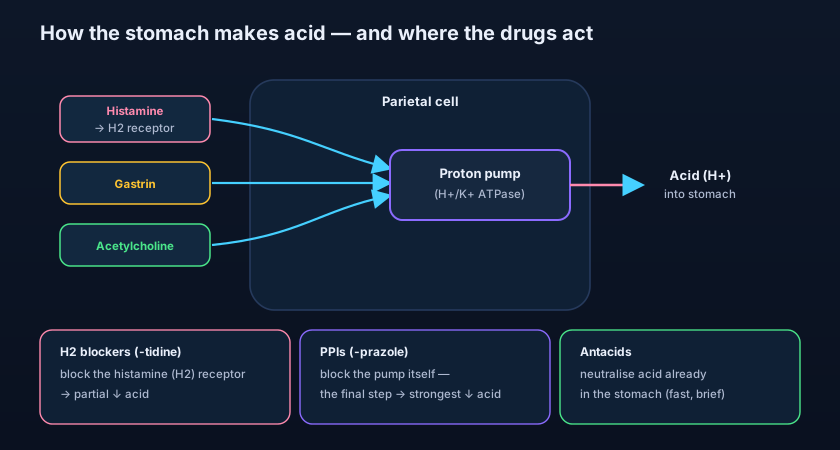
Acid is made by one cell, driven by three stimulators, through one final pump. Acid is produced by a specialised stomach cell called the parietal cell, and its wiring is beautifully simple. Three signals tell the parietal cell to make acid: histamine (acting on an H2 receptor), gastrin (a hormone released when you eat), and acetylcholine (from the vagus nerve — a callback to the parasympathetic 'rest and digest' system). All three converge on one final machine: a pump in the cell membrane called the proton pump (the H+/K+ ATPase), which physically pumps acid out into the stomach. This is the crucial point — no matter which of the three signals is doing the stimulating, the acid all comes out through that one pump. That single fact explains the entire hierarchy of acid-suppressing drugs: block one of the three signals and you partly reduce acid, but block the final pump itself and you shut down acid production almost completely, whatever is stimulating it.
The three ways to lower acid — and defending the wall
This pathway maps directly onto the acid-related drugs you'll meet in the next articles, so learning it now does most of the work. You can lower stomach acid in three places. First, block a stimulating signal: the H2 blockers (like famotidine) block the histamine receptor — but because histamine is only one of three signals, they reduce acid only partly. Second, block the final pump: the proton pump inhibitors (PPIs, like omeprazole — the '-prazole' drugs) switch off the pump itself, the last common step, so they suppress acid far more powerfully than H2 blockers and are the mainstay of acid disease. Third, don't reduce production at all — just neutralise the acid that's already there: the antacids (like magnesium or calcium salts) are simple bases that mop up acid in the stomach for fast, short-lived relief. Separately, a few drugs work on the OTHER side of the balance — boosting the mucosal defence rather than cutting acid (these 'cytoprotective' agents come later). But the headline framework is this simple: three signals stimulate one pump to make acid; block the signal, block the pump, or neutralise the acid — and you've understood almost every heartburn and ulcer drug before even meeting them.
- The stomach makes strong acid (to digest/kill microbes) and protects its lining with mucus + bicarbonate.
- Acid comes from the parietal cell, stimulated by 3 signals: histamine (H2), gastrin, acetylcholine.
- All three converge on ONE final proton pump (H+/K+ ATPase) that secretes acid.
- H2 blockers block one signal (partial ↓); PPIs block the pump (strongest ↓); antacids neutralise existing acid.
- Ulcers/reflux = too much acid or too little mucosal defence — drugs restore the balance.
The reason PPIs are so much more powerful than H2 blockers falls straight out of the diagram: it's about where in the pathway you strike. Histamine, gastrin and acetylcholine are three separate 'on' switches, but they all feed into a single final machine — the proton pump. Block one switch (an H2 blocker) and the other two can still drive the pump, so acid only partly falls. Block the pump itself (a PPI) and it doesn't matter which switches are being pressed — the final common step is disabled, and acid production collapses. It's a general principle worth carrying everywhere in pharmacology: when several pathways converge on one final step, the drug that blocks that final step is almost always the most powerful, because nothing upstream can bypass it.
- Thinking H2 blockers and PPIs are interchangeable — PPIs suppress acid far more (they block the final pump).
- Forgetting that acid disease can be too much acid OR too little mucosal protection.
- Expecting antacids to heal ulcers — they only neutralise acid briefly, they don't reduce production.
- Overlooking that acetylcholine (vagus) is one of the acid signals — links to the autonomic chapter.
Why do proton pump inhibitors suppress acid more powerfully than H2 blockers?
- The stomach makes strong acid and protects its lining with mucus + bicarbonate; disease = too much acid or too little defence.
- Three signals (histamine/H2, gastrin, acetylcholine) drive the parietal cell's proton pump.
- H2 blockers block one signal (partial); PPIs block the pump (strongest); antacids neutralise existing acid.
- Blocking the final common step (the pump) is the most powerful way to lower acid.
- Katzung BG. Basic & Clinical Pharmacology — Drugs Used in Acid-Peptic Diseases.
- Brunton LL, et al. Goodman & Gilman's The Pharmacological Basis of Therapeutics — Gastric acid secretion & agents.
- Guyton & Hall. Textbook of Medical Physiology — Secretory functions of the alimentary tract.
- Rang HP, Dale MM, et al. Rang & Dale's Pharmacology — The gastrointestinal tract.