
The Vomiting Reflex & Gut Motility: The Map Behind the Drugs
Why does one anti-sickness drug work brilliantly for chemotherapy but uselessly for travel sickness? Because vomiting can be triggered through several different receptors, and each drug blocks a different one. Learn this one map of the vomiting reflex, and you'll be able to pick the right antiemetic for the right cause — the single most useful idea in this whole section.
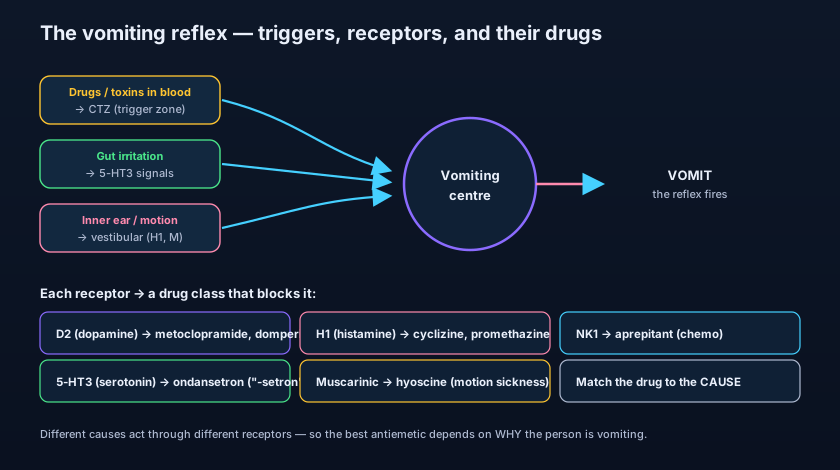
Nausea and vomiting feel like one thing, but they can be set off in several completely different ways — and that turns out to be the whole key to treating them. A drug or toxin in the blood, food poisoning irritating the gut, the spinning of motion sickness, a migraine, pregnancy, or the anaesthetic after surgery — each of these triggers vomiting through a different route and a different chemical messenger. All these routes eventually converge on one control hub in the brain, the 'vomiting centre', which fires the reflex. Because different triggers use different receptors along the way, the trick to treating sickness is to match the drug to the cause. Understanding this map is what separates guessing from choosing.
The receptors — and their antiemetics
Each trigger route uses a receptor, and each receptor has its own drug. A handful of receptors do the work, and knowing them lets you predict which antiemetic to use. Drugs and toxins in the blood are detected by a 'chemoreceptor trigger zone' rich in dopamine (D2) and serotonin (5-HT3) receptors. Irritation of the gut releases serotonin acting on 5-HT3. Motion sickness works through the inner ear's balance system, using histamine (H1) and muscarinic receptors. And chemotherapy, the most severe cause, strongly involves 5-HT3 and a receptor called NK1. Each of these has a matching drug class that blocks it: the D2 blockers (metoclopramide, domperidone, prochlorperazine) for many general and drug-induced causes; the 5-HT3 blockers (the '-setrons' like ondansetron) which are powerful, especially for chemotherapy and after surgery; the antihistamines/antimuscarinics (cyclizine, promethazine, hyoscine) which are best for motion sickness and vertigo because those work through H1 and muscarinic receptors; and the NK1 blockers (aprepitant) reserved for severe chemotherapy sickness. The whole logic is right there: identify the receptor the trigger uses, and choose the drug that blocks it.
Motility: the gut's own movement
The other half of this foundation is motility — the coordinated muscular movement that pushes contents along the gut, from the stomach emptying to the bowel. When motility is too slow, food and waste back up: the stomach empties sluggishly (causing nausea and bloating) or the bowel becomes constipated. When it's too fast, you get diarrhoea. Just like acid and vomiting, gut movement is controlled largely by the autonomic nervous system — the parasympathetic 'rest and digest' system speeds the gut up (acetylcholine promotes movement), while other signals slow it. This sets up two whole families of drugs you'll meet soon: prokinetics that speed a sluggish gut up (some antiemetics, like metoclopramide, do double duty here — blocking D2 to stop nausea AND getting the stomach moving), and the laxatives and antidiarrhoeals that adjust bowel movement in either direction. Notice the recurring theme of this section: whether it's making acid, triggering vomiting, or moving contents along, the gut is largely run by a small set of receptors and the autonomic nerves — and its drugs work by nudging those same controls. Master the map, and the pharmacology becomes navigation rather than memorisation.
- Vomiting has several trigger routes, each using a different receptor, converging on the vomiting centre.
- Receptors → drugs: D2 (metoclopramide/domperidone), 5-HT3 (ondansetron), H1/muscarinic (cyclizine/hyoscine), NK1 (aprepitant).
- Match the antiemetic to the CAUSE: e.g. antihistamine/antimuscarinic for motion sickness, ondansetron for chemo.
- Gut motility is autonomically controlled: too slow → nausea/constipation; too fast → diarrhoea.
- Prokinetics speed a sluggish gut; laxatives/antidiarrhoeals adjust bowel movement.
The single most useful thing in the whole nausea topic is to stop asking 'what's a good anti-sickness drug?' and start asking 'what receptor is THIS person's vomiting coming through?' Motion sickness runs through the inner ear's histamine and muscarinic pathways, so an antihistamine (cyclizine) or hyoscine works and a 5-HT3 blocker won't. Chemotherapy floods the 5-HT3 and NK1 pathways, so ondansetron and aprepitant are the answer and an antihistamine barely helps. A drug or metabolic upset acts on the dopamine trigger zone, so a D2 blocker fits. There is no single 'best' antiemetic — there's a best one for each cause, and the map tells you which. Get this, and you'll prescribe anti-sickness drugs like someone who understands the reflex, not someone reaching blindly for whatever's on the shelf.
- Giving the same antiemetic for every cause — match the drug to the receptor the trigger uses.
- Using a 5-HT3 blocker for motion sickness — that works through H1/muscarinic, not 5-HT3.
- Forgetting metoclopramide is both an antiemetic (D2) and a prokinetic.
- Ignoring that gut motility (and much of GI function) is run by the autonomic system.
What determines which antiemetic to choose?
- Vomiting has several trigger routes, each via a different receptor, converging on the vomiting centre.
- Match the antiemetic to the cause: D2 (metoclopramide), 5-HT3 (ondansetron), H1/muscarinic (cyclizine/hyoscine), NK1 (aprepitant).
- Gut motility is autonomically controlled — sets up prokinetics, laxatives and antidiarrhoeals.
- The gut runs on a small set of receptors + autonomic nerves — learn the map, not a drug list.
- Katzung BG. Basic & Clinical Pharmacology — Drugs Used to Treat Nausea, Vomiting & GI Motility.
- Brunton LL, et al. Goodman & Gilman's The Pharmacological Basis of Therapeutics — Treatment of nausea, vomiting & prokinetics.
- Guyton & Hall. Textbook of Medical Physiology — Motility & vomiting reflex.
- Rang HP, Dale MM, et al. Rang & Dale's Pharmacology — Nausea, vomiting & GI motility.

