
Alpha-Blockers for BPH: Relaxing the Dynamic Outlet
A man in his sixties gets up four or five times a night to pass a weak, hesitant stream that never quite empties. His prostate has slowly enlarged and is squeezing the outlet of his bladder. There are two ways to open that outlet: shrink the gland, which takes months, or relax the muscle wrapped around it, which takes days. Alpha-blockers do the second — they don't touch the size of the prostate at all, yet they can turn a miserable night into a decent one within a week. Understanding why means separating the prostate's bulk from its tone.
A 68-year-old man finally sees his doctor about the nights. For two years he has woken repeatedly to urinate, and the stream has become weak and hesitant, dribbling to a stop with the feeling that his bladder is never empty. His prostate, felt on examination, is smoothly enlarged — benign prostatic hyperplasia. He is not keen on surgery, and his gland is not huge. He is started on tamsulosin, taken at night, and warned to stand up slowly for the first few days. Within a week his flow is stronger and he wakes twice, not five times. His prostate has not shrunk by a single millimetre. What changed was not the gland's size but its grip — and that is the whole idea behind an alpha-blocker.
Two obstructions, not one
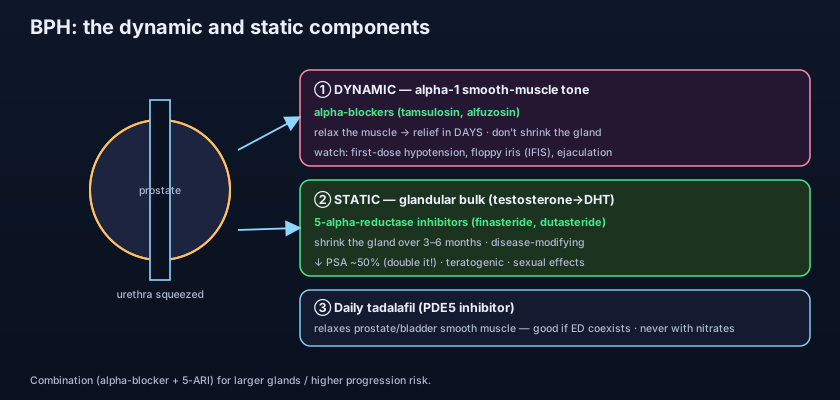
The blocked outlet in BPH is part muscle, part mass. The lower urinary tract symptoms of BPH — the weak stream, hesitancy, incomplete emptying, frequency and nocturia — come from a single problem: the enlarging prostate obstructs the bladder outlet. But that obstruction has two components, and they behave completely differently. The static component is the physical bulk of the overgrown gland pressing on the urethra — a matter of tissue volume that only changes if you shrink the gland. The dynamic component is something more immediate: the smooth muscle of the prostate and bladder neck is held in a state of active tension, and that tone can be dialled up or down in real time by the nervous system. The dynamic part is estimated to account for a large share of the obstruction — which is exactly why relaxing it, without removing an ounce of tissue, can help so quickly.
What sets that smooth-muscle tone? Sympathetic nerves acting on alpha-1 adrenergic receptors, densely expressed in the prostate stroma, capsule and bladder neck. Noradrenaline binding these receptors keeps the muscle contracted, tightening the outlet. This is the same alpha-1 receptor pharmacology taught in the Autonomic Nervous System section — here it has a specific job: it is the tap that controls the dynamic component. Block it, and the muscle relaxes and the outlet opens. The two components map neatly onto two drug classes: alpha-blockers for the dynamic tone, and 5-alpha-reductase inhibitors for the static bulk (the next chapter).
Think of a garden hose someone is standing on. There are two reasons the water barely trickles: the person's weight pressing down (the static bulk), and the hose kinked tight at that point (the dynamic muscle tone). You could ask the person to lose weight — slow, but it lifts the pressure. Or you could simply un-kink the hose right now and the water flows again. Alpha-blockers un-kink the hose. Five-alpha-reductase inhibitors, over months, make the person lighter.
The drugs: blocking alpha-1 in the outlet
Every drug in this class relaxes the same smooth muscle — they differ in how selectively they hit the prostate. The alpha-1 receptor comes in subtypes, and the prostate and bladder neck are rich in the alpha-1A subtype, whereas blood vessels rely more on alpha-1B for their tone. That distinction is the organizing principle of the whole class. The alpha-1A-selective agents — tamsulosin and silodosin — aim preferentially at the prostatic subtype, relaxing the outlet while largely sparing the vasculature, so they cause less drop in blood pressure. Alfuzosin is functionally uroselective in practice for similar reasons. At the other end sit the older non-selective, long-acting agents: doxazosin and terazosin. They block alpha-1 everywhere, including on blood vessels, so as well as relaxing the outlet they lower systemic blood pressure — which is why they were historically used to treat hypertension, and why they carry more orthostatic risk. This is the same drug family the Cardiovascular section discusses as antihypertensives; in BPH the blood-pressure effect is usually an unwanted side rather than the goal.
The clinical payoff is speed. Because alpha-blockers act on tone, not tissue, symptom relief and improved urinary flow arrive within days to a couple of weeks — far faster than anything that has to remodel the gland. This makes them the usual first-line drug for bothersome moderate-to-severe LUTS, especially in men whose glands are not markedly enlarged. What they emphatically do not do is shrink the prostate, halt its long-term growth, or reduce the risk of eventual acute urinary retention. For those size-dependent outcomes you need a different mechanism, and that is where the decision to add or switch to a 5-alpha-reductase inhibitor comes in.
Alpha-1A-selective (uroselective, less effect on blood pressure): tamsulosin (Flomax), silodosin (Rapaflo). Functionally uroselective: alfuzosin (Uroxatral). Non-selective, long-acting (also lower blood pressure — once used for hypertension): doxazosin (Cardura), terazosin (Hytrin). All relax prostatic and bladder-neck smooth muscle and work within days. The uroselective agents are favoured when avoiding a fall in blood pressure matters (an elderly man prone to falls); the older agents can be handy when a man also has untreated hypertension, though dedicated antihypertensives are generally preferred for the blood pressure itself.
- BPH outlet obstruction has two parts: a DYNAMIC component (alpha-1 smooth-muscle tone) and a STATIC component (glandular bulk).
- Alpha-1 blockers relax prostatic and bladder-neck muscle → better flow and symptom relief in days to weeks.
- They do NOT shrink the gland, slow its growth, or lower the long-term retention risk.
- Alpha-1A-selective (tamsulosin, silodosin) and alfuzosin target the prostate with little blood-pressure effect.
- Non-selective doxazosin and terazosin also lower blood pressure — historically antihypertensives, more orthostatic risk.
- First-line for bothersome LUTS, especially when the prostate is not markedly enlarged.
The price: hypotension, ejaculation, and a surgical trap
Relax alpha-1 in the outlet and you inevitably relax it elsewhere too. The most familiar adverse effect is a consequence of blocking alpha-1 on blood vessels: orthostatic (postural) hypotension and dizziness, most pronounced with the very first dose — the so-called first-dose phenomenon. This is why alpha-blockers are started at a low dose, taken at bedtime, with a warning to rise slowly, and titrated up. The effect is greatest with the non-selective doxazosin and terazosin and least with the alpha-1A-selective agents, though even tamsulosin can drop the pressure in a frail, dehydrated or elderly patient. Two other predictable effects: abnormal or retrograde ejaculation — a reduction or redirection of ejaculate because the bladder neck no longer closes tightly — which is notably common with the highly selective tamsulosin and silodosin; and nasal congestion, from alpha-1 blockade in the nasal mucosa. None of these is dangerous, but they drive many men to stop the drug, so they are worth mentioning up front.
The effect students most often miss is not in the urinary tract at all — it is in the eye. Alpha-1 receptors also drive the iris dilator muscle, and chronic alpha-blockade leaves that muscle floppy and poorly responsive. During cataract surgery this produces intraoperative floppy iris syndrome (IFIS): the iris billows, prolapses toward the incision and constricts progressively, greatly raising the risk of surgical complications. The catch is that stopping the drug shortly before surgery does not reliably reverse it — the iris changes persist. The practical rule is therefore twofold: always ask a man about alpha-blocker use before eye surgery so the ophthalmologist can prepare for it, and, where feasible, defer starting an alpha-blocker until after planned cataract surgery. This is a classic cross-discipline warning that belongs as much to the Ophthalmology section as to urology — a urinary drug that reaches out and complicates an eye operation.
Alpha-blockers are not only prostate drugs. Because they relax smooth muscle throughout the lower urinary tract — including the distal ureter — tamsulosin is widely used as medical expulsive therapy to help a lodged ureteric stone pass, a use covered in the Stones chapter. So the same tablet that eases a man's nocturia can also speed a kidney stone on its way out. It is a neat reminder that the pharmacology follows the receptor, not the diagnosis: wherever alpha-1-mediated smooth-muscle tone obstructs flow, blocking it opens the path.
When one drug isn't enough: adding a 5-ARI
An alpha-blocker deals with tone but leaves the bulk untouched, so in a man with a genuinely large prostate — and especially one at risk of progression to acute retention — controlling only the dynamic component may not be enough over the years. This is where the static-component drug earns its place. A 5-alpha-reductase inhibitor such as finasteride or dutasteride blocks the conversion of testosterone to the more potent dihydrotestosterone (DHT) that drives glandular growth, gradually shrinking the prostate over months and reducing the long-term risk of retention and surgery. The two classes are complementary rather than competing: the alpha-blocker delivers fast relief while the 5-ARI slowly attacks the underlying bulk, and combination therapy is a standard strategy for large, progressive glands. The trade-offs, the teratogenicity of 5-ARIs and their effect on PSA are the subject of the next two chapters; the point here is simply that alpha-blockers open the door quickly, and a 5-ARI is what you add when size is the enduring problem.
- First-dose orthostatic hypotension and dizziness — start low, dose at bedtime, rise slowly.
- Abnormal/retrograde ejaculation — especially tamsulosin and silodosin; nasal congestion too.
- Intraoperative floppy iris syndrome — always ask about alpha-blockers before cataract surgery.
- Stopping the drug pre-op does not reliably reverse IFIS; ideally start alpha-blockers after cataract surgery.
- Add or switch to a 5-alpha-reductase inhibitor for large glands / progression risk (static bulk).
- Tamsulosin also aids ureteric stone expulsion — same smooth-muscle relaxation, different site.
- Not asking about alpha-blocker use before cataract surgery — the drug causes intraoperative floppy iris syndrome, and stopping it late doesn't reliably fix it. Warn the eye surgeon.
- Expecting an alpha-blocker to shrink the prostate or prevent retention. It relaxes tone only; for the static bulk you need a 5-alpha-reductase inhibitor.
- Starting at full dose in the daytime and ignoring first-dose hypotension, risking a fall in an elderly man — start low, at night, and titrate up.
A 70-year-old man on tamsulosin for BPH is scheduled for cataract surgery. What is the single most important action regarding his medication?
- BPH outlet obstruction is part dynamic (alpha-1 smooth-muscle tone, treatable in days) and part static (glandular bulk, needs a 5-ARI over months).
- Alpha-1 blockers relax prostatic/bladder-neck muscle for fast symptom relief but do NOT shrink the gland; tamsulosin, silodosin and alfuzosin are uroselective, doxazosin and terazosin also lower blood pressure.
- Key harms: first-dose orthostatic hypotension (start low, at night), abnormal/retrograde ejaculation, nasal congestion, and intraoperative floppy iris syndrome — always warn the eye surgeon.
- Add or switch to a 5-alpha-reductase inhibitor for large or progressive glands; tamsulosin is also used to help ureteric stones pass.
- Rang & Dale's Pharmacology — The genitourinary system: drugs for benign prostatic hyperplasia.
- Katzung Basic & Clinical Pharmacology — Adrenoceptor antagonist drugs (alpha-1 blockers).
- NICE guideline NG97 / CG97: Lower urinary tract symptoms in men — management.
- EAU Guidelines on Management of Non-neurogenic Male Lower Urinary Tract Symptoms (LUTS), incl. BPO.
- British National Formulary (BNF) — Alpha-adrenoceptor blocking drugs; tamsulosin, alfuzosin, doxazosin.
- Chang DF, Campbell JR. Intraoperative floppy iris syndrome associated with tamsulosin. Journal of Cataract & Refractive Surgery.