
Sexually Transmitted Infections: A Treatment Map
Treating a sexually transmitted infection is never just about one patient. Every prescription carries three questions at once: which organism, which drug still works, and who else needs treating. The pharmacology is mostly a matter of matching a known bug to a first-line antibiotic — but layered on top is a public-health logic that has no parallel elsewhere in medicine: you treat before the swab comes back, you treat the partner you never met, and you watch, with gonorrhoea, an organism burning through the last drugs we have. This chapter is the map: organism by organism, the drug that still works.
A 24-year-old man comes to a sexual-health clinic with a burning discharge that started three days ago. The clinician does not wait for a laboratory result. On the strength of the swab appearance and the history, he is given a single intramuscular injection of ceftriaxone there and then — empirical treatment, because the cost of waiting is onward transmission and complications. He is also treated for chlamydia at the same visit, because the two so often travel together. Then comes the part that has no equivalent in a chest infection: he is asked, gently, to name his recent partners, so they too can be traced and treated before they infect anyone else. And he is booked back for a test of cure — because the organism he is carrying, Neisseria gonorrhoeae, is running out of drugs that reliably kill it. One consultation, and every principle of STI pharmacology is already in play.
The four principles behind every STI prescription
Before any single drug, four ideas shape how the whole field is prescribed. First, empirical treatment: because these infections spread and scar (pelvic inflammatory disease, infertility, ectopic pregnancy), you often treat on clinical suspicion the same day, before the confirmatory test returns. Second, partner notification (contact tracing): the person in front of you is one node in a network, and treating them alone leaves a reservoir that will simply re-infect them — so partners are traced and treated, sometimes without ever being tested. Third, test of cure where it matters: for most STIs, a good regimen is assumed to work, but for gonorrhoea — and in pregnancy, and for anything treated with a second-line drug — you go back and prove the organism is gone. Fourth, resistance surveillance: the drugs on this map are not fixed. They change as organisms evolve, and gonorrhoea is the living example the whole world watches. The drug mechanisms themselves belong to the Antimicrobials section — this chapter is where they are applied.
Gonorrhoea: the resistance story in one injection
Neisseria gonorrhoeae is the cautionary tale of antimicrobial stewardship told in real time. Within living memory it was reliably killed by penicillin, then by tetracyclines, then by ciprofloxacin, then by oral cephalosporins — and one by one it defeated them all. Today the first-line treatment across most guidelines has narrowed to a single intramuscular dose of ceftriaxone, a third-generation cephalosporin (a beta-lactam that blocks bacterial cell-wall synthesis; see the Antimicrobials cephalosporin chapter). For years azithromycin was added alongside it, partly to slow resistance and partly to cover co-existing chlamydia; but as azithromycin resistance rose and provided little real protection, several major guidelines have stripped it back out, leaving ceftriaxone monotherapy at a higher dose. That change — adding a drug, then deliberately removing it — is stewardship happening on the page. Because ceftriaxone is now close to the last reliable option, gonorrhoea is one of the few infections where a test of cure is routine: you must confirm the organism is actually gone.
Chlamydia: the commonest, and the quietest
Chlamydia trachomatis is the most common bacterial STI and its defining feature is silence — the majority of infections cause no symptoms, which is exactly why screening and contact tracing matter so much. First-line treatment is a course of doxycycline, a tetracycline that blocks bacterial protein synthesis at the ribosome; it has overtaken single-dose azithromycin as the preferred regimen because it clears the organism more reliably, particularly at rectal sites. Azithromycin remains the key alternative — notably in pregnancy, where tetracyclines are avoided because they deposit in fetal bone and teeth (this belongs to the Pregnancy-prescribing chapter). Because gonorrhoea and chlamydia so frequently co-exist, a patient treated empirically for gonorrhoea is usually co-treated for chlamydia at the same visit. One important variant, lymphogranuloma venereum — an invasive chlamydial serovar — needs a longer course of doxycycline (typically three weeks) rather than the standard short course.
Think of the STI treatment map like a set of well-worn keys, each cut for one lock. For most locks the key still turns first time — doxycycline for chlamydia, penicillin for syphilis, metronidazole for trichomonas — and has done so for decades. Gonorrhoea is the one lock that keeps changing its mechanism. Every time we find a key that fits, the organism re-machines the tumblers, and we are forced to reach for a newer, more expensive key on a shrinking ring. Stewardship is the discipline of not wearing out the few keys we have left — which is why gonorrhoea is now guarded down to a single injection, used carefully and checked afterwards.
Syphilis: the old drug that never failed
In dramatic contrast to gonorrhoea, Treponema pallidum — the spirochaete of syphilis — has never developed meaningful resistance to penicillin, the drug first used against it more than seventy years ago. First-line treatment is intramuscular benzathine penicillin, a long-acting depot formulation that maintains treponemicidal levels for the days the slow-dividing organism needs. The dosing is stage-dependent: early (primary, secondary, early latent) syphilis is treated with a single dose, whereas late latent or syphilis of unknown duration needs three weekly doses to match the organism's sluggish replication. For a genuinely penicillin-allergic patient, doxycycline is the standard alternative — again a tetracycline, again avoided in pregnancy, where the answer to a penicillin allergy is usually careful desensitisation so that penicillin can still be given. One classic quirk to warn patients about: the Jarisch–Herxheimer reaction — fever, chills, headache and myalgia within hours of the first dose, caused by a flood of inflammatory mediators as huge numbers of spirochaetes are killed at once. It is alarming but self-limiting, and is not an allergy or a reason to stop.
Notice how the same drug class reappears with different jobs across this map. A tetracycline (doxycycline) is first-line for chlamydia, the penicillin-allergy alternative for syphilis, and — as we will see — an emerging preventive taken after sex. A cephalosporin (ceftriaxone) carries gonorrhoea almost alone. Metronidazole handles the anaerobes and protozoa. The exam skill is not memorising a hundred regimens but pairing each organism to its class and remembering the two big exceptions the map turns on: gonorrhoea, where resistance keeps narrowing the options, and pregnancy, where the tetracyclines drop out and azithromycin or penicillin step in.
- Gonorrhoea (N. gonorrhoeae): single IM ceftriaxone; azithromycin removed from many guidelines as resistance rose; test of cure is routine.
- Chlamydia (C. trachomatis): first-line doxycycline; azithromycin the alternative (e.g. in pregnancy); often co-treated with gonorrhoea.
- Lymphogranuloma venereum needs a longer (≈3-week) doxycycline course, not the standard short one.
- Syphilis (T. pallidum): benzathine penicillin, stage-dependent duration; still no meaningful penicillin resistance.
- Jarisch–Herxheimer: transient fever/chills after the first syphilis dose — a die-off reaction, not an allergy.
- The two hinges of the map: gonorrhoea resistance narrows options; pregnancy removes tetracyclines.
Trichomonas and bacterial vaginosis: the metronidazole pair
Two very different conditions share one drug. Trichomonas vaginalis is a flagellated protozoan causing a frothy discharge and, importantly, a truly sexually transmitted infection — so partners must be treated. Bacterial vaginosis is not classically an STI but an overgrowth of anaerobes replacing the normal lactobacilli; partners are not routinely treated. Both respond to metronidazole (or its relative tinidazole), a nitroimidazole that is activated only inside anaerobic and protozoal cells, where it generates reactive intermediates that fragment their DNA — an elegantly selective mechanism covered in the Antimicrobials section. The counselling point that always appears in exams: warn patients firmly against alcohol during and just after the course, because metronidazole causes a disulfiram-like reaction — inhibiting acetaldehyde dehydrogenase so that even a small drink triggers flushing, nausea, vomiting and palpitations.
Viral STIs: suppressing herpes, preventing HPV
With viruses the goal shifts from cure to control and prevention. Genital herpes is caused by herpes simplex virus (HSV). The antivirals aciclovir and its better-absorbed prodrug valaciclovir are guanosine analogues activated specifically inside infected cells, where they block the viral DNA polymerase (the mechanism sits in the Antivirals chapter). They shorten and soften outbreaks but do not eradicate the latent virus, so treatment is either episodic — a short course at the first tingle of a recurrence — or suppressive, taken daily to cut the frequency of attacks and reduce transmission to a partner. It is control, never cure. Genital warts, caused by human papillomavirus (HPV), are managed by removing the visible lesions: patient-applied topical agents such as imiquimod (an immune-response modifier) or podophyllotoxin, or clinic procedures such as cryotherapy. But the transformative intervention against HPV is not treatment at all — it is prevention through HPV vaccination, which pre-empts both genital warts and, far more importantly, HPV-driven cervical and other cancers. This links to the Dermatology chapter for the topical wart therapies and to immunisation for the vaccine.
Gonorrhoea (Neisseria gonorrhoeae) → ceftriaxone IM. Chlamydia (Chlamydia trachomatis) → doxycycline (azithromycin alternative). Syphilis (Treponema pallidum) → benzathine penicillin. Trichomonas / bacterial vaginosis → metronidazole. Genital herpes (HSV) → aciclovir / valaciclovir (episodic or suppressive). Genital warts (HPV) → imiquimod / podophyllotoxin / cryotherapy — plus HPV vaccination as prevention. HIV → antiretroviral therapy, with PrEP and PEP for prevention. Read down the list and the pattern is clear: a specific first-line agent per organism, tetracyclines swapped out in pregnancy, and — for the viral entries — control and prevention rather than cure.
HIV: treatment as prevention, and prevention as a pill
HIV has moved, in a generation, from a fatal diagnosis to a controlled chronic condition, and the pharmacology behind that shift matters here for two reasons. First, antiretroviral therapy (ART): a combination of drugs from different classes (reverse-transcriptase, integrase and protease inhibitors) taken together to suppress viral replication at several steps at once, prevent resistance, and drive the viral load to undetectable levels — at which point the virus is not transmitted sexually (the "undetectable = untransmittable" principle). The detailed classes live in the Antiretrovirals chapter. Second — and central to a genitourinary STI chapter — is prevention with the same drugs. Pre-exposure prophylaxis (PrEP), typically tenofovir with emtricitabine, is taken by HIV-negative people at risk to prevent acquisition, and is highly effective. Post-exposure prophylaxis (PEP) is a short course started urgently, within hours to a couple of days of a high-risk exposure, to abort infection before it establishes. The idea that an antiviral drug can be a preventive is one of the most important public-health shifts in the field.
The same preventive logic is now reaching bacterial STIs. Doxycycline post-exposure prophylaxis — doxy-PEP — is an emerging strategy in which a single dose of doxycycline is taken after condomless sex to cut the risk of acquiring chlamydia and syphilis (and, less reliably, gonorrhoea). It is genuinely effective for the tetracycline-susceptible organisms, but it is not free of concern: widespread post-exposure antibiotic use raises the very stewardship question that hangs over this whole chapter — whether it will accelerate resistance, including in gonorrhoea and in bystander gut bacteria. Doxy-PEP is a live example of the field's central tension: a real preventive benefit weighed against the long shadow of resistance.
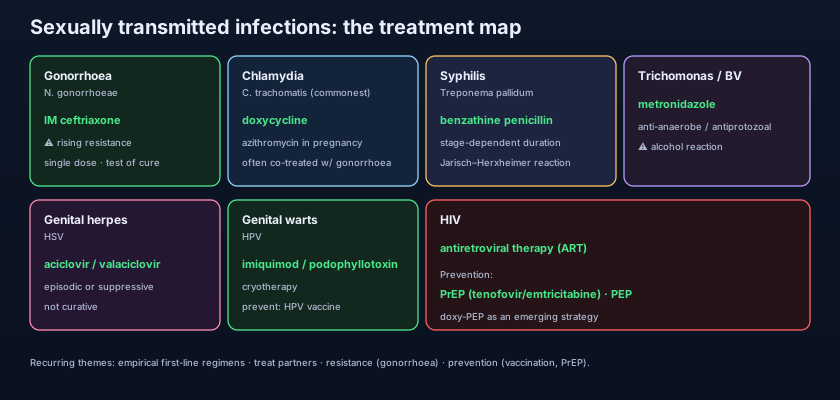
- Trichomonas and bacterial vaginosis both respond to metronidazole; warn against alcohol (disulfiram-like reaction).
- Genital herpes: aciclovir/valaciclovir given episodically or as daily suppression — control, not cure.
- Genital warts: topical imiquimod/podophyllotoxin or cryotherapy; HPV vaccination is the key prevention.
- HIV: combination antiretroviral therapy suppresses to undetectable = untransmittable.
- PrEP (tenofovir/emtricitabine) prevents HIV acquisition; PEP is an urgent short post-exposure course.
- Doxy-PEP is an emerging bacterial-STI preventive — effective but a stewardship concern.
- Reaching for an oral cephalosporin or ciprofloxacin for gonorrhoea. Resistance has removed those — it is IM ceftriaxone, with a test of cure.
- Giving doxycycline for chlamydia or syphilis in pregnancy. Tetracyclines are contraindicated — use azithromycin (chlamydia) or penicillin (syphilis).
- Mistaking the Jarisch–Herxheimer reaction after the first syphilis dose for a penicillin allergy and stopping treatment — it is a transient die-off reaction.
A man is diagnosed with uncomplicated gonorrhoea confirmed on swab. According to current guidance, what is the most appropriate first-line treatment?
- STI pharmacology runs on four principles: empirical first-line treatment, partner notification, test of cure where it matters, and resistance surveillance.
- Bacterial map: gonorrhoea → IM ceftriaxone (test of cure); chlamydia → doxycycline (azithromycin in pregnancy); syphilis → benzathine penicillin; trichomonas/BV → metronidazole.
- Gonorrhoea is the live stewardship example — resistance has narrowed treatment to one injection and stripped azithromycin from many guidelines.
- Viral STIs shift to control and prevention: aciclovir suppresses herpes, HPV vaccination prevents warts and cancer, and HIV is met with ART plus PrEP/PEP (and emerging doxy-PEP for bacterial STIs).
- British Association for Sexual Health and HIV (BASHH) — National guidelines for the management of gonorrhoea, chlamydia and syphilis.
- Rang & Dale's Pharmacology — Antibacterial and antiviral drugs.
- British National Formulary (BNF) — Genito-urinary system infections; antivirals; antiprotozoals.
- WHO Guidelines for the Treatment of Neisseria gonorrhoeae, Chlamydia trachomatis and Treponema pallidum, and WHO Global AMR surveillance (gonococcal antimicrobial resistance).
- US CDC Sexually Transmitted Infections Treatment Guidelines; guidance on HIV PrEP/PEP and doxycycline post-exposure prophylaxis (doxy-PEP).
- Luetkemeyer AF, et al. Postexposure Doxycycline to Prevent Bacterial Sexually Transmitted Infections (DoxyPEP trial). New England Journal of Medicine.