
The Lower Urinary Tract as a Drug Target: Storing and Voiding
Almost every drug used for the bladder and the prostate makes sense only against one simple picture: the lower urinary tract spends its life doing two opposite jobs — quietly storing urine, then decisively emptying it. Each job is run by a different branch of the autonomic nervous system pressing on a different muscle through a different receptor. Learn that one control diagram and the whole pharmacology falls out of it: which receptor to block to calm an overactive bladder, which to block to open an obstructed outlet, which nerve to reinforce to hold urine in. Get the map right and you never memorise these drugs again — you derive them.
A 68-year-old man has stopped travelling. He wakes four times a night to pass water, and by day he plans his life around toilets — a sudden, un-ignorable urge that he barely reaches in time. Down the corridor sits a different patient with the opposite complaint: a 71-year-old man who feels the urge but then stands at the urinal for a minute before a thin, hesitant stream begins, and leaves still feeling half-full. Same organ, two failures — one bladder that squeezes when it should be quiet, one outlet that stays shut when it should open. Their prescriptions will pull in opposite directions, and both are written straight off the same wiring diagram of nerves, muscles and receptors that governs every drop of urine either man passes.
One tract, two opposite jobs
Micturition is not one event — it is a switch between two stable states. For roughly 99% of the day the lower urinary tract is in storage mode: the bladder wall (the detrusor muscle) stays relaxed and expands to hold a rising volume at low pressure, while the outlet — the bladder neck and the urethral sphincters — stays firmly shut. Then, for a few controlled seconds, everything flips into voiding mode: the detrusor contracts, the outlet relaxes, and urine flows. A healthy tract is defined not by strength but by coordination — the outlet must open at the exact moment the bladder squeezes. Almost every lower-urinary-tract disorder is a failure of one of these two states, and almost every drug is an attempt to nudge the balance back toward the one that is failing.
The players and their receptors
Three muscles, three nerves, four receptors — memorise these and the drugs write themselves. The detrusor — the muscle of the bladder wall — is driven by the parasympathetic nerves (via pelvic splanchnic fibres) acting on M3 muscarinic receptors: acetylcholine here means "contract and void." The same detrusor also carries beta-3 adrenergic receptors that, when stimulated by circulating and local noradrenaline, tell it to "relax and keep storing." The bladder neck and the prostatic smooth muscle are the dynamic part of the outlet, held shut by the sympathetic nerves acting on alpha-1 adrenergic receptors — this is the tone that resists flow. Finally the external urethral sphincter is skeletal muscle under somatic (voluntary) control through the pudendal nerve at nicotinic receptors — the switch you consciously hold to "wait." This is applied autonomic pharmacology, and it rewards a detour back to the Autonomic Nervous System chapter, where the muscarinic, alpha-1 and beta-3 receptors are taught from first principles.
Think of the bladder as a balloon guarded by a drawstring. The parasympathetic M3 signal is the fist that squeezes the balloon (voiding); the beta-3 signal is the hand that lets it stay slack and fill (storage). The sympathetic alpha-1 tone is the drawstring pulled tight at the neck, keeping the balloon shut, and the somatic sphincter is a second, conscious hand you can clamp over the opening when you choose to wait. To empty smoothly the fist must squeeze at the very instant both the drawstring and your hand let go. Every drug in this section either strengthens the fist, loosens it, tightens the drawstring, or slackens it.
- The tract lives in two states: storage (detrusor relaxed, outlet shut) and voiding (detrusor contracts, outlet opens).
- Detrusor: parasympathetic → M3 muscarinic → contraction (voiding).
- Detrusor also: beta-3 adrenergic → relaxation (storage).
- Bladder neck & prostate: sympathetic → alpha-1 adrenergic → contraction (dynamic outlet tone).
- External urethral sphincter: somatic (pudendal) → nicotinic → voluntary hold.
- Coordination, not power, defines a healthy tract — the outlet must open exactly as the detrusor squeezes.
Storage symptoms vs voiding symptoms
The patient's own words tell you which state has failed — and therefore which receptor to target. Symptoms cluster into two families that map cleanly onto the two states. Storage symptoms — urinary frequency, urgency, and nocturia (waking at night to void) — mean the bladder will not stay quiet during filling; the detrusor is misbehaving. Voiding (obstructive) symptoms — hesitancy, a weak or intermittent stream, straining, terminal dribble and a sense of incomplete emptying — mean the bladder cannot push urine out past a resistant outlet. This distinction is the single most useful thing at the bedside, because it points to entirely different drugs: storage complaints call for something that calms the detrusor, while voiding complaints call for something that relaxes or shrinks the outlet. The two men in the scene sit on opposite sides of this line.
You do not treat "a bladder problem" — you treat storage or voiding, and you name the receptor before you name the drug. Frequency and urgency? The detrusor is over-active during filling: block M3 or stimulate beta-3. Weak, hesitant stream in an older man? The outlet is obstructed: block alpha-1 or shrink the prostate. Deciding on the receptor first turns a long, look-alike drug list into two short, obvious ones — and instantly warns you when a drug is being aimed at the wrong state (an antimuscarinic given to a man who already can't empty is asking for retention).
Helping storage: the overactive bladder
When the problem is storage — the detrusor contracting uninvited during filling, producing urgency, frequency and urge incontinence — there are two rational moves, and both come straight off the diagram. First, block the accelerator: antimuscarinics such as oxybutynin, solifenacin and tolterodine block M3 receptors on the detrusor, damping the parasympathetic "contract" signal so the bladder stays quiet longer. Their limitation is selectivity — muscarinic receptors are everywhere, so the class-typical anticholinergic burden appears: dry mouth, constipation, blurred vision, and, importantly in older patients, confusion (cross-linking to the anticholinergic-burden warning in Principles of Pharmacology). Second, release the brake instead: mirabegron, a beta-3 adrenergic agonist, actively relaxes the detrusor to expand storage without touching muscarinic receptors — so it spares the dry-mouth/constipation profile, at the cost of watching blood pressure. The full clinical algorithm — first-line choice, bladder training, and where botulinum toxin fits — is the subject of the dedicated Overactive Bladder chapter.
Helping voiding: benign prostatic hyperplasia
When the problem is voiding — an ageing prostate obstructing the outlet, giving hesitancy, a weak stream and incomplete emptying — the strategy is to lower outlet resistance, and the prostate offers two separable targets. The obstruction has a dynamic component (the alpha-1-driven smooth-muscle tone of the bladder neck and prostate) and a static component (the sheer bulk of the enlarged gland). Attack the dynamic tone with an alpha-1 blocker: tamsulosin (relatively uroselective for the alpha-1A subtype concentrated in the prostate) relaxes that smooth muscle within days, easing the stream quickly. Attack the static bulk with a 5-alpha-reductase inhibitor: finasteride or dutasteride block conversion of testosterone to the more potent dihydrotestosterone (DHT) that drives prostatic growth, shrinking the gland over months. Alpha-blockers act fast but don't change the gland; 5-alpha-reductase inhibitors act slowly but actually reduce its size, so a large prostate is often treated with both. The full comparison — onset, PSA effects, sexual side effects and combination therapy — belongs to the BPH chapter.
Helping the sphincter: stress incontinence
The third failure is a weak outlet during storage: with a poorly supported urethra or a lax sphincter, a cough or a sneeze raises abdominal pressure above what the sphincter can hold, and urine leaks — stress urinary incontinence. Here the aim is the opposite of BPH: strengthen the sphincter, not relax it. The pharmacological lever is the pudendal (somatic) nerve to the external sphincter, which is potentiated by serotonin and noradrenaline in the spinal cord; duloxetine, a serotonin–noradrenaline reuptake inhibitor, raises sphincter tone during filling and can reduce leakage. It is an adjunct rather than a cure — pelvic-floor exercises remain first-line — but it shows the diagram running the other way: reinforce the somatic hold instead of releasing an outlet.
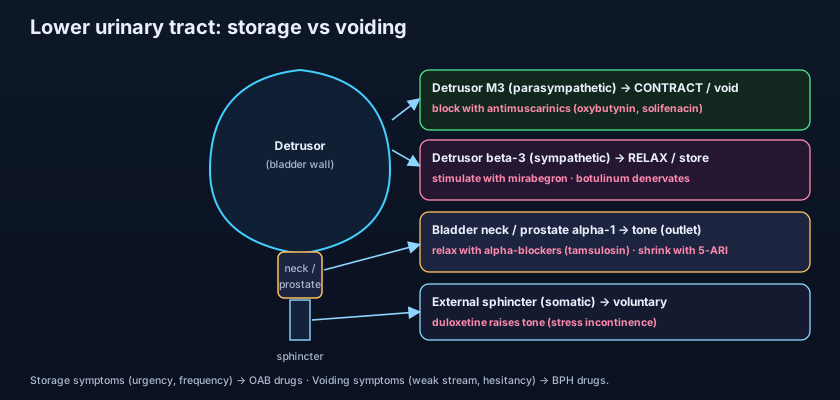
Detrusor, to STORE better: antimuscarinics (oxybutynin, solifenacin, tolterodine) block M3; mirabegron stimulates beta-3. Outlet, to VOID better: tamsulosin (and alfuzosin, doxazosin) block alpha-1; finasteride and dutasteride (5-alpha-reductase inhibitors) shrink the prostate. Sphincter, to HOLD better: duloxetine boosts serotonin/noradrenaline drive to the pudendal sphincter. Read the symptom family first — storage (frequency, urgency, nocturia) versus voiding (hesitancy, weak stream, incomplete emptying) — then pick the line.
- Storage failure (overactive bladder): block M3 with antimuscarinics or stimulate beta-3 with mirabegron.
- Voiding failure (BPH): block alpha-1 with tamsulosin (fast) and/or shrink the gland with a 5-alpha-reductase inhibitor (slow).
- Weak sphincter (stress incontinence): reinforce pudendal drive with duloxetine (adjunct to pelvic-floor training).
- Antimuscarinics carry an anticholinergic burden (dry mouth, constipation, confusion in the elderly); mirabegron spares it but raises BP.
- 5-alpha-reductase inhibitors block testosterone→DHT conversion, so they lower PSA by roughly half and can affect sexual function.
- Always match the drug to the failing state — an antimuscarinic in a man who cannot empty risks acute urinary retention.
- Giving an antimuscarinic for urgency in a man with an obstructing prostate who already empties poorly — weakening the detrusor on top of an obstructed outlet can precipitate acute urinary retention.
- Forgetting that finasteride is teratogenic and lowers PSA by about 50% — women (especially if pregnant) must not handle crushed or broken tablets, and a PSA read for cancer screening must be doubled to interpret it correctly.
- Overlooking the first-dose orthostatic hypotension of alpha-1 blockers, and their intra-operative floppy iris syndrome — take the first dose at night and always warn the ophthalmologist before cataract surgery.
A 70-year-old man reports hesitancy, a weak intermittent stream and a feeling of incomplete emptying, with a moderately enlarged prostate. Which drug most directly relieves the dynamic component of his outlet obstruction and works within days?
- The lower urinary tract alternates between storage (detrusor relaxed, outlet shut) and voiding (detrusor contracts, outlet opens); every drug nudges this balance.
- Receptor map: detrusor M3 (parasympathetic, contract) and beta-3 (relax); bladder-neck/prostate alpha-1 (sympathetic, contract); external sphincter somatic/nicotinic (voluntary).
- Storage symptoms (frequency, urgency, nocturia) → calm the detrusor (antimuscarinics / mirabegron); voiding symptoms (hesitancy, weak stream) → relax or shrink the outlet (tamsulosin / 5-alpha-reductase inhibitors).
- Name the failing state and its receptor before the drug; watch the traps — retention from antimuscarinics in obstruction, floppy iris and postural drop with alpha-blockers, finasteride teratogenicity and its 50% PSA drop.
- Rang & Dale's Pharmacology — The autonomic nervous system and the control of micturition.
- Katzung, Basic & Clinical Pharmacology — Drugs used in the lower urinary tract (cholinoceptor and adrenoceptor agents).
- NICE guideline NG97 — Lower urinary tract symptoms in men: management (assessment, alpha-blockers, 5-alpha-reductase inhibitors).
- NICE guideline NG123 — Urinary incontinence and pelvic organ prolapse in women (antimuscarinics, mirabegron, duloxetine).
- British National Formulary (BNF) — Drugs for urinary frequency, enuresis and incontinence; drugs for urinary retention.
- EAU Guidelines on Management of Non-neurogenic Male LUTS and on Urinary Incontinence.