
Inducing and Augmenting Labour: Oxytocin and Prostaglandins
A pregnancy has run past its date, or a membrane has ruptured with no contractions to follow, or a labour has stalled halfway. In each case the obstetrician must persuade a reluctant uterus to do what it will not do on its own — and there are only two levers to pull. Soften and open the cervix so it will yield, and drive the muscle of the uterine body to contract in a rhythm strong enough to deliver. Two drug families own those two jobs: prostaglandins ripen the cervix, and oxytocin powers the contractions. Learn how each works, and — far more importantly — where each turns dangerous, because the same drugs that start a labour can, pushed too hard, choke the baby of oxygen or poison the mother with water.
A 39-week pregnant woman comes to the labour ward: her waters broke this morning but no contractions have started. On examination her cervix is still long, firm and closed — unfavourable. The plan unfolds in a deliberate order. First a prostaglandin pessary is placed against the cervix overnight to soften and shorten it. By morning the cervix has ripened and opened a little, so a fine catheter delivers a slow, carefully titrated infusion of oxytocin, nudged up drop by drop until she is contracting three or four times every ten minutes. A belt around her abdomen traces two lines the whole time: the tightening of the uterus and the baby's heartbeat. When the contractions crowd too close and the baby's heart rate dips with each one, the infusion is turned down at once — and a tocolytic is drawn up in case the uterus needs to be relaxed. Every step is a lever, and every lever has a limit.
Two jobs: ripen the cervix, contract the uterus
Getting a baby out is two mechanical problems, and each needs a different drug. The uterus is two tissues doing opposite work. The body (fundus) is thick smooth muscle — the myometrium — whose job is to contract and push. The cervix at the bottom is a firm collar of connective tissue whose job, for nine months, is to stay shut and hold the pregnancy in. To deliver, the collar must first soften, thin and open (this is "ripening"), and then the muscle above must contract in a coordinated rhythm to drive the baby through it. Induction that ignores the order fails: pour on contractions against a hard, closed cervix and you get a painful, unproductive, and dangerous labour. So the pharmacology tracks the two jobs — prostaglandins to ripen the cervix, oxytocin to power the contractions — and the art is doing them in sequence.
Prostaglandins: ripening the cervix
Prostaglandins are the natural chemical signals of cervical remodelling — the same lipid mediators you meet in the Inflammation section, here doing reproductive rather than inflammatory work. Given as a vaginal preparation they soften the connective tissue of the cervix and, at the same time, stimulate myometrial contractions, so they can both ripen an unfavourable cervix and get labour going. Two agents dominate. Dinoprostone is PGE2, supplied as a vaginal gel, tablet or slow-release pessary — the standard, licensed cervical-ripening agent, with the advantage that a controlled-release pessary can simply be pulled out if the uterus is over-stimulated. Misoprostol is a PGE1 analogue: cheap, stable at room temperature (no refrigeration), and highly effective, which has made it the workhorse of induction worldwide, especially where cost and cold storage matter. Both share the whole-class hazard — push the dose and you get too many contractions.
Misoprostol is worth a moment's distinction, because you will meet it far beyond the term labour ward. The same drug that induces labour is used — in different doses and regimens — to manage early miscarriage (helping the uterus expel a failed or incomplete pregnancy) and, combined with the anti-progesterone mifepristone, for medical abortion: mifepristone first blocks progesterone to prime and soften the uterus, then misoprostol contracts it. It is the same fundamental pharmacology (a prostaglandin making the uterus contract) applied at different gestations and for different goals. The clinical context, not the molecule, changes.
Oxytocin: the mainstay for augmentation
Once the cervix is favourable, oxytocin is the drug that drives the labour. Oxytocin is a nine-amino-acid peptide made in the hypothalamus and released from the posterior pituitary — physiology you meet in the Endocrine section — and the synthetic version (Syntocinon) is the mainstay for two jobs: augmenting a labour that has started but slowed, and inducing labour once the cervix is favourable and the membranes have ruptured. Its mechanism is direct: it binds oxytocin receptors on the myometrium, triggering a rise in intracellular calcium that produces rhythmic, coordinated contractions. A crucial detail explains why it is a term drug and not an early-pregnancy one: the density of uterine oxytocin receptors climbs steeply towards the end of pregnancy, so the same dose that does little at 20 weeks produces powerful contractions at term. Because its effect is potent and the therapeutic window narrow, oxytocin is never given as a bolus for induction — it is a carefully titrated intravenous infusion, started low and increased in small steps while contractions and the fetal heart are watched, then dialled back the moment the uterus is doing enough.
Think of oxytocin like the accelerator of a car you cannot fully see the road ahead of. A gentle, steady press gets you moving at a safe speed; flooring it doesn't get you there faster — it just spins the wheels and risks a crash. That is why oxytocin is titrated drop by drop rather than given in one push: you are feeling for the smallest pressure that keeps a productive rhythm, and you lift your foot the instant the contractions come too fast. The fetal heart-rate trace is your view of the road.
- Induction has two jobs done by two drug families: ripen the cervix (prostaglandins), then contract the uterus (oxytocin).
- Dinoprostone (PGE2, vaginal gel/pessary) is the standard cervical-ripening agent; a slow-release pessary can be removed if over-stimulated.
- Misoprostol (PGE1 analogue) is cheap, heat-stable and effective — also used for miscarriage management and, with mifepristone, medical abortion.
- Oxytocin (Syntocinon) binds myometrial oxytocin receptors → rhythmic contractions; receptor density rises near term.
- Oxytocin is given as a titrated IV infusion for augmentation and for induction once the cervix is favourable — never as a bolus.
- Any uterotonic can over-drive the uterus, so contractions and the fetal heart are monitored throughout.
The key safety issue: hyperstimulation and fetal distress
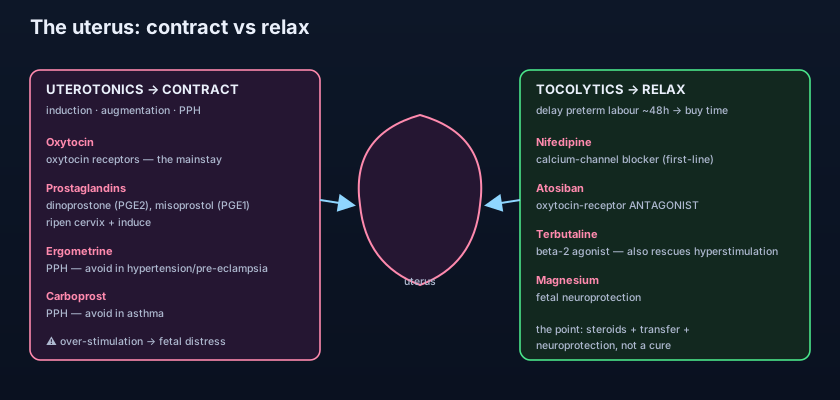
The commonest danger is not too little contraction but too much. The baby is oxygenated through the placenta, and the placenta is perfused between contractions — during a contraction, blood flow through the uterine wall is briefly squeezed off. A normal labour spaces contractions so the placenta refills each time. Push any uterotonic too hard and you get uterine hyperstimulation (tachysystole): contractions too frequent, too prolonged, or with too little relaxation between them. The uterus never gets the chance to refill the placenta, and the baby is progressively starved of oxygen — seen on the trace as fetal heart-rate decelerations and, if unchecked, distress. The response is immediate and mechanical: stop or reduce the uterotonic, reposition the mother and give oxygen and fluids, and if the uterus will not relax, give a tocolytic — typically terbutaline, a beta-2 agonist — to actively quiet the muscle. This is the direct link to the Tocolytics chapter: those drugs are the pharmacological opposite of everything here, used to relax a uterus rather than contract it, and terbutaline on the labour ward is kept precisely as the antidote to hyperstimulation.
Oxytocin carries a second, sneakier hazard that comes straight from its chemistry. Its structure is very close to that of vasopressin (antidiuretic hormone, ADH) — the two peptides differ by only a couple of amino acids — so at high doses oxytocin cross-activates vasopressin receptors in the kidney and exerts an antidiuretic effect: the kidney holds on to water. Give a high-dose, prolonged infusion made up in large volumes of hypotonic (dextrose) fluid, and the retained free water dilutes the blood, producing water intoxication and hyponatraemia — which in the extreme causes confusion, seizures and, in mother or newborn, real harm. The Endocrine section covers this vasopressin overlap in full; the practical lesson here is to run oxytocin in a concentrated form in isotonic saline, keep total fluid volumes modest, and watch for it in any long induction. A milder, more immediate effect is transient hypotension (with a reflex tachycardia) if oxytocin is pushed too fast — another reason it is infused slowly rather than injected.
The single most exam-worthy idea in this whole chapter: every drug that makes the uterus contract shares one dose-limiting toxicity — hyperstimulation that starves the fetus of oxygen. It does not matter whether it is dinoprostone, misoprostol, or oxytocin; the safety principle is identical. Monitor the two traces (contractions and fetal heart rate), and keep a tocolytic within reach as the brake. If you understand that a uterotonic and a tocolytic are the accelerator and the brake of the same organ, you already understand three chapters at once.
When to induce — and when not to
Whether the cervix is ready is scored objectively by the Bishop score, which grades favourability from the cervix's dilatation, effacement (thinning), consistency, position, and the station of the baby's head. A high (favourable) score predicts that induction will succeed easily — often oxytocin and rupturing the membranes are enough; a low (unfavourable) score means the cervix must be ripened with a prostaglandin first. Alongside the drugs are mechanical methods that work by physical pressure rather than pharmacology: a balloon (Foley) catheter passed through the cervix and inflated to dilate it, and a membrane sweep, where an examining finger separates the membranes from the lower uterus to release local prostaglandins and encourage spontaneous labour. These are useful where a drug is contraindicated or best avoided.
The contraindications flow from one question: can this uterus safely contract hard? Because a uterotonic makes the uterus contract forcefully, it is dangerous wherever a forceful contraction would do harm. A uterus with a previous classical (vertical) caesarean scar or other major uterine surgery may rupture along the scar under strong contractions — a catastrophe for mother and baby — so induction is generally contraindicated. Malpresentation such as a transverse lie cannot deliver vaginally, so driving contractions is futile and dangerous. And a baby already showing signs of compromise (a non-reassuring fetal heart trace) should be delivered promptly, usually by caesarean, not subjected to the added stress of induced contractions. In each case the logic is the same: a uterotonic is only safe when a normal vaginal delivery is both possible and safe to pursue.
Oxytocin (Syntocinon) — synthetic; titrated IV infusion; augmentation and induction of the favourable cervix; watch for hyperstimulation and, at high prolonged doses, hyponatraemia. Dinoprostone (PGE2) — vaginal gel/pessary; the standard cervical-ripening agent. Misoprostol (PGE1 analogue) — cheap, heat-stable; induction plus miscarriage and (with mifepristone) medical-abortion regimens. Ergometrine — an ergot alkaloid that causes a sustained tetanic uterine contraction; not used to induce a controlled labour but reserved, usually combined with oxytocin as Syntometrine, for the third stage and postpartum haemorrhage — the subject of the PPH chapter, where these same uterotonics reappear in a completely different context: stopping bleeding after the baby is out. (Ergometrine is contraindicated in hypertension and pre-eclampsia — see the Mistakes below.)
- Hyperstimulation (tachysystole) is the shared, dose-limiting danger of all uterotonics → fetal hypoxia; monitor contractions + fetal heart rate.
- Keep a tocolytic (terbutaline) ready as the antidote to relax an over-stimulated uterus.
- Oxytocin resembles vasopressin — high-dose prolonged infusion in hypotonic fluid causes water intoxication and hyponatraemia.
- The Bishop score grades cervical favourability and decides whether prostaglandin ripening is needed before oxytocin.
- Contraindicated where forceful contraction is unsafe: prior classical caesarean/uterine scar, malpresentation, fetal compromise.
- The same uterotonics (oxytocin, ergometrine, misoprostol) reappear after delivery to treat postpartum haemorrhage.
- Flooding an unfavourable, unripe cervix with oxytocin. Contractions against a hard closed cervix are painful and unproductive — ripen with a prostaglandin first (check the Bishop score).
- Giving ergometrine in a hypertensive or pre-eclamptic mother. Its intense vasoconstriction can spike the blood pressure dangerously — oxytocin is preferred where hypertension is a concern.
- Running high-dose oxytocin in large volumes of dextrose and ignoring fluid balance — the vasopressin-like antidiuresis causes water intoxication and hyponatraemia. Use concentrated oxytocin in isotonic saline and limit total fluids.
A woman receiving a high-dose oxytocin infusion made up in 5% dextrose over many hours for a prolonged induction becomes confused and has a seizure. Her serum sodium is low. What is the mechanism?
- Induction/augmentation has two jobs: ripen the cervix with prostaglandins (dinoprostone PGE2 pessary; misoprostol PGE1 analogue) and contract the uterus with oxytocin.
- Oxytocin (Syntocinon) binds myometrial oxytocin receptors (density rises near term) and is given as a titrated IV infusion for the favourable cervix — never a bolus.
- The shared danger is hyperstimulation → fetal distress; monitor contractions + fetal heart and keep a tocolytic (terbutaline) as the brake.
- Oxytocin's vasopressin similarity causes hyponatraemia at high prolonged doses; contraindications include prior classical caesarean scar, malpresentation and fetal compromise. The same uterotonics reappear for postpartum haemorrhage.
- Rang & Dale's Pharmacology — The reproductive system: drugs affecting uterine motility (oxytocics, prostaglandins, tocolytics).
- Katzung Basic & Clinical Pharmacology — Hypothalamic & pituitary hormones (oxytocin); drugs used in obstetrics.
- NICE guideline NG207: Inducing labour.
- British National Formulary (BNF) — Oxytocin, dinoprostone, misoprostol, ergometrine; prostaglandins and oxytocics.
- WHO recommendations on induction of labour and for the prevention and treatment of postpartum haemorrhage.
- Bishop EH. Pelvic scoring for elective induction. Obstetrics & Gynecology.