
Iron Deficiency and Iron Therapy: Oral, IV, and Why Timing Matters
She is 24, exhausted, breathless on the stairs, and her tablets have turned her stool black. She takes them faithfully — with her morning coffee — and after two months her blood count has barely moved. Nothing is wrong with the iron. Everything is wrong with the timing. Follow one iron atom from the plate to the marrow and you will see exactly where half her dose is lost, why alternate-day dosing can beat daily, and when a tablet is simply the wrong tool.
A young woman sits across from you, pale and tired, her periods heavy for years. You start ferrous sulfate. She does everything right — one tablet each morning, swallowed with a mug of hot tea or coffee to "take it with something." Her stools turn black, which frightens her but is harmless. Yet at follow-up her haemoglobin has crawled up by almost nothing. The iron is not defective and she is not lying about taking it. The problem is that most of each dose never made it across the gut wall — the tea, the timing, and even her own body's traffic-control hormone were fighting the absorption. To fix her, we must follow the metal itself.
Where iron enters: the duodenum and the ferrous switch
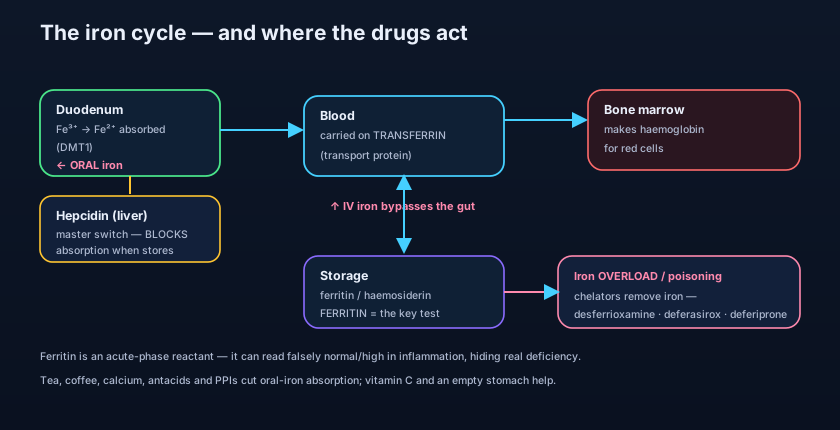
Dietary iron comes in two very different forms. Haem iron, from meat and blood, is absorbed efficiently and almost intact. Non-haem iron, from plants and cereals, is far less available and arrives mostly as ferric iron (Fe³⁺), which the gut cannot take up directly. At the brush border of the duodenum, ferric iron must first be reduced to ferrous iron (Fe²⁺) — helped by stomach acid and by vitamin C — before the divalent metal transporter (DMT1) can carry it into the enterocyte. This single chemistry point explains many bedside choices: acid helps, alkali (antacids, proton-pump inhibitors) hurts, and vitamin C is a genuine aid.
Inside the enterocyte iron faces a fork. It can be exported into the blood through a channel called ferroportin, or it can be locked away in the cell as ferritin and lost when that cell is shed a few days later. Iron that reaches the blood is grabbed by transferrin, the plasma taxi that carries ferric iron safely to the bone marrow, where developing red cells pull it in through transferrin receptors to build haemoglobin. Whatever the body does not need immediately is banked in the liver and macrophages as ferritin (soluble, readily mobilized) and, when stores are heavy, as haemosiderin (dense and slow to release).
The body has no regulated way to EXCRETE iron — no route to actively dump a surplus. It controls its iron balance almost entirely at the front door, by tuning absorption. That one fact underlies both iron-overload disease (once too much is in, it stays in) and the logic of hepcidin, the hormone that guards the door.
Hepcidin: the master regulator at the gate
Hepcidin, made by the liver, is the hormone that decides how much iron enters the circulation. It works by binding ferroportin — the export channel on enterocytes and macrophages — and dragging it inside to be destroyed. When ferroportin is gone, iron is trapped in the gut cells and in the macrophages and cannot reach the blood. So high hepcidin means low iron availability. Hepcidin rises when body iron stores are full (a sensible off-switch) and, crucially, when there is inflammation. In chronic inflammation or infection, high hepcidin walls iron off inside macrophages, starving the marrow despite adequate total stores — this is the anaemia of chronic disease, and it is why oral iron often fails there.
One test sits at the centre of the whole diagnosis: ferritin. Serum ferritin mirrors the body's iron stores, so a low ferritin is the single most specific pointer to iron deficiency — nothing else drives it truly low. But ferritin has a treacherous second job: it is an acute-phase reactant, meaning inflammation, infection, liver disease, and malignancy all push it up regardless of iron status. So a deficient patient who also has an infection or chronic illness can show a normal or even high ferritin and be missed. Read ferritin against the clinical picture and the inflammatory markers, not in isolation.
- Iron is absorbed in the duodenum; ferric (Fe³⁺) must be reduced to ferrous (Fe²⁺) for DMT1 uptake.
- Transferrin transports iron in plasma; ferritin and haemosiderin store it.
- Hepcidin blocks absorption by degrading ferroportin — high when stores are full or in inflammation.
- The body cannot actively excrete iron; balance is set at absorption.
- Low ferritin = deficiency, but it is an acute-phase reactant and can be falsely normal/high in inflammation.
Why she became deficient: the causes
Iron deficiency is never a diagnosis on its own — it is a signpost pointing at a cause. The dominant mechanism worldwide is chronic blood loss, because each millilitre of blood carries about half a milligram of iron out of the body. In women of reproductive age that means heavy menstrual loss; in men and postmenopausal women, unexplained iron deficiency is gastrointestinal bleeding until proven otherwise (ulcers, and colorectal cancer that must be excluded). Other causes are poor intake (strict vegetarian or impoverished diets, low in bioavailable haem iron), malabsorption (coeliac disease, gastrectomy, or the reduced acid of long-term PPI use), and increased demand that outstrips supply — infancy, adolescent growth spurts, and especially pregnancy, where the fetus and expanding blood volume draw heavily on maternal stores.
Oral iron: the first-line workhorse
For most patients, oral iron is first-line: cheap, safe, and effective when given and absorbed correctly. The available salts are all ferrous (the absorbable form) — ferrous sulfate, ferrous fumarate, and ferrous gluconate — and they differ mainly in how much elemental iron each tablet contains, not in some hidden superiority. A therapeutic target of roughly 100–200 mg of elemental iron per day historically meant one tablet two or three times daily, but the whole dose need not be large to work, as the next section explains.
Ferrous sulfate 200 mg tablet delivers about 65 mg of elemental iron; ferrous fumarate 210 mg delivers about 68 mg; ferrous gluconate 300 mg delivers only about 35 mg (a lower-iron, sometimes better-tolerated option). Always prescribe by elemental iron content, not by the salt's total weight — comparing "300 mg gluconate" with "200 mg sulfate" is meaningless until you convert to elemental iron.
Oral iron irritates the gut, and the side effects are the main reason patients stop: nausea, epigastric discomfort, constipation (sometimes diarrhoea), and the harmless black stools that come from unabsorbed iron. These are broadly dose-related, so a lower elemental dose or a switch to a gentler salt often rescues a patient who "cannot tolerate iron." Warn about the black stools in advance — unwarned patients frighten themselves into stopping, or worse, mistake it for gastrointestinal bleeding.
Absorption is a battlefield, and most of it is won or lost at the moment of swallowing. Take iron on an empty stomach, because food — and especially the tannins in tea and coffee, calcium, and dairy — binds iron in the gut and blocks it. Vitamin C (or a glass of orange juice) reduces ferric to ferrous and genuinely improves uptake. Antacids and proton-pump inhibitors raise gastric pH and cut absorption, so separate them or reconsider the PPI. Our patient's morning tablet-with-coffee was close to worst-case: the coffee alone can slash absorption substantially. Move the tablet to a fasting moment, add vitamin C, and drop the coffee near the dose, and the same milligrams suddenly work.
A large single dose of iron transiently spikes hepcidin, which then blunts the absorption of a second dose given the same day or the next morning. Because that hepcidin rise takes about a day to fade, giving iron on ALTERNATE days (or a single daily dose rather than split doses) can absorb a greater fraction and provoke fewer side effects than the traditional two-or-three-times-daily regimen. Less can genuinely be more — a modern, physiology-driven change to how we dose.
Iron rewards patience. The marrow answers first with a reticulocyte rise at about one week — the earliest sign the therapy is working — while the haemoglobin itself climbs only over several weeks, typically around 20 g/L per three to four weeks. Crucially, correcting the haemoglobin is not the finish line: the stores are still empty. Continue iron for about three months after the haemoglobin normalizes to refill ferritin, or the patient simply relapses. Stopping at a normal blood count is one of the commonest reasons iron deficiency comes straight back.
- Prescribe by ELEMENTAL iron; ferrous sulfate/fumarate/gluconate differ mainly in iron content.
- Take on an empty stomach; vitamin C helps; tea, coffee, calcium, antacids and PPIs reduce absorption.
- Alternate-day (or single daily) dosing may absorb better by avoiding the hepcidin spike.
- Response is slow: reticulocytes at ~1 week, Hb over weeks (~20 g/L per 3–4 weeks).
- Continue ~3 months after Hb normalizes to refill stores, or deficiency relapses.
- Black stools are harmless and expected — warn the patient in advance.
IV iron: when the gut is not the answer
Intravenous iron delivers the metal straight into the blood, bypassing the duodenum, hepcidin, and every dietary interference at once. It is reserved for real indications, not convenience: intolerance of or failure to respond to oral iron, genuine malabsorption, chronic kidney disease (especially on dialysis, where erythropoiesis-stimulating agents demand iron), inflammatory bowel disease (where oral iron irritates the gut and inflammation blocks its uptake), and situations needing rapid repletion when there is little time — such as late pregnancy or the run-up to surgery. Modern preparations allow large doses in one or two sittings.
Ferric carboxymaltose and ferric derisomaltose (isomaltoside) both allow large single infusions of over 1000 mg, making one-visit correction possible. Iron sucrose is safe and widely used but delivers smaller doses, so it needs several sessions. The older high-molecular-weight iron dextran carried the greatest anaphylaxis risk and has largely been replaced. Whatever the agent, give it where anaphylaxis can be managed.
IV iron is not risk-free. Infusion reactions range from a transient flush and mild self-limiting symptoms (the Fishbane reaction) to true, if rare, anaphylaxis — so give it with resuscitation facilities and trained staff. A distinctive modern concern is hypophosphataemia, most associated with ferric carboxymaltose: it can drive urinary phosphate wasting and, with repeated dosing, symptomatic low phosphate and even osteomalacia, so phosphate should be monitored with recurrent use. Skin staining at the injection site and, historically, the abandoned deep intramuscular route round out the cautions.
The other extreme: iron overdose
Because the body cannot dump excess iron, an acute overdose is a genuine emergency — and iron tablets, brightly coloured and sugar-coated, are a classic cause of poisoning in young children who mistake them for sweets. The clinical course is deceptive: early vomiting, abdominal pain, and gastrointestinal bleeding, then a treacherous quiet phase, followed by shock, severe metabolic acidosis, and hepatic necrosis as free iron poisons cells. Treatment is supportive resuscitation plus chelation with intravenous desferrioxamine (deferoxamine), which binds free iron and allows it to be excreted in the urine. Keep iron preparations locked away from children — the humble household tablet is a lethal dose in a toddler.
- Giving iron with tea, coffee, a PPI, or calcium and then blaming the drug when it fails — these block absorption.
- Stopping iron the moment the haemoglobin normalizes, while the stores are still empty — guaranteeing relapse.
- Giving iron in anaemia of chronic disease without confirming true deficiency — high hepcidin makes oral iron futile.
- Reading a normal ferritin as "no deficiency" in an inflamed patient — ferritin is falsely raised by inflammation.
- Treating iron deficiency as a diagnosis rather than a symptom — always hunt for the blood-loss source.
A woman with iron-deficiency anaemia has taken ferrous sulfate for two months with little rise in haemoglobin. She swallows each tablet with a mug of tea at breakfast. The single best first step is to:
- Iron is absorbed in the duodenum (Fe³⁺→Fe²⁺, DMT1), carried by transferrin, stored as ferritin, and gated by hepcidin.
- Low ferritin confirms deficiency — but it is an acute-phase reactant, falsely normal/high in inflammation.
- Oral iron first-line: empty stomach, vitamin C helps, tea/coffee/calcium/PPIs hurt; alternate-day may absorb better.
- Response is slow — continue ~3 months after Hb normalizes to refill stores.
- IV iron for intolerance/malabsorption/CKD/IBD/rapid need; watch anaphylaxis and hypophosphataemia.
- Iron overdose (children) is an emergency — chelate with desferrioxamine.
- Rang HP, Dale MM, et al. Rang & Dale's Pharmacology — Haematopoietic system: iron, iron therapy & iron overload.
- Katzung BG. Basic & Clinical Pharmacology — Agents used in anaemias: iron, oral and parenteral preparations, acute iron toxicity.
- Hoffbrand AV, Moss PAH. Hoffbrand's Essential Haematology — Iron metabolism, hepcidin, iron-deficiency anaemia & its treatment.
- Brunton LL, et al. Goodman & Gilman's The Pharmacological Basis of Therapeutics — Haematopoietic agents: iron and deferoxamine.
- Camaschella C. Iron-deficiency anaemia (review of hepcidin physiology and alternate-day oral iron dosing).