
How Blood Is Made: Haematopoiesis and Where the Drugs Act
Right now, in the marrow of your bones, roughly two million red cells are being finished every single second — and just as many worn-out ones are being retired. It is the busiest factory in the body, and it never closes. This chapter is the map of that factory: the one stem cell everything descends from, the three signals that drive the main production lines, and — the point of the whole Hematology section — exactly where each drug reaches in to speed the line up, restock its raw materials, or shut it down.
Picture a factory floor that runs at two million units per second and has done so, without a break, since before you were born. That factory is your bone marrow, and the units are red blood cells — plus platelets, neutrophils, monocytes and lymphocytes rolling off adjacent lines. It is silent, it is invisible, and you never think about it — until a drug touches it. Speed the line up with erythropoietin and blood thickens. Starve it of iron and the line stalls, half-built cells shipped out small and pale. Poison it with chemotherapy and every line goes quiet at once — which is why the patient bleeds, catches infections and tires. Understand this one factory and every drug in this section suddenly has an address.
One ancestor for everything: the haematopoietic stem cell
Every blood cell — red or white — traces back to a single kind of cell. That cell is the haematopoietic stem cell (HSC), a rare resident of the bone marrow with two almost magical properties: it can self-renew (make more copies of itself, so the supply never runs out) and it can differentiate (mature into any blood cell the body needs). From this one ancestor the family tree splits into two great branches. The myeloid lineage gives rise to red cells (erythrocytes), platelets (from megakaryocytes), and most white cells — neutrophils and the other granulocytes, plus monocytes. The lymphoid lineage gives rise to the lymphocytes: B cells, T cells and natural killer (NK) cells.
Hold on to one idea and half of haematology falls into place: red cells and white cells are NOT rivals from separate factories — they are siblings from the same HSC. That is why a drug that hits the stem-cell compartment (say, chemotherapy) drops the red count, the white count AND the platelet count together. When you see all three lines fall at once (pancytopenia), suspect a problem at the trunk of the tree, not at one branch.
The three signals that drive the lines: EPO, TPO, G-CSF
A stem cell will not commit to a lineage on its own — it waits for a signal. Those signals are the haematopoietic growth factors (colony-stimulating and related hormones), and three of them do the heavy lifting you must know. Erythropoietin (EPO), made by the kidney in response to low oxygen, drives red-cell production — climb a mountain and your kidneys pour out EPO to build more oxygen-carriers. Thrombopoietin (TPO), made mainly by the liver, drives megakaryocytes to shed platelets. Granulocyte colony-stimulating factor (G-CSF), released during infection, drives the neutrophil line and pushes mature neutrophils out of the marrow into the blood. Each factor is a throttle on one production line — and each, as we will see, has been turned into a drug.
- All blood cells arise from one self-renewing haematopoietic stem cell (HSC).
- Two branches: myeloid (red cells, platelets, neutrophils, monocytes) and lymphoid (B, T, NK).
- EPO (kidney) → red cells; TPO (liver) → platelets; G-CSF → neutrophils.
- Growth factors are the throttles: each drives one line, and each is now a drug.
- Hit the trunk (stem cells) and all three lineages fall together (pancytopenia).
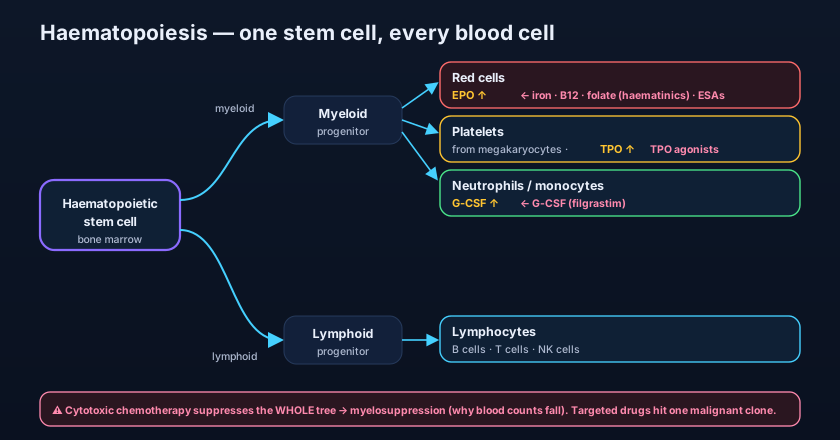
Mapping the drugs onto the tree
Here is the payoff — the reason to learn the factory before the pharmacology. Every drug group in this Hematology section acts at one of four addresses on the tree. First, the haematinics — iron, vitamin B12 and folate — supply the RAW MATERIALS the red-cell line needs; without them the line runs but builds defective cells (this is the whole story of anaemia we cover next). Second, the growth-factor agents — the erythropoiesis-stimulating agents (ESAs), G-CSF and the TPO-receptor agonists — push the marrow HARDER by copying the natural throttles. Third, cytotoxic chemotherapy suppresses the WHOLE tree because it kills fast-dividing cells, and marrow is the fastest-dividing tissue there is — hence its signature blood toxicity. Fourth, targeted agents aim at a single malignant CLONE — one branch gone rogue — sparing the rest of the tree.
Raw materials: ferrous sulfate (oral iron), hydroxocobalamin (B12) and folic acid restock the red-cell line. Harder push: epoetin alfa / darbepoetin (ESAs) for the anaemia of chronic kidney disease; filgrastim (G-CSF) to rescue neutrophils after chemotherapy; eltrombopag / romiplostim (TPO agonists) to lift platelets. Whole-tree suppression: cytarabine or cyclophosphamide, whose predictable side effect is marrow suppression. Single clone: imatinib, a targeted tyrosine-kinase inhibitor that switches off the one abnormal signal driving chronic myeloid leukaemia — attacking the rogue branch while the tree survives.
This is why chemotherapy's classic toxicities are a delayed drop in blood counts. Neutrophils fall first (short-lived, so the shortage shows within about a week — the nadir), platelets next, and red cells last, because circulating red cells live around 120 days and the shelf stays stocked longest. Read a post-chemo blood count in that order and you can practically date the last dose.
- Haematinics (iron, B12, folate) = raw materials for the red-cell line.
- ESAs, G-CSF and TPO agonists = copy the natural throttles to push the marrow harder.
- Cytotoxic chemotherapy suppresses the whole tree — marrow is the fastest-dividing tissue.
- Targeted agents (e.g., imatinib) attack one malignant clone, sparing normal marrow.
- Cell lifespan sets the order of toxicity: neutrophils fall first, red cells last.
What the rest of this section builds on this map
Keep this tree open as your table of contents. The next chapters walk down the red-cell line into the anaemias and the haematinics that treat them. A dedicated growth-factor chapter takes the throttles further — the ESAs, G-CSF and TPO-receptor agonists and how we use them safely. Later chapters turn to the branches that have gone malignant: the blood cancers — the leukaemias and lymphomas — where cytotoxic chemotherapy suppresses the whole tree and targeted agents pick off a single clone. When you meet marrow suppression as the dose-limiting toxicity in those chapters, it is this same trunk being hit. Every drug you meet from here has a home on this one diagram.
- Believing red cells and white cells come from separate stem cells. Both descend from the single HSC — that is why one insult can drop every line.
- Assuming chemotherapy hits only the cancer. It hits every fast-dividing tissue, and the marrow divides fastest — hence the predictable blood toxicity.
- Thinking EPO raises white cells or platelets. Each growth factor drives its own line only: EPO → red, G-CSF → neutrophils, TPO → platelets.
- Confusing a raw-material problem with a signal problem. Iron/B12/folate lack starves the line; ESAs push a line that may still lack materials.
A patient receiving cytotoxic chemotherapy develops a fall in red cells, white cells AND platelets together. This pattern is best explained by the drug acting at:
- One haematopoietic stem cell (HSC) gives rise to every blood cell via a myeloid and a lymphoid branch.
- Three growth factors are the main throttles: EPO → red cells, TPO → platelets, G-CSF → neutrophils.
- Four drug addresses: haematinics supply raw materials; ESAs/G-CSF/TPO agonists push harder; chemo suppresses the whole tree; targeted agents hit one clone.
- Because the marrow is shared and fast-dividing, chemo's blood toxicity is predictable — neutrophils fall first, red cells last.
- Hoffbrand AV, Steensma DP. Hoffbrand's Essential Haematology — Haemopoiesis, stem cells & growth factors.
- Rang HP, Dale MM, et al. Rang & Dale's Pharmacology — Haematopoietic system & haematinic / growth-factor agents.
- Katzung BG. Basic & Clinical Pharmacology — Agents used in anaemias; haematopoietic growth factors.
- Brunton LL, et al. Goodman & Gilman's The Pharmacological Basis of Therapeutics — Haematopoietic agents.
- Hoffman R, et al. Hematology: Basic Principles and Practice — Haematopoietic stem cells & lineage commitment.