
Colony-Stimulating Factors and Platelet Agonists: Rebuilding the Marrow
Erythropoietin already taught us that we can order the bone marrow to build more of one cell line on demand — for red cells. But the marrow is a tree with three great branches, and each has its own hormone. This chapter meets the drugs that pull up the other two branches: G-CSF to raise neutrophils and rescue a chemotherapy patient from deadly infection, and TPO receptor agonists to raise platelets and spare a patient the surgeon's knife. One growth factor per lineage — a precise lever on the haematopoiesis tree.
Ten days after her chemotherapy, a woman with breast cancer feels a fever climb and a shaking chill. Her blood count tells the real danger: her neutrophils — the front-line soldiers against bacteria — have crashed almost to zero. This is febrile neutropenia, and without those cells an ordinary infection can kill within hours. The oncologist orders an injection under the skin. It is not an antibiotic. It is a growth factor, G-CSF, and its only job is to shout at the marrow's neutrophil line: make more, faster. Over the next days the count climbs back out of the danger zone. In another room a young man with immune thrombocytopenia (ITP) has platelets so low he bruises at a touch — the standard next step used to be removing his spleen. Instead he swallows a daily tablet, a TPO agonist, and his platelets rise. Two patients, two branches of the same tree, two hormones summoned by prescription.
One tree, three hormones
All blood cells grow from one stem cell in the marrow. From that single haematopoietic stem cell the marrow branches into three great lineages we care about clinically: red cells, the white-cell line that includes neutrophils, and the platelet line born from megakaryocytes. Each branch is coaxed forward by its own naturally occurring growth factor — a hormone that binds a receptor and tells that lineage to divide and mature. Biotechnology has copied each of these hormones as a recombinant drug, so we can now selectively boost whichever branch a patient is short of. Erythropoietin (EPO) does this for red cells and was covered earlier; here we meet its two siblings.
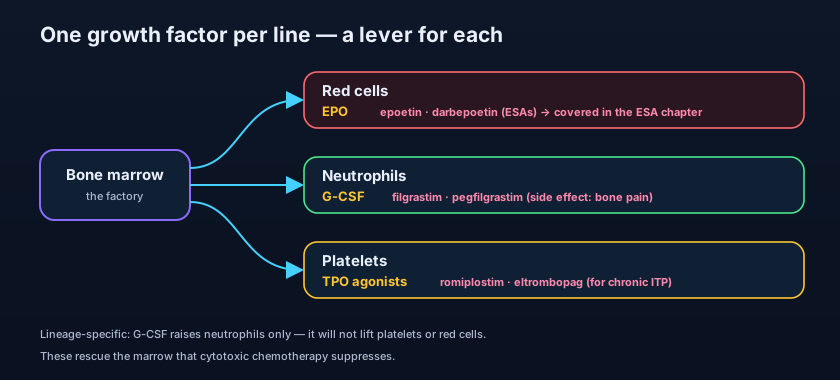
Keep the map fixed in mind, because it prevents almost every exam error in this topic: EPO drives red cells, G-CSF drives neutrophils, and TPO receptor agonists drive platelets. Each drug is lineage-specific — it lifts one line and one line only. Reach for the wrong one and you will wait for a rise in a cell type the drug simply cannot touch.
The whole chapter collapses into one sentence: red = EPO, white (neutrophils) = G-CSF, platelets = TPO agonists. If you can name the deficient lineage on a blood count, you can name the growth factor.
G-CSF: the neutrophil factory's foreman
Granulocyte colony-stimulating factor (G-CSF) binds receptors on neutrophil precursors and drives them to proliferate, mature and leave the marrow into the blood. The recombinant drugs are filgrastim, its long-acting pegylated form pegfilgrastim (which lasts long enough for a single dose per chemotherapy cycle), and lenograstim. Their headline use is chemotherapy-induced neutropenia: given after cytotoxic chemotherapy, they shorten the depth and duration of the neutrophil nadir and so prevent or cut short febrile neutropenia — the very emergency in our scene. They are also used in severe congenital neutropenia, where the marrow chronically fails to make enough neutrophils.
G-CSF has a second, cleverer trick. Beyond making more neutrophils, G-CSF can mobilise haematopoietic stem cells out of the marrow and into the circulating blood. Before a stem-cell (bone-marrow) transplant, we give the donor — or the patient about to receive their own cells back — several days of G-CSF; the stem cells spill into the bloodstream where they can be collected by apheresis, far more gently than harvesting marrow from bone. So the same molecule serves two jobs: raising the neutrophil count, and stocking the collection bag before a transplant.
A patient on a chemotherapy regimen with a high risk of febrile neutropenia receives a single subcutaneous dose of pegfilgrastim about a day after each cycle. Its pegylated tail slows clearance so one injection covers the whole nadir, unlike plain filgrastim, which is given as daily injections. The commonest complaint is bone pain — a dull ache in the back and long bones as the busy marrow expands. It is a sign the drug is working, and it is usually managed with simple analgesics.
There is also GM-CSF (granulocyte-macrophage colony-stimulating factor), the drug sargramostim, which stimulates a broader range of white cells. It is used less often than G-CSF; for the exam, remember G-CSF (filgrastim) as the default neutrophil driver and GM-CSF as its broader, less-used cousin.
- G-CSF (filgrastim, pegfilgrastim, lenograstim) stimulates NEUTROPHIL production only.
- Main use: chemotherapy-induced neutropenia — prevent or shorten febrile neutropenia.
- Also used in severe congenital neutropenia.
- Mobilises stem cells into the blood for apheresis collection before a transplant.
- Classic side effect: bone pain from the expanding marrow.
- GM-CSF (sargramostim) is broader-acting and used less often.
TPO receptor agonists: forcing the platelet line
Thrombopoietin (TPO) is the natural hormone that drives megakaryocytes to make platelets. Rather than give TPO itself, we use TPO receptor agonists — molecules that switch on the same receptor. Romiplostim is an injectable "peptibody" (a peptide fused to an antibody fragment) given subcutaneously once weekly. Eltrombopag and avatrombopag are oral small molecules that bind a different part of the receptor and are taken as tablets. All three end in the same result: more megakaryocyte activity and a rising platelet count.
Their central role is in chronic immune thrombocytopenia (ITP) that has failed first-line therapy — an autoimmune disease in which antibodies destroy platelets. When steroids and other first-line measures fail, a TPO agonist can raise the count enough to protect the patient and, importantly, may let them avoid splenectomy (surgical removal of the spleen). They also have a role in some cases of aplastic anaemia, where the marrow is broadly failing. Eltrombopag additionally is used to raise platelets before procedures in patients with chronic liver disease, whose diseased liver makes too little natural TPO.
A patient with chronic ITP relapses every time their steroid dose is lowered, and platelets sit dangerously low. The old fork in the road was splenectomy. Instead the haematologist starts oral eltrombopag; the platelet count climbs into a safe range and the operation is shelved. The lesson: a TPO agonist tells the body to MAKE more platelets. This is entirely different from a platelet transfusion, which pours in ready-made platelets from a donor for an immediate but short-lived lift in an acute bleed.
- TPO receptor agonists stimulate PLATELET production via megakaryocytes.
- Romiplostim = injectable peptibody (weekly SC); eltrombopag and avatrombopag = oral tablets.
- Main use: chronic ITP refractory to first-line therapy — can avoid splenectomy.
- Also used in some aplastic anaemia.
- Eltrombopag: raises platelets before procedures in chronic liver disease.
- They MAKE platelets — not the same as transfusing ready-made ones.
These drugs rarely work alone. They sit at the crossroads of several other topics. The recombinant erythropoietins (ESAs) that raise red cells are the third member of this family and were covered in the earlier ESA chapter. The chemotherapy-induced marrow suppression that G-CSF and TPO agonists rescue comes straight out of the blood-cancer chapters, where the cytotoxic drugs that flatten the marrow live. And ITP, the leading reason to reach for a TPO agonist, is an autoimmune disease — its first-line treatments belong to the inflammation and immunosuppression section. Read across those chapters and this one clicks into a larger map.
- Giving G-CSF and expecting it to raise platelets or red cells. It is lineage-specific — it lifts neutrophils only.
- Forgetting bone pain as the classic, expected side effect of G-CSF.
- Confusing TPO agonists (tell the body to MAKE platelets over days) with a platelet transfusion (ready-made platelets for an immediate, short-lived rise).
- Assuming EPO, G-CSF and TPO agonists are interchangeable. Each drives a different branch of the marrow.
A patient develops febrile neutropenia one week after chemotherapy. Which growth factor is indicated to raise the deficient cell line?
- One growth factor per lineage: EPO → red cells, G-CSF → neutrophils, TPO agonists → platelets.
- G-CSF (filgrastim, pegfilgrastim) treats chemo-induced neutropenia and mobilises stem cells; classic side effect is bone pain.
- TPO agonists (romiplostim injectable; eltrombopag, avatrombopag oral) raise platelets in refractory ITP and can avoid splenectomy.
- Each drug is lineage-specific — match the drug to the deficient cell line, and don't confuse making platelets with transfusing them.
- Katzung BG. Basic & Clinical Pharmacology — Agents used in anemias & haematopoietic growth factors (G-CSF, GM-CSF, thrombopoietic agents).
- Rang HP, Dale MM, et al. Rang & Dale's Pharmacology — Haemopoietic growth factors & colony-stimulating factors.
- Brunton LL, et al. Goodman & Gilman's The Pharmacological Basis of Therapeutics — Haematopoietic agents: growth factors, minerals & vitamins.
- Whalen K. Lippincott Illustrated Reviews: Pharmacology — Colony-stimulating factors & thrombopoietin receptor agonists.
- Provan D, et al. International consensus report on the diagnosis and management of immune thrombocytopenia — TPO receptor agonists in ITP.