
Sickle Cell Disease: The Drugs That Change the Course
A single letter is wrong in the DNA, and a child grows up counting years in hospital admissions. For decades all we offered was pain relief and transfusions. Then came a daily capsule that switches a silenced fetal gene back on, an antibody that unglues cells from vessel walls, and a molecule that keeps haemoglobin in the shape that never sickles. This is the story of how sickle cell disease went from a life managed to a disease modified.
It is 3 a.m. and a seven-year-old is curled on the emergency bed, sobbing that his legs and back are on fire. There is no cut, no fracture, no infection to point to — his blood cells have turned to tiny sickles and jammed the small vessels feeding his bones, starving them of oxygen. This is a vaso-occlusive crisis, and by now the staff know him by name; he has been here more times than he has had birthdays. Months later he is back — but not in crisis. He is here for a routine check, taking one capsule every morning that has quietly rewritten his year: fewer crises, fewer nights like that one. The capsule is hydroxyurea, and it works by waking a gene his body switched off before he was born.
One mutation, one polymer, two disasters
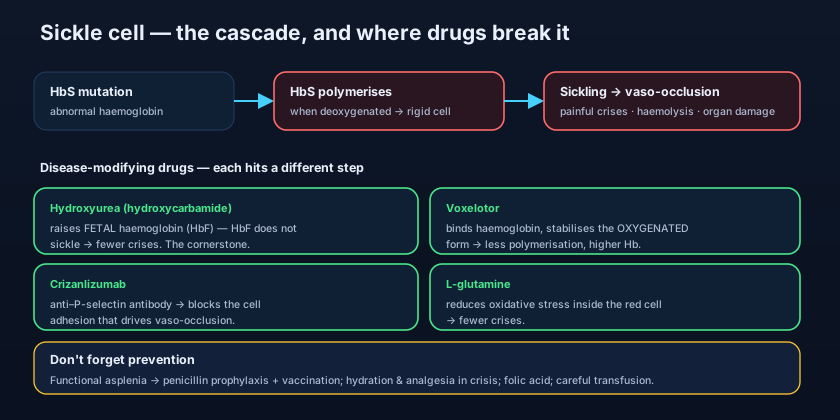
The whole disease starts from a single point mutation. In the β-globin gene, one amino acid is swapped — glutamate becomes valine at position 6 — producing an abnormal haemoglobin called haemoglobin S (HbS). In the oxygenated state HbS behaves almost normally. But when it gives up its oxygen — in a tissue that is hypoxic, acidic, or cold — HbS molecules stick to one another and polymerise into long stiff fibres. Those fibres distort the once-flexible red cell into the rigid, crescent (sickle) shape that gives the disease its name.
From that one polymer flow two separate disasters. First, the rigid sickled cells cannot glide through capillaries; they clump, stick to the vessel wall, and block blood flow — vaso-occlusion — causing the agonising pain crises and, over years, silent damage to bone, kidney, lung, brain and spleen. Second, the abused, deformed cells are fragile and die early — chronic haemolysis — giving anaemia, jaundice and gallstones. Understanding these two arms is the key to the drugs: some aim at the polymer itself, some at the sticky occlusion, some at the fragile cell.
The trigger list is worth memorising because it is also the prevention list: Hypoxia, Dehydration, Infection, acidosis, and Cold. Anything that makes HbS give up oxygen or concentrates the cell drives polymerisation. Half of managing sickle cell is simply keeping the patient warm, hydrated, oxygenated and free of infection.
The cornerstone: hydroxyurea and the fetal-haemoglobin switch
Before birth we all make a different haemoglobin. The fetus runs on fetal haemoglobin (HbF), which has γ-chains instead of β-chains — so it carries no valine mutation and cannot join the HbS polymer. HbF physically gets in the way of sickling. Around birth the body switches from HbF to adult HbA (or, in this disease, HbS), and the protection fades. The whole idea of hydroxyurea (also called hydroxycarbamide) is to switch some of that fetal haemoglobin back on. By raising HbF inside the red cells, it dilutes HbS and blocks polymerisation from within.
Hydroxyurea does more than raise HbF. It lowers the neutrophil and reticulocyte counts, and reduces the stickiness (adhesion) of white cells and red cells to the vessel wall — several of the mechanisms that drive vaso-occlusion at once. The clinical payoff, proven in landmark trials, is real: fewer pain crises, fewer episodes of acute chest syndrome, fewer hospital admissions, and a reduced need for blood transfusion. It is the cornerstone disease-modifying therapy and, in most guidelines, should be offered to essentially all patients with significant sickle cell disease, started early.
Hydroxyurea is the same cytoreductive drug used in myeloproliferative neoplasms (like polycythaemia vera and essential thrombocythaemia) to bring down overproduced blood cells — see the Myeloproliferative neoplasms chapter. Same molecule, completely different rationale: there it lowers cell counts; here its prize is the rise in HbF. Recognising the overlap helps you remember its marrow-suppressing side effects (neutropenia, macrocytosis) in both settings.
- Sickle cell disease = one point mutation (Glu→Val) making HbS.
- Deoxygenated HbS polymerises → rigid sickle cells → vaso-occlusion + haemolysis.
- Triggers = hypoxia, dehydration, infection, acidosis, cold.
- Fetal haemoglobin (HbF) cannot join the polymer and physically blocks sickling.
- Hydroxyurea raises HbF (plus lowers adhesion) → fewer crises, less transfusion.
The newer targeted drugs: three different points of attack
Around the cornerstone, three newer drugs each attack a different link in the chain. L-glutamine works on the fragile cell: sickle red cells suffer heavy oxidative stress, and L-glutamine feeds the antioxidant machinery (NAD redox balance) that defends them, cutting the frequency of pain crises. Voxelotor works on the polymer directly: it binds haemoglobin and stabilises it in its oxygenated (R-state) shape, which is far less likely to polymerise — this both reduces sickling and raises the haemoglobin level, easing the anaemia. Crizanlizumab works on the occlusion: it is a monoclonal antibody against P-selectin, the adhesion molecule on the vessel wall that acts like glue, tethering cells to the endothelium; block P-selectin and cells stop sticking, so fewer vaso-occlusive crises occur.
A clean way to hold all four in your head. Map each drug to the step it interrupts. Hydroxyurea and voxelotor both reduce polymer formation, but by different routes — one dilutes HbS with HbF, the other locks HbS in the un-sickling shape. Crizanlizumab attacks the adhesion step downstream of the polymer. L-glutamine props up the exhausted cell's defences. None of them cures the underlying gene; they modify how badly it expresses itself. Cure requires replacing the faulty blood-forming cells altogether.
Cure on the horizon: transplant and gene therapy
The only established cure is an allogeneic haematopoietic stem-cell transplant — replacing the patient's marrow with a healthy donor's, so the new red cells carry normal β-globin. It can be curative, but it needs a matched donor and carries the real risks of graft-versus-host disease and transplant-related toxicity, which limits who can have it. More recently, gene therapy and gene editing have moved from dream to approved reality: the patient's own stem cells are collected and genetically modified — either to add a working globin gene or to re-activate fetal haemoglobin (for example by editing BCL11A, the switch that normally silences HbF) — then given back. These autologous approaches avoid the donor-matching problem and are reshaping what a cure can mean.
The backbone nobody should skip: supportive care and prevention
Disease-modifying drugs do not replace the basics. During an acute crisis the pillars are simple and urgent: aggressive hydration to keep cells from concentrating, prompt and adequate analgesia (often opioids for severe pain), oxygen if hypoxic, and treating any precipitating infection. Between crises, prevention does the heavy lifting. Because repeated splenic infarction leaves these patients functionally asplenic, they cannot fight encapsulated bacteria — so they need penicillin prophylaxis (especially in early childhood) and vaccination against pneumococcus, meningococcus and Haemophilus influenzae. Daily folic acid supports the marrow's high red-cell turnover. And blood transfusion, used judiciously (for acute chest syndrome, stroke prevention, severe anaemia), can be life-saving.
Every unit of blood brings iron the body cannot excrete, so repeatedly transfused patients accumulate toxic iron in the heart, liver and endocrine glands. That is why chronic transfusion is paired with iron chelation using drugs like deferasirox, deferiprone or desferrioxamine to pull the excess iron out — the same iron-overload problem covered in depth in the Thalassaemia and iron chelation chapter. Transfuse when you must, but respect the iron bill that comes with it.
- L-glutamine ↓ oxidative stress in red cells → fewer crises.
- Voxelotor stabilises oxygenated Hb (less polymer) → raises haemoglobin.
- Crizanlizumab is an anti–P-selectin antibody → blocks adhesion/vaso-occlusion.
- Allogeneic transplant and gene therapy/editing are the curative options.
- Functional asplenia → penicillin prophylaxis + vaccination are non-negotiable.
- Judicious transfusion + folic acid + iron chelation for overload.
- Withholding hydroxyurea for fear of its marrow effects — it is the proven disease-modifier, and monitored dosing is safe and effective for most patients.
- Forgetting penicillin prophylaxis and vaccines in these functionally asplenic patients — an overwhelming pneumococcal infection can be fatal.
- Treating only the pain and never the disease — analgesia manages a crisis but does nothing to stop the next one; the disease-modifying drug does.
- Transfusing chronically without iron chelation — accumulated iron silently poisons the heart and liver.
Which mechanism best explains how hydroxyurea reduces vaso-occlusive crises in sickle cell disease?
- One mutation makes HbS, which polymerises when deoxygenated → sickling, vaso-occlusion and haemolysis.
- Hydroxyurea is the cornerstone — it raises HbF and lowers adhesion → fewer crises.
- L-glutamine (↓oxidative stress), voxelotor (stabilises oxy-Hb), crizanlizumab (blocks P-selectin) each hit a different step.
- Cure = allogeneic transplant or gene therapy/editing; the backbone is prophylactic penicillin, vaccines, folate, judicious transfusion + chelation.
- Hoffbrand AV, Moss PAH. Hoffbrand's Essential Haematology — Sickle cell disease: pathophysiology, hydroxyurea and management.
- Ware RE, de Montalembert M, Tshilolo L, Abboud MR. Sickle cell disease. Lancet 2017.
- Kato GJ, et al. Sickle cell disease. Nature Reviews Disease Primers 2018.
- Vichinsky E, et al. Voxelotor / HOPE trial — haemoglobin response in sickle cell disease. NEJM 2019.
- Ataga KI, et al. Crizanlizumab (SUSTAIN) for sickle cell pain crises. NEJM 2017.
- Niihara Y, et al. L-glutamine therapy for sickle cell disease. NEJM 2018.
- Frangoul H, et al. CRISPR-Cas9 gene editing (BCL11A) for sickle cell disease. NEJM 2021.