
Haemostasis: The Map of Where Every Clotting Drug Acts
There are dozens of drugs that touch a clot — aspirin, clopidogrel, heparin, warfarin, apixaban, alteplase, tranexamic acid — and students memorize them as a scattered list. But they are not scattered. Every one of them aims at exactly one of THREE steps in the body's own clotting story: build the platelet plug, reinforce it with fibrin, or dissolve it away. Learn the map first, and each drug clicks into a single, obvious slot. This chapter is that map — the detailed pharmacology of each class lives in its own chapter.
You nick your finger on a sheet of paper. For a heartbeat, blood wells up — then it stops. Watch closely what just happened in three acts. First, tiny platelets rush to the tear and pile into a soft plug, like sandbags thrown against a leak. Second, an invisible chemical relay lays down threads of fibrin over the sandbags — a mesh that turns the soft plug into a firm, welded clot. Third, once the wall behind is healed, a cleanup crew quietly dissolves the clot and washes it away. Three steps: plug, reinforce, tidy. Now here is the whole point of pharmacology: a drug can be aimed at ANY one of those three steps — to hold a clot back, or to tear it down.
The big picture: three phases, three drug jobs
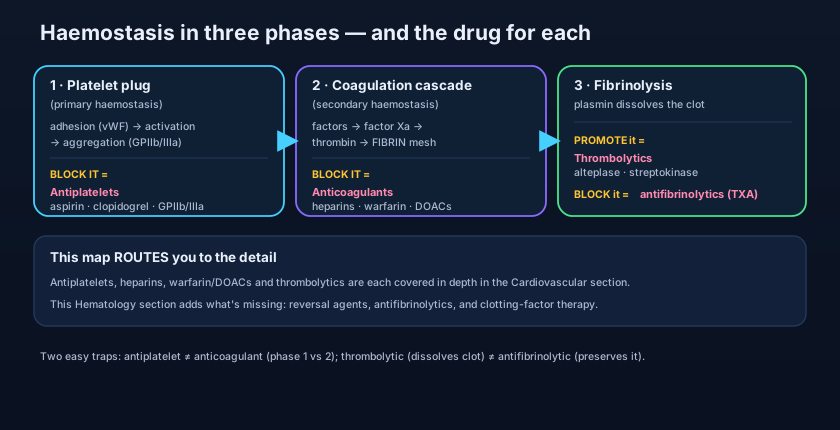
Haemostasis (Haemostasis) is the body stopping its own bleeding. It unfolds in three ordered phases. Primary haemostasis builds the soft platelet plug. Secondary haemostasis is the coagulation cascade (Coagulation cascade) that reinforces the plug with fibrin. Fibrinolysis (Fibrinolysis) later dissolves the clot when it is no longer needed. Match each phase to the drug that touches it and the entire pharmacology of clotting collapses into a tidy table: block the platelet plug with ANTIPLATELETS, block the cascade with ANTICOAGULANTS, and either promote breakdown with FIBRINOLYTICS or preserve the clot with ANTIFIBRINOLYTICS.
One sentence to carry the whole chapter: antiplatelets fight the PLUG, anticoagulants fight the MESH, and fibrinolytics/antifibrinolytics fight over the CLEANUP. If you can name which of the three a drug touches, you already understand its indication, its main risk (bleeding), and why you'd never casually stack two from different phases without reason.
Phase 1 — Primary haemostasis: the platelet plug
When a vessel wall tears, the platelets act in three quick beats. Adhesion: the platelet grabs the exposed collagen, bridged by von Willebrand factor (von Willebrand factor, vWF) that clips onto the platelet's GPIb receptor. Activation: the stuck platelet fires off chemical signals — chiefly ADP and thromboxane A2 (Thromboxane A2, TXA2) — which recruit and switch on more platelets. Aggregation: activated platelets expose their GPIIb/IIIa receptors, which cross-link to one another using fibrinogen as the rope. Adhere, activate, aggregate — and the soft plug is built.
Each antiplatelet class jams one of those three beats. Aspirin irreversibly blocks COX-1, so the platelet can no longer make thromboxane A2 (it hits ACTIVATION). Clopidogrel and ticagrelor block the P2Y12 ADP receptor, silencing the ADP signal (also ACTIVATION). Abciximab and the other 'GPIIb/IIIa inhibitors' block the final common receptor, so platelets cannot cross-link (they hit AGGREGATION). Notice they all serve arterial, platelet-rich clots — the classic setting is coronary artery disease. Their detailed pharmacology is covered in the Cardiovascular section.
- Primary haemostasis = the platelet plug: adhesion → activation → aggregation.
- Adhesion needs von Willebrand factor bridging collagen to platelet GPIb.
- Activation is driven by ADP and thromboxane A2.
- Aggregation = GPIIb/IIIa receptors cross-linking via fibrinogen.
- Antiplatelets block phase 1: aspirin (TXA2), clopidogrel/ticagrelor (P2Y12), abciximab (GPIIb/IIIa).
Phase 2 — Secondary haemostasis: the coagulation cascade
The soft plug would wash away without reinforcement. So a chain reaction of clotting factors — the coagulation cascade — welds it down. Two arms feed in: the intrinsic pathway (triggered by contact within the vessel) and the extrinsic pathway (triggered by tissue factor from damaged tissue). Both arms converge on a single hinge: the activation of factor X. Activated factor X (Xa) then converts prothrombin into thrombin (factor IIa), and thrombin is the master switch — it turns soluble fibrinogen into the sticky fibrin threads that mesh over the platelet plug. Two paths in, one funnel: X → thrombin → fibrin.
Anticoagulants attack the cascade, not the platelets. Heparins work indirectly: they supercharge the natural inhibitor antithrombin, which then shuts down factor Xa and thrombin (IIa). Warfarin blocks the recycling of vitamin K, so the liver cannot finish the vitamin-K-dependent factors II, VII, IX and X — a slow, oral effect. The DOACs (direct oral anticoagulants) hit a single target directly: apixaban and rivaroxaban are direct factor Xa inhibitors, while dabigatran is a direct thrombin (IIa) inhibitor. All four families lower the mesh; all are detailed in the Cardiovascular section. Anticoagulants are the drugs for venous, fibrin-rich clots (DVT, PE, atrial-fibrillation stroke prevention).
- Secondary haemostasis = the coagulation cascade that lays down fibrin.
- Intrinsic + extrinsic pathways converge on factor X → thrombin (IIa) → fibrin.
- Heparins act indirectly via antithrombin on Xa and IIa.
- Warfarin blocks vitamin-K-dependent factors II, VII, IX, X.
- DOACs are direct: apixaban/rivaroxaban (Xa), dabigatran (IIa).
- Anticoagulants suit venous, fibrin-rich clots; antiplatelets suit arterial ones.
Phase 3 — Fibrinolysis: dissolving the clot
A clot is temporary scaffolding. Once the wall behind it heals, the body must clear it away — or the vessel would stay blocked. The demolition enzyme is plasmin, cut from its inactive precursor plasminogen by tissue plasminogen activator (tPA). Plasmin chews the fibrin mesh into soluble fragments and the clot melts. This is the third handle a drug can grab — and pharmacology pulls it in both directions.
To PROMOTE dissolution, we give fibrinolytics (thrombolytics) such as alteplase (a recombinant tPA) or streptokinase: they boost plasmin and blast open a fresh, life-threatening clot — a blocked coronary or an ischaemic stroke. Their detailed use lives in the Cardiovascular section. To BLOCK dissolution and PRESERVE a clot, we give antifibrinolytics such as tranexamic acid, which stops plasminogen from becoming plasmin — used to control heavy bleeding (trauma, menorrhagia, surgery). Same phase, opposite intent: one melts the clot, the other guards it.
This is the cleanest place to slot the Hematology-specific drugs. While antiplatelets, heparins, warfarin/DOACs and thrombolytics are studied in Cardiovascular, the tools this section owns cluster around bleeding and reversal: antifibrinolytics (tranexamic acid), reversal agents (vitamin K and prothrombin complex for warfarin, protamine for heparin, idarucizumab for dabigatran, andexanet for the Xa inhibitors), and factor concentrates for haemophilia. They are the counterweights that push the map back toward clotting.
- Fibrinolysis = plasmin (from plasminogen, via tPA) dissolves the fibrin mesh.
- Fibrinolytics/thrombolytics (alteplase, streptokinase) PROMOTE breakdown to open acute clots.
- Antifibrinolytics (tranexamic acid) BLOCK breakdown to control bleeding.
- Reversal agents and factor concentrates are the Hematology-specific counterweights.
- Confusing antiplatelets with anticoagulants. Antiplatelets fight the primary PLUG; anticoagulants fight the secondary CASCADE — different phases, different clots (arterial vs venous).
- Thinking heparin and warfarin work the same way. Heparin acts indirectly via antithrombin (immediate, injected); warfarin blocks vitamin-K-dependent factor synthesis (slow, oral). Same goal, opposite mechanism and timing.
- Mixing up fibrinolytics with antifibrinolytics. Fibrinolytics DISSOLVE a clot (alteplase); antifibrinolytics PRESERVE it (tranexamic acid). The names are near-mirror images — so is what they do.
A drug that blocks the P2Y12 ADP receptor on platelets acts on which phase of haemostasis, and belongs to which class?
- Haemostasis has three phases: platelet plug (primary), coagulation cascade (secondary), fibrinolysis.
- Antiplatelets block the plug; anticoagulants block the cascade (X → thrombin → fibrin).
- Fibrinolytics dissolve the clot (alteplase); antifibrinolytics preserve it (tranexamic acid).
- This chapter is the map; antiplatelets, heparins, warfarin/DOACs and thrombolytics are detailed in Cardiovascular, while reversal agents, antifibrinolytics and factor therapy come next here.
- Rang HP, Dale MM, et al. Rang & Dale's Pharmacology — Haemostasis and thrombosis: antiplatelet drugs, anticoagulants and fibrinolytics.
- Katzung BG. Basic & Clinical Pharmacology — Drugs used in disorders of coagulation.
- Brunton LL, et al. Goodman & Gilman's The Pharmacological Basis of Therapeutics — Blood coagulation and anticoagulant, fibrinolytic and antiplatelet drugs.
- Whalen K. Lippincott Illustrated Reviews: Pharmacology — Drugs affecting the blood: coagulation and fibrinolysis.
- Hoffman R, et al. Hematology: Basic Principles and Practice — Overview of haemostasis.