
Chronic Myeloid Leukaemia and the Imatinib Revolution
One broken molecule causes an entire leukaemia. And one pill, designed to fit that molecule like a key in a lock, switches it off. This is the story of chronic myeloid leukaemia and imatinib — the moment cancer therapy learned to aim at a single enzyme instead of poisoning every dividing cell, turning a fatal disease into a controllable one taken as a daily tablet.
Before 2001, the words "chronic myeloid leukaemia" started a countdown. The disease sat quiet for a few years — a stable chronic phase — then, almost inevitably, it accelerated and tipped into blast crisis, an aggressive acute leukaemia that treatment could rarely hold. Chemotherapy poisoned every fast-dividing cell in the body, cancerous or not, and still the clock ran down. Then came a small orange capsule built for a single purpose: to fit one abnormal enzyme, and only that one. Patients who would have died in years began living decades. Overnight, oncology had its proof that a drug could aim at a molecule.
One chromosome, one broken switch
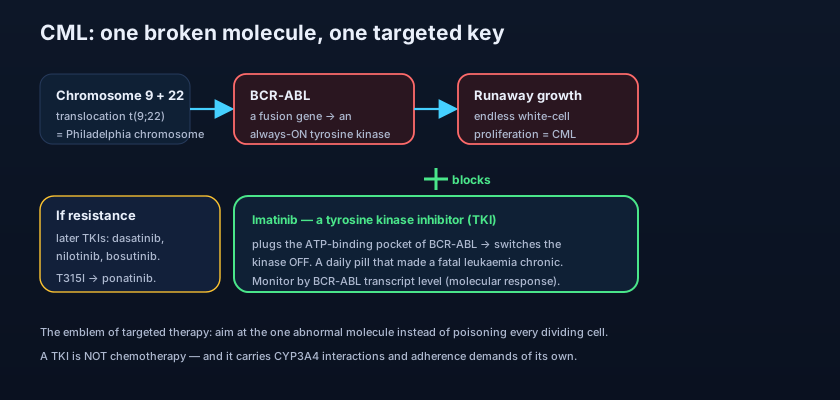
Nearly every case of CML traces back to a single genetic accident. In a blood stem cell, a piece of chromosome 9 swaps places with a piece of chromosome 22 — a reciprocal translocation written t(9;22). The shortened chromosome 22 that results is the famous Philadelphia chromosome (named for the city where it was discovered). This swap fuses two genes that should never meet: ABL from chromosome 9 and BCR from chromosome 22. The fusion gene, BCR-ABL, codes for a single hybrid protein — and that protein is the whole disease.
Normal ABL is a tyrosine kinase — an enzyme that adds phosphate groups to other proteins to pass along growth signals. Crucially, it is normally switched ON only when the cell needs it and switched OFF the rest of the time. Fused to BCR, that off-switch is broken. BCR-ABL is a constitutively active tyrosine kinase: permanently on, relentlessly firing the signals that tell the cell to divide and to resist dying. The bone marrow floods the blood with white cells. There is no external growth factor driving it, no toxin — just one enzyme jammed in the on position.
CML is the textbook example of a single-hit malignancy: one specific molecular lesion (BCR-ABL) is both necessary AND sufficient to drive the chronic phase. That is exactly why it was the first cancer to be cracked open by a molecularly targeted drug — when a disease has one clear cause, you can design a single key to lock it.
The key in the lock: how imatinib works
A tyrosine kinase needs fuel to fire: it grabs a molecule of ATP and transfers its phosphate onto a target protein. That means every kinase has an ATP-binding pocket. Imatinib is a small molecule shaped to slide into the ATP-binding pocket of BCR-ABL and sit there. With the pocket blocked, no ATP can bind, no phosphate is transferred, and the kinase falls silent. The signal to proliferate stops; the malignant clone loses its drive and dies back. This is the entire logic of a tyrosine kinase inhibitor (TKI): don't poison the cell — unplug its broken switch.
Imatinib (Glivec / Gleevec) is a once-daily oral tablet. In chronic-phase CML it produces deep, durable remissions in the large majority of patients, and it transformed median survival from a few years into a near-normal life expectancy for many. It is the emblem of rational drug design — a medicine built backwards from a known molecular target rather than stumbled upon in a screen.
But how do you know the pill is working? You don't just watch the white-cell count — you measure the enemy directly. Because BCR-ABL is a unique fusion, its messenger RNA can be counted with exquisite sensitivity by quantitative PCR. The BCR-ABL transcript level tells you how much disease remains. A falling transcript is a molecular response; a deep, sustained drop (often reported on an international scale) is the treatment goal. Monitoring is molecular, not just morphological — you track the very molecule the drug was built to hit.
- CML is driven by the Philadelphia chromosome — t(9;22) — which fuses BCR and ABL.
- BCR-ABL is a constitutively active tyrosine kinase: permanently "on", driving white-cell proliferation.
- Imatinib is a TKI that plugs the ATP-binding pocket of BCR-ABL and switches the kinase off.
- It is targeted, not cytotoxic — it unplugs a switch rather than poisoning all dividing cells.
- Response is monitored by BCR-ABL transcript levels (molecular response) via quantitative PCR.
When the key stops fitting: resistance and newer TKIs
Sometimes the disease that responded beautifully starts to return, or never responded well from the start. The commonest reason is a mutation in the kinase domain of BCR-ABL — a small change in the shape of the ATP pocket so that imatinib no longer fits snugly. The lock changed, and the old key slips. This is not a failure of the concept; it is the tumour evolving. The answer was to build better keys.
Dasatinib, nilotinib and bosutinib are later-generation TKIs used when a patient is intolerant of imatinib or when the disease becomes resistant; several are also approved as first-line options and can drive faster, deeper molecular responses. Each still targets BCR-ABL but binds differently, covering many resistance mutations imatinib misses. One mutation, T315I (the "gatekeeper" mutation), resists imatinib and most of these — for it, ponatinib is specifically designed to still fit the altered pocket.
A targeted drug, but not a free one: tolerability
Because TKIs spare the rest of the body far more than classical chemotherapy, they are generally well tolerated and taken for years. But "targeted" is not "side-effect-free". Imatinib commonly causes fluid retention (puffiness, periorbital oedema), cytopenias (low blood counts, since normal marrow shares the pathway), nausea and other GI upset, muscle cramps and rash. The newer agents add their own drug-specific signatures — dasatinib is associated with pleural effusions, while nilotinib and ponatinib carry cardiovascular and vascular-occlusive risks. Choice of TKI is therefore matched to the patient's other conditions.
Two practical points decide whether the pill keeps working. First, adherence: these are oral drugs taken at home, indefinitely, and skipped doses are a leading cause of lost molecular response — the kinase simply switches back on between doses. Second, drug interactions: imatinib and its cousins are metabolized by the liver enzyme CYP3A4, so strong CYP3A4 inhibitors (like certain antifungals) can raise levels and toxicity, while inducers (like rifampicin) can drop levels below the effective range. A careful medication and even grapefruit-juice history matters.
- Resistance usually arises from kinase-domain mutations that reshape the ATP pocket.
- Dasatinib, nilotinib and bosutinib cover intolerance and many resistance mutations.
- The T315I mutation resists most TKIs; ponatinib is designed to overcome it.
- TKIs are well tolerated overall but have real effects: fluid retention, cytopenias, GI, and drug-specific cardiovascular/pleural risks.
- Adherence and CYP3A4 interactions are decisive for keeping the disease controlled.
- Calling a TKI "chemotherapy". Imatinib is targeted, not cytotoxic — it inhibits one specific enzyme rather than killing all dividing cells.
- Ignoring adherence and CYP3A4 interactions. A missed dose or a strong inhibitor/inducer can silently sink or spike drug levels.
- Forgetting resistance mutations — especially T315I — when a stable patient stops responding, instead of just raising the dose.
- Treating "targeted" as "harmless". Each TKI has its own toxicity profile that guides which one to choose.
Imatinib controls chronic myeloid leukaemia mainly because it:
- CML is caused by the Philadelphia chromosome t(9;22), which fuses BCR and ABL into a permanently active tyrosine kinase.
- Imatinib, a TKI, plugs that kinase's ATP pocket and switches it off — targeted therapy, not chemo.
- Response is tracked by BCR-ABL transcript levels; resistance comes from kinase-domain mutations (esp. T315I).
- Later TKIs (dasatinib, nilotinib, bosutinib; ponatinib for T315I) cover resistance/intolerance; watch adherence and CYP3A4.
- Katzung BG. Basic & Clinical Pharmacology — Cancer chemotherapy: targeted therapy & tyrosine kinase inhibitors (imatinib and BCR-ABL).
- Druker BJ, et al. Five-Year Follow-up of Patients Receiving Imatinib for Chronic Myeloid Leukemia. N Engl J Med. 2006.
- Hochhaus A, et al. Long-Term Outcomes of Imatinib Treatment for Chronic Myeloid Leukemia (IRIS). N Engl J Med. 2017.
- Brunton LL, et al. Goodman & Gilman's The Pharmacological Basis of Therapeutics — Protein kinase inhibitors & BCR-ABL.
- National Comprehensive Cancer Network (NCCN) Guidelines — Chronic Myeloid Leukemia: TKI selection, monitoring & resistance.