
Inflammation & the Prostaglandin Pathway: The Key to Every Painkiller
Almost every anti-inflammatory painkiller — from ibuprofen to aspirin to steroids — works by acting on one chemical pathway. Learn this single diagram, the arachidonic acid pathway, and you'll understand not just how these drugs relieve pain, but exactly why they damage the stomach and kidneys. One pathway explains both the benefit and the harm.
When tissue is injured or infected, it becomes inflamed — red, hot, swollen and painful. A big part of that inflammation is produced by a family of local chemical messengers called prostaglandins. Prostaglandins cause the pain, the fever and the swelling of inflammation. So if you could block their production, you could relieve pain, bring down fever and reduce inflammation all at once — and that's exactly what the common anti-inflammatory drugs do. But here's the twist that makes this pathway so important to understand: prostaglandins don't only cause inflammation. They also do essential 'housekeeping' jobs around the body — protecting the stomach lining, maintaining kidney blood flow, and helping blood clot. So the very drugs that relieve pain by blocking prostaglandins also strip away these protections. One pathway, and it explains both why these drugs work and why they're dangerous.
The pathway, step by step
Membrane fat → arachidonic acid → COX → prostaglandins. The pathway is short and worth memorising. It starts with the fatty phospholipids in cell membranes. When a cell is stimulated, an enzyme (phospholipase A2) releases arachidonic acid from that membrane. Arachidonic acid is then converted by an enzyme called cyclo-oxygenase — universally abbreviated COX — into the prostaglandins. So the chain is: phospholipids → arachidonic acid → (COX) → prostaglandins → inflammation. This gives us two obvious places to block the pathway, and they correspond to the two great classes of anti-inflammatory drug. Corticosteroids (the steroids from the endocrine chapter) act high up, reducing the release of arachidonic acid in the first place — which is one reason they're such broad, powerful anti-inflammatories. The NSAIDs — non-steroidal anti-inflammatory drugs like ibuprofen and aspirin — act one step lower, blocking the COX enzyme itself, so less arachidonic acid gets turned into prostaglandins. Both end up reducing prostaglandins, but at different points. Once you can picture this ladder, you can place any anti-inflammatory drug on it.
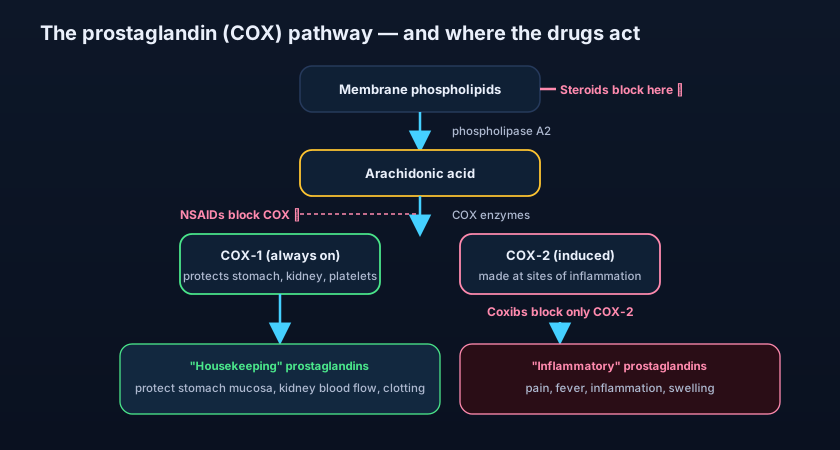
COX-1 vs COX-2: the good and the bad prostaglandins
Here's the crucial refinement that explains the side effects, and it's the single most important idea in this whole section. The COX enzyme comes in two forms. COX-1 is the 'housekeeping' enzyme — it's switched on all the time in normal tissues, quietly making the protective prostaglandins that guard the stomach lining, maintain blood flow through the kidneys, and help platelets clot. COX-2 is the 'inflammatory' enzyme — it's largely switched on (induced) only at sites of injury and inflammation, making the prostaglandins that cause pain, fever and swelling. Now you can see the whole problem with NSAIDs in one glance: ordinary NSAIDs block BOTH COX-1 and COX-2. Blocking COX-2 gives the wanted effect (relieving pain and inflammation), but blocking COX-1 at the same time removes the protection of the stomach, kidneys and platelets — which is exactly why NSAIDs cause stomach ulcers, kidney problems, and affect bleeding. This immediately explains the entire strategy of the coxibs: drugs designed to block ONLY COX-2, aiming to keep the anti-inflammatory benefit while sparing the protective COX-1 (whether they fully succeed is a story for their own article). Understand COX-1 as protection and COX-2 as inflammation, and every NSAID benefit and side effect falls into place.
- Prostaglandins cause pain, fever and inflammation — but also protect stomach, kidney and platelets.
- Pathway: membrane phospholipids → arachidonic acid → COX → prostaglandins.
- Steroids block high up (arachidonic acid release); NSAIDs block the COX enzyme.
- COX-1 = 'housekeeping' (protects stomach/kidney/platelets); COX-2 = 'inflammatory' (pain, fever, swelling).
- NSAIDs block BOTH → benefit (anti-inflammatory) + harm (ulcers, kidney, bleeding); coxibs block only COX-2.
The single most powerful idea in this section is that the benefit and the harm of NSAIDs come from the same action, split between two enzymes. When an NSAID blocks COX-2, it stops the inflammatory prostaglandins — that's the pain relief you want. When the same NSAID blocks COX-1, it stops the protective prostaglandins — and that's the stomach ulcer, the kidney injury and the bleeding you don't want. There is no separating them for an ordinary NSAID; the good and the bad are two sides of one coin. This is why you can predict an NSAID's entire side-effect profile from first principles: anything COX-1's protective prostaglandins normally do (guard the stomach, perfuse the kidney, help clotting), an NSAID will undo. Memorise 'COX-1 protects, COX-2 inflames', and you never again have to memorise a list of NSAID side effects — you can derive them.
- Thinking of prostaglandins as only 'bad' — they also protect the stomach, kidneys and clotting.
- Forgetting NSAIDs block COX-1 too — that's the source of their side effects.
- Confusing where steroids and NSAIDs act — steroids block higher up, NSAIDs block COX.
- Assuming COX-2 selectivity removes all risk — it changes, not abolishes, the risk profile.
Why do ordinary NSAIDs cause stomach and kidney side effects?
- Prostaglandins cause inflammation/pain/fever but also protect the stomach, kidney and platelets.
- Pathway: phospholipids → arachidonic acid → COX → prostaglandins. Steroids block high up; NSAIDs block COX.
- COX-1 = protection (stomach/kidney/platelets); COX-2 = inflammation (pain/fever/swelling).
- NSAIDs block both → benefit + harm; coxibs target only COX-2. Master this to derive every NSAID effect.
- Katzung BG. Basic & Clinical Pharmacology — NSAIDs, Antirheumatic Drugs & the eicosanoids.
- Brunton LL, et al. Goodman & Gilman's The Pharmacological Basis of Therapeutics — Lipid-derived autacoids & anti-inflammatory drugs.
- Rang HP, Dale MM, et al. Rang & Dale's Pharmacology — Local hormones & inflammation.
- Guyton & Hall. Textbook of Medical Physiology — Inflammation & prostaglandins.