
Treating Pain: The Analgesic Ladder and the Right Drug for the Right Pain
Pain isn't one thing, and there's no single best painkiller — there's a logical way to escalate from mild to severe, and a crucial distinction between ordinary pain and 'nerve pain' that responds to completely different drugs. This simple framework, the analgesic ladder, organises pain relief for the whole of medicine.
Faced with a patient in pain, the question isn't just 'which painkiller?' but 'how much pain, and what kind?' The World Health Organization gave us a beautifully simple framework for the first question — the analgesic ladder — originally designed for cancer pain but now used everywhere. The idea is to match the strength of the drug to the severity of the pain, stepping up the ladder as pain increases and, when it settles, stepping back down. It stops you from reaching for a strong opioid for a mild ache, or leaving someone in agony on paracetamol. Combined with one crucial distinction — between ordinary pain and nerve pain — it turns pain relief from guesswork into a logical system.
The three steps
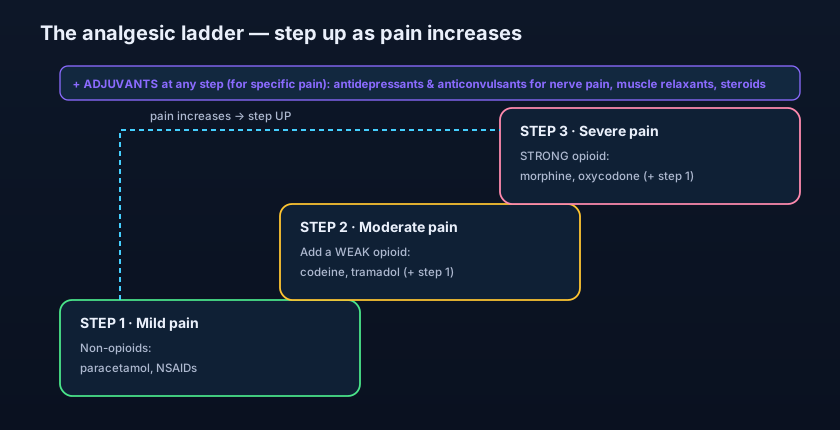
Step up from non-opioids, to weak opioids, to strong opioids. The ladder has three steps. Step 1, for mild pain, is the non-opioid analgesics — paracetamol and the NSAIDs (the drugs of this section). Step 2, for moderate pain, adds a weak opioid — codeine or tramadol — on top of the step 1 drug. Step 3, for severe pain, swaps the weak opioid for a strong opioid — morphine, oxycodone and the rest (the opioids from the CNS chapter) — again usually kept alongside a step 1 non-opioid. Two principles make the ladder work well. First, you keep the simple analgesics going even as you climb — paracetamol and an NSAID are continued underneath the opioid, because they work by different mechanisms and add to its effect (letting you use less opioid). Second, and running alongside every step, are the adjuvants: drugs that aren't classic painkillers but help specific pain types — most importantly, the drugs for nerve pain, plus muscle relaxants and sometimes steroids. The ladder tells you how HARD to treat; the adjuvants tell you to also ask what KIND of pain you're treating.
Two kinds of pain — and why it matters
The most important insight beyond the ladder is that there are fundamentally two different kinds of pain, and they respond to different drugs. Nociceptive pain is 'ordinary' pain — the pain of injury, inflammation, a broken bone or a bruise, where pain nerves are doing their normal job of signalling tissue damage. This is the pain the ladder is built for, and it responds well to the standard analgesics (NSAIDs, paracetamol, opioids). Neuropathic pain is completely different: it's pain caused by damage to the nerves themselves (from diabetes, shingles, nerve injury), producing burning, shooting, electric-shock or tingling sensations. Crucially, neuropathic pain responds poorly to ordinary painkillers — even strong opioids often barely help. Instead, it responds to a surprising set of drugs borrowed from elsewhere: certain antidepressants and anticonvulsants (from the CNS chapter), which calm the over-firing nerves (this is the subject of its own article later). This is why the single most useful question when someone is in pain is not just 'how bad?' but 'is this ordinary pain or nerve pain?' — because getting that wrong means giving morphine for a pain it can't touch, or missing that a low-dose antidepressant would work far better. The ladder plus this distinction is the whole framework of analgesia.
- The analgesic ladder matches drug strength to pain severity: non-opioids → weak opioids → strong opioids.
- Keep step-1 drugs (paracetamol/NSAID) going underneath opioids — different mechanisms add up, sparing opioid.
- Adjuvants (for specific pain types) can be used at any step.
- Nociceptive ('ordinary') pain responds to standard analgesics; neuropathic ('nerve') pain often doesn't.
- Neuropathic pain responds to antidepressants/anticonvulsants, not usually to opioids — always ask which pain it is.
The most clinically powerful idea in pain management is that neuropathic pain plays by different rules. Faced with severe pain, the instinct is to climb the ladder toward stronger opioids — but if the pain is coming from damaged nerves (a burning, shooting, electric quality), even morphine may barely dent it, and you can end up giving escalating doses of a drug that was never going to work. The answer instead lies with drugs that look nothing like painkillers: an antidepressant like amitriptyline or duloxetine, or an anticonvulsant like gabapentin or pregabalin, which quieten the misfiring nerves. So before you climb the ladder, ask what kind of pain you're treating. Recognising nerve pain — and reaching for the right, non-obvious drug — is one of the most useful skills in all of medicine.
- Reaching straight for a strong opioid for mild pain — start at the appropriate rung.
- Stopping the paracetamol/NSAID when starting an opioid — keep them; they add to the effect.
- Escalating opioids for neuropathic pain — it responds poorly; use antidepressants/anticonvulsants.
- Not asking what KIND of pain it is before choosing a drug.
A patient has burning, shooting nerve pain from diabetes. What's most likely to help?
- The analgesic ladder: non-opioids → weak opioids → strong opioids, matched to pain severity.
- Keep step-1 drugs going under opioids (they add up); use adjuvants for specific pain types.
- Nociceptive (ordinary) pain responds to standard analgesics; neuropathic (nerve) pain often doesn't.
- Nerve pain needs antidepressants/anticonvulsants — always ask what KIND of pain you're treating.
- Katzung BG. Basic & Clinical Pharmacology — Analgesic principles & the management of pain.
- Brunton LL, et al. Goodman & Gilman's The Pharmacological Basis of Therapeutics — Analgesic-antipyretics & pain management.
- WHO — Analgesic ladder & guidelines on pain management.
- Rang HP, Dale MM, et al. Rang & Dale's Pharmacology — Analgesic drugs.