
NSAIDs: The World's Painkillers, and Their Three Big Dangers
Ibuprofen, naproxen and diclofenac are among the most-used drugs on the planet — brilliant for pain, inflammation and fever. But they carry three serious risks that all trace back to one thing you already understand: blocking the protective COX-1. Learn the three dangers — stomach, kidney, and heart — and you'll use these everyday drugs safely.
The non-steroidal anti-inflammatory drugs (NSAIDs) — ibuprofen, naproxen, diclofenac and many others — are everywhere: in medicine cabinets, on pharmacy shelves, prescribed for everything from headaches to arthritis. They do three useful things at once, all from blocking prostaglandins: they relieve pain (analgesic), reduce inflammation (anti-inflammatory), and bring down fever (antipyretic). That triple action, plus being cheap and available without prescription, makes them enormously popular. But their very familiarity is a trap — because they are far from harmless. NSAIDs cause a large share of serious drug-related complications, and the striking thing is that all their major dangers can be predicted from a single fact you already know: they block COX-1, and COX-1's prostaglandins protect the stomach, the kidneys, and normal blood clotting.
The three big risks — all from blocking COX-1
Stomach, kidney, heart — each is a lost COX-1 protection. The first and commonest danger is to the stomach and gut. COX-1's prostaglandins maintain the protective mucus barrier of the stomach lining; block them, and the stomach is exposed to its own acid, causing indigestion, ulcers, and dangerous gastrointestinal bleeding — one of the leading causes of drug-related hospital admissions. That's why NSAIDs are used cautiously (or with a protective PPI) in anyone at risk, and why they connect straight back to the peptic ulcer article. The second danger is to the kidneys. Prostaglandins help maintain blood flow through the kidneys, especially when the kidneys are under stress; block them, and NSAIDs can reduce kidney blood flow and cause acute kidney injury — particularly in the dehydrated, the elderly, and those already on other kidney-stressing drugs. The third danger is to the cardiovascular system: NSAIDs can raise blood pressure, cause fluid retention (worsening heart failure), and, importantly, increase the risk of heart attacks and strokes with regular use. Stomach, kidney, heart — three risks, one mechanism. And there's a fourth effect worth adding: because prostaglandins are involved in platelet function, NSAIDs affect clotting and can increase bleeding.
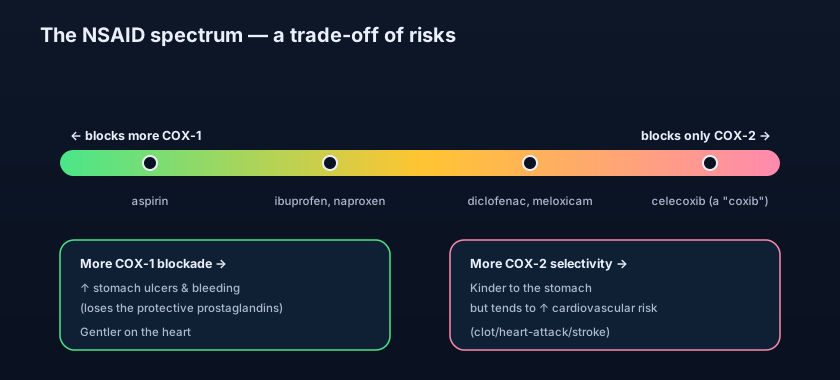
Using them wisely
Knowing the risks tells you exactly how to use NSAIDs safely: the lowest effective dose for the shortest necessary time, and extra caution in the people most at risk. Who's at risk? For the stomach: the elderly, anyone with a previous ulcer, and those also taking steroids or blood thinners (so they're often co-prescribed a PPI for protection). For the kidneys: the dehydrated, the elderly, and those with existing kidney disease or on other kidney-stressing drugs — a particularly dangerous combination is an NSAID together with an ACE inhibitor/ARB and a diuretic (the 'triple whammy' from the cardiovascular chapter, which can tip the kidneys into failure). For the heart: those with heart failure, hypertension or heart disease. There are also everyday cautions worth knowing: NSAIDs are generally avoided in the later stages of pregnancy, in severe asthma (they can trigger bronchospasm in some asthmatics), and alongside other drugs that stress the same organs. The practical wisdom is simple: NSAIDs are excellent drugs, but they are not sweets. Match the drug to the patient, use the least you can for the shortest time, and always ask 'is this a person whose stomach, kidneys or heart can't afford the risk?'
- NSAIDs relieve pain, inflammation and fever by blocking COX (and prostaglandins).
- Three big risks, all from blocking COX-1's protective prostaglandins:
- STOMACH: indigestion, ulcers, GI bleeding (co-prescribe a PPI in at-risk patients).
- KIDNEY: reduced renal blood flow → acute kidney injury (beware the ACEi/ARB + diuretic + NSAID 'triple whammy').
- HEART: raised BP, fluid retention (worsens heart failure), higher heart-attack/stroke risk. Lowest dose, shortest time.
The beauty of understanding the COX pathway is that you never have to memorise NSAID side effects — you can derive every one of them from a single sentence: 'COX-1's prostaglandins protect the stomach, kidney and platelets.' Take that protection away and each consequence follows automatically: no stomach protection → ulcers and bleeding; no kidney blood-flow support → acute kidney injury; disturbed platelets → bleeding; and, more subtly, the effects on blood vessels and salt-and-water balance → raised blood pressure and cardiovascular risk. This is pharmacology at its most satisfying: one mechanism, fully understood, generating the drug's benefit AND its entire risk profile. Whenever you're handed a new NSAID or asked about its dangers, don't reach for a memorised list — reach for the pathway, and read the answer straight off it.
- Giving an NSAID to a dehydrated/elderly patient on an ACEi + diuretic — the 'triple whammy' can cause kidney failure.
- Not co-prescribing a PPI in a high-risk patient (elderly, prior ulcer, on steroids/anticoagulants).
- Using NSAIDs freely in heart failure/hypertension — fluid retention and raised BP.
- Giving an NSAID to a severe asthmatic (can trigger bronchospasm) or in late pregnancy.
The main risks of NSAIDs (stomach, kidney, heart) all come from…
- NSAIDs relieve pain, inflammation and fever by blocking COX/prostaglandins.
- Three big risks from blocking COX-1: stomach (ulcers/bleeding), kidney (AKI), heart (BP, fluid, MI/stroke).
- Beware the 'triple whammy' (NSAID + ACEi/ARB + diuretic) on the kidneys; co-prescribe a PPI in at-risk stomachs.
- Lowest dose, shortest time; extra caution in the elderly, heart/kidney disease, asthma, late pregnancy.
- Katzung BG. Basic & Clinical Pharmacology — NSAIDs & antirheumatic drugs.
- Brunton LL, et al. Goodman & Gilman's The Pharmacological Basis of Therapeutics — Anti-inflammatory & analgesic agents.
- NICE / ACR — Guidance on safe NSAID prescribing.
- Whalen K. Lippincott Illustrated Reviews: Pharmacology — NSAIDs.