
Refeeding Syndrome: When Feeding the Starved Becomes Dangerous
It is one of medicine's cruellest paradoxes: the treatment that should save a starving patient can be the thing that kills them. Give food too fast to a body that has spent weeks running on its own reserves, and the metabolic switch back to sugar unleashes a silent electrolyte collapse — phosphate, potassium and magnesium vanish from the blood in hours, the heart falters, the muscles fail. The danger is not the food itself but its speed. Understanding why turns a fatal mistake into a routine, preventable one.
A frail 58-year-old man with alcohol dependence is admitted after a fortnight of eating almost nothing. He looks wasted; his BMI is 15. The team, meaning only kindness, starts a full nutritional feed straight away. Twenty-four hours later he is confused, breathless and his heart is throwing ectopic beats. The bloods come back: phosphate dangerously low, potassium and magnesium falling, and his ECG deteriorating by the hour. Nothing new has infected him and nothing has bled — the feeding itself did this. He is in refeeding syndrome, and had the team started low and slow with thiamine on board, none of it would have happened.
What starvation does to the cell
A starved body is not simply empty — it has quietly rewired its entire metabolism. After a few days without carbohydrate, insulin falls and the body abandons glucose as its main fuel. It switches to burning fat and protein, producing ketone bodies to feed the brain — the metabolism of survival. Over the following weeks something dangerous happens beneath the surface: the intracellular stores of phosphate, potassium and magnesium are steadily depleted, drained to keep failing cells running. The catch is that the blood levels of these ions can still read completely normal, because the body defends the serum concentration even as the cellular tank runs dry. The patient is profoundly deficient in a way no routine blood test reveals. They are a coiled spring, and carbohydrate is what releases it.
The trigger: carbohydrate and the insulin surge
Now reintroduce food — especially carbohydrate — and the switch flips back violently. Blood glucose rises, and the pancreas, quiet for weeks, releases a surge of insulin. Insulin is an anabolic, storage hormone: it drives glucose into cells, and it drags phosphate, potassium and magnesium in with it, because building new cellular machinery consumes exactly those ions. Phosphate is pulled in hardest of all — it is the backbone of the ATP and 2,3-DPG the newly fed cells are suddenly scrambling to make. So the serum concentrations, already propped up over an empty cellular tank, fall off a cliff. The hallmark, the single fact the exams and the ward both hang on, is hypophosphataemia, accompanied by hypokalaemia and hypomagnesaemia. The blood test that looked normal yesterday is now frankly dangerous.
And there is a second casualty of the returning carbohydrate: thiamine. Thiamine (vitamin B1) is the essential coenzyme that lets cells burn glucose. In a malnourished or alcohol-dependent patient it is already scraping empty. The moment you flood the system with carbohydrate, the cells consume what little thiamine remains at high speed — and tip into frank deficiency. The result is Wernicke's encephalopathy: confusion, eye-movement palsy and ataxia, which can become the irreversible Korsakoff amnesia if missed. This is exactly why the Thiamine chapter insists on giving thiamine before or with any glucose or feed in these patients — glucose given first, on an empty thiamine tank, can precipitate the very brain injury you were trying to prevent.
Think of the starved body as a house that has switched off the mains power and lived for weeks on candles. The rooms look fine in the dark — the meter reads normal. Then you throw the main breaker back on all at once: every appliance surges to life and the sudden draw trips the whole system into darkness. Refeeding is that surge. Carbohydrate throws the breaker; insulin is the current; and the fuses that blow are phosphate, potassium and magnesium. The fix is not to keep the power off — the house needs it — but to bring it up one circuit at a time.
What actually kills the patient
These are not abstract numbers on a chart — the falling ions attack the organs that keep the patient alive. Phosphate depletion starves every cell of ATP: without it the heart muscle weakens into arrhythmias and frank cardiac failure, and the respiratory muscles tire until ventilation fails. Low potassium and magnesium add their own arrhythmias, the same electrical instability covered in the Cardiovascular section. Skeletal muscle can break down outright — rhabdomyolysis — and red cells, short of the phosphate they need, can haemolyse. The brain, from thiamine loss and electrolyte chaos together, slides into seizures and encephalopathy, the territory of the Central Nervous System chapter. The grim signature of the syndrome is that this cascade unfolds within days of starting to feed — the sicker the patient, the faster and more lethal the collapse.
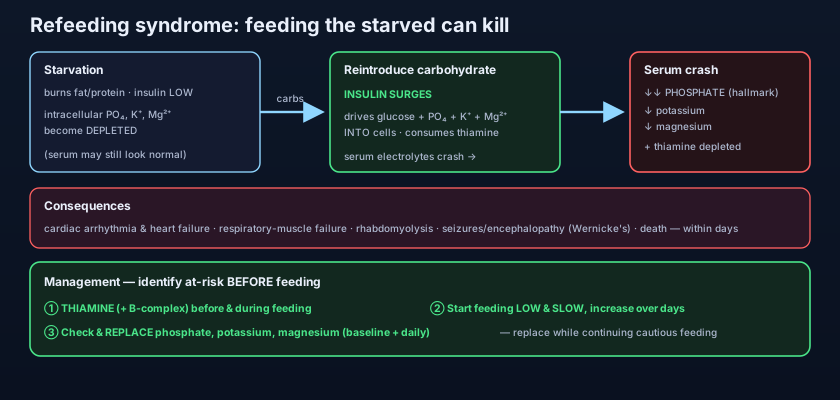
- Prolonged starvation depletes intracellular phosphate, potassium and magnesium — even when serum levels look normal.
- Reintroduced carbohydrate → insulin surge → glucose and those ions driven into cells → serum levels crash.
- Hypophosphataemia is the hallmark (phosphate consumed making ATP and 2,3-DPG), with hypokalaemia and hypomagnesaemia.
- Thiamine, already low, is rapidly consumed by new carbohydrate metabolism → Wernicke's encephalopathy.
- Consequences: cardiac arrhythmia and failure, respiratory muscle failure, rhabdomyolysis, seizures, haemolysis — within days.
- The danger is the speed of feeding, not the food itself.
Who is at risk — spotting them before you feed
Refeeding syndrome is almost entirely preventable, but only if you identify the at-risk patient before the first feed. The NICE criteria frame this as a simple risk assessment. A patient is at high risk with any one of: a very low BMI (roughly under 16), little or no nutritional intake for more than about ten days, significant unintentional weight loss, or low baseline potassium, phosphate or magnesium before feeding. Two of a milder set count too: a BMI under about 18.5, negligible intake for more than five days, a history of alcohol misuse, or drugs such as insulin, diuretics or chemotherapy. Beyond the criteria, keep a high index of suspicion in the classic contexts — anorexia nervosa, chronic alcoholism, the post-bariatric or post-operative patient, and anyone chronically undernourished by illness. The lesson is that the assessment happens on the way in, not after the arrhythmia.
The single most dangerous instinct in refeeding is the humane one: to feed the starving patient fully and fast because they look so depleted. Reverse that instinct. The more starved the patient, the slower and more cautious the feed must be — and the more urgently you give thiamine and check electrolytes first. A normal phosphate on admission is not reassurance; it is the calm before the fall, because the deficit is hidden inside the cells and only declares itself once feeding drives the ions inward.
Prevention and management: low, slow, thiamine, replace
The protocol is simple once the mechanism is clear. First, identify the at-risk patient before feeding begins. Second, give thiamine (and usually a B-complex or multivitamin) before and throughout the first days of feeding — never let carbohydrate reach the cells on an empty thiamine tank. Third, start the feed low and slow: a deliberately reduced calorie rate for the highest-risk patients, increased gradually over several days rather than jumping to full requirements. Fourth, check phosphate, potassium and magnesium at baseline and daily, and replace them aggressively the moment they fall — do not wait for a symptom. Crucially, the response to a falling phosphate is to correct it while continuing cautious feeding, not to stop feeding altogether; you replace the electrolyte and keep the careful feed going, only slowing further if the fall is severe. Throughout, monitor fluid balance and cardiac status, because fluid overload and arrhythmia are the ways the syndrome turns fatal.
This is also the essential safety rule that sits underneath the whole of Clinical nutrition. Whether you feed by the enteral route (a tube into the gut) or parenterally (nutrition into a vein, TPN), refeeding syndrome is the shared danger of both — and if anything the risk is sharper with concentrated parenteral carbohydrate. The individual electrolyte battles are fought in their own chapters — the Phosphate chapter for aggressive phosphate replacement, and the Potassium and Magnesium chapters for their replacement and the arrhythmias they cause — and the insulin-driven intracellular shift at the heart of it all is the same physiology taught in the Endocrine section. Refeeding syndrome is where those threads are pulled together at the bedside.
High-risk BMI under ~16; negligible intake for >10 days; significant weight loss; low baseline phosphate, potassium or magnesium. Classic contexts: anorexia nervosa, chronic alcohol misuse, chemotherapy, and the post-bariatric or post-operative patient. Practical bundle: thiamine before feeding, feed low and slow (a reduced calorie rate built up over days), daily phosphate/potassium/magnesium with aggressive replacement, and monitoring of fluid balance and cardiac rhythm — the whole approach captured in NICE nutrition-support guidance.
- Assess refeeding risk (NICE criteria) BEFORE the first feed — a normal phosphate is not reassurance.
- Give thiamine (and B-complex/multivitamin) before and during feeding — never carbohydrate on an empty thiamine tank.
- Start feeding low and slow: a reduced calorie rate built up gradually over days.
- Check phosphate, potassium and magnesium at baseline and daily; replace aggressively without waiting.
- Correct/replace electrolytes while continuing cautious feeding — don't simply stop feeding.
- Refeeding is the shared danger of both enteral and parenteral (TPN) nutrition.
- Giving glucose or a full feed before thiamine in a malnourished or alcoholic patient — precipitating Wernicke's encephalopathy.
- Feeding the most starved patients fully and fast out of compassion — speed, not the food, is what kills.
- Trusting a normal admission phosphate and skipping daily monitoring — the deficit is intracellular and declares itself only after feeding starts.
A 22-year-old woman with anorexia nervosa (BMI 13) is admitted having eaten almost nothing for two weeks. Which single step most reduces her risk of dying from refeeding syndrome?
- Prolonged starvation empties intracellular phosphate, potassium and magnesium — while serum levels can still look normal.
- Reintroduced carbohydrate spikes insulin, driving glucose and those ions into cells → hypophosphataemia (the hallmark), hypokalaemia, hypomagnesaemia, and thiamine consumption.
- Consequences within days: cardiac arrhythmia and failure, respiratory failure, rhabdomyolysis, seizures, haemolysis — and death.
- Prevention: identify the at-risk patient, give thiamine first, feed low and slow, and check/replace phosphate, potassium and magnesium daily — correcting while continuing cautious feeding.
- NICE Clinical Guideline CG32 — Nutrition support for adults: oral nutrition support, enteral tube feeding and parenteral nutrition (refeeding risk criteria and management).
- Rang & Dale's Pharmacology — Nutrition, vitamins and metabolic disorders.
- Mehanna HM, Moledina J, Travis J. Refeeding syndrome: what it is, and how to prevent and treat it. BMJ.
- ESPEN / ASPEN guidelines on clinical nutrition and the prevention of refeeding syndrome.
- Ganong's Review of Medical Physiology — insulin action and cellular electrolyte handling.
- BNF — thiamine (vitamin B1), phosphate, potassium and magnesium replacement.

