
Trace Elements: Zinc, Copper, Selenium and the Rest
You need them in milligrams — sometimes micrograms — a day, and yet an enzyme somewhere will not turn over without them. Trace elements are the tiny metal cofactors threaded through hundreds of reactions: the zinc in a healing wound, the copper that lets you use iron, the selenium guarding a heart muscle from oxidative damage. Run short and the body writes a distinctive signature — a rash around the mouth, an anaemia that looks like marrow failure, a cardiomyopathy in a starving child. And two of them, zinc and copper, are locked in a see-saw so tight that treating one deficiency can quietly cause the other. This is the chapter of small amounts and sharp consequences.
A 3-year-old boy is admitted with a rash no cream has touched: red, scaly, weeping plaques ringing his mouth, his fingertips and his nappy area. His hair is thinning and he has had loose stools for weeks. He is irritable, off his food, and simply not growing. The dermatologist recognizes the pattern — perioral and acral — and the paediatrician orders a serum zinc. It is low. This is acrodermatitis enteropathica, a failure to absorb zinc, and the whole florid picture reverses within days of starting oral zinc. The same element, in an adult two floors up, is quietly causing harm the opposite way: a man on long-term zinc lozenges for "colds" is being worked up for an unexplained anaemia and low white count. His zinc is high — and his copper has been driven to the floor.
What "trace" really means
Tiny quantity, non-negotiable role. A trace element is a mineral the body needs in vanishingly small amounts — milligrams or micrograms daily — yet cannot manufacture and cannot function without. Most work as enzyme cofactors: a single metal ion sitting at the active site of an enzyme, doing the chemistry the protein alone cannot. Because the requirement is so small, deficiency rarely comes from a normal diet. It comes from three recurring situations that every prescriber should learn to smell: malabsorption or high-output gastrointestinal losses (short bowel, fistulae, chronic diarrhoea), long-term parenteral nutrition without the right additives, and restrictive states such as after bariatric surgery. Hold onto that trio — it is the through-line of this whole chapter, and the reason trace elements belong in a pharmacology course at all.
Zinc: the cofactor of hundreds of enzymes
Zinc is the workhorse. It is a structural and catalytic cofactor for hundreds of enzymes and for the "zinc-finger" proteins that switch genes on and off, so it touches almost every fast-turnover tissue: skin, gut lining, immune cells, the growing child. Deficiency therefore hits all of them at once. The classic picture is impaired wound healing and a dermatitis that favours the mouth, the tips of the fingers and the perineum — the acral, perioral rash of acrodermatitis enteropathica. Add hair loss (alopecia), a blunted or distorted sense of taste and smell, and a weakened immune system with frequent infections. In children the signature is growth retardation and diarrhoea — and here zinc becomes a public-health drug: WHO recommends oral zinc alongside oral rehydration for childhood diarrhoea, because it shortens episodes and cuts diarrhoeal mortality. Causes follow the familiar trio: malabsorption, high-output GI losses, and parenteral nutrition given without zinc.
Zinc is also a deliberate therapy, not just a deficiency to correct. Two prescribing uses are worth knowing. In Wilson's disease, oral zinc is given precisely because it blocks copper absorption from the gut — it induces a protein called metallothionein in the intestinal cells that binds copper and carries it away in shed cells, so zinc is used as maintenance therapy to keep copper from re-accumulating (see the Toxicology / hepatology chapter). And in age-related eye disease, zinc is a component of the AREDS antioxidant formulation used to slow progression of age-related macular degeneration (a link across to the Ophthalmology section). The same property that makes zinc therapeutic in Wilson's — its power to shut down copper uptake — is exactly what makes casual high-dose zinc dangerous, as the next section shows.
Picture zinc and copper on a see-saw in the gut. When you flood the intestine with zinc, you tip the board: zinc switches on metallothionein, a sticky sponge in the gut-lining cells that grabs copper and holds it. Those cells are shed every few days and carried out in the stool, taking the trapped copper with them. Give a little zinc and the board sits level. Pile zinc high — colds lozenges, denture creams, supplements taken "just in case" — and the far end lifts until copper can no longer get on board at all. That is why a well-meant zinc habit ends in copper deficiency.
- Trace elements are needed in mg/µg amounts as enzyme cofactors; deficiency comes from malabsorption, GI losses, TPN, or bariatric surgery — not a normal diet.
- Zinc is a cofactor for hundreds of enzymes and zinc-finger proteins — it drives wound healing, skin, immunity and growth.
- Zinc deficiency: poor wound healing, perioral/acral dermatitis (acrodermatitis enteropathica), alopecia, impaired taste/smell, immune impairment.
- In children, zinc deficiency causes growth retardation and diarrhoea; WHO zinc supplementation reduces childhood diarrhoeal mortality.
- Zinc is therapeutic in Wilson's disease (blocks copper absorption) and in the AREDS formula for macular degeneration.
- High-dose zinc induces metallothionein and traps copper — a recognized supplement/drug cause of copper deficiency.
Copper: iron's partner, and the Wilson's overload
Copper is the quieter partner, but it does two jobs students under-rate. First, it is essential for iron metabolism: the copper-containing protein ceruloplasmin (and its relatives) is needed to load iron for transport, so copper deficiency produces an iron-refractory anaemia — you can give all the iron you like and the anaemia will not budge. Second, copper enzymes cross-link connective tissue and build the covering of nerves. Deficiency is genuinely rare, but when it appears the causes are, again, the familiar trio plus one drug trap: malabsorption, bariatric surgery, parenteral nutrition without copper — and excess zinc ingestion, the metallothionein mechanism from the see-saw. The clinical picture is a beautiful mimic: anaemia and neutropenia that on a blood film can look exactly like myelodysplasia (a hard-won pearl for the Haematology section), together with a myeloneuropathy — a spinal-cord and nerve syndrome of numbness, tingling and unsteady gait. Recognize the pattern and you save the patient a marrow-failure work-up and simply replace the copper.
Copper's other face is not too little, but too much. Wilson's disease is the overload counterpart — an inherited failure to excrete copper into bile, so it accumulates in the liver, brain and eyes. The result is liver disease (from hepatitis to cirrhosis and acute liver failure), a movement and psychiatric disorder from copper in the basal ganglia, and the Kayser–Fleischer rings of copper in the cornea. The pharmacology is a neat mirror image of deficiency: you remove copper. Chelators — penicillamine or the better-tolerated trientine — bind copper and drag it out in the urine, and oral zinc is used, as above, to block further absorption for maintenance. Wilson's sits at the crossroads of this chapter, toxicology and hepatology, and is the reason copper appears twice in every exam: once as a deficiency mimicking marrow failure, once as an overload treated by chelation.
The zinc–copper interaction is the single most examined trap in this chapter. A patient with unexplained anaemia and neutropenia — sometimes a subacute numb, unsteady gait — who happens to use a lot of zinc (cold lozenges, denture-fixative cream, supplements) has zinc-induced copper deficiency until proven otherwise. Check a copper and a zinc together, not iron and B12 alone. It is fully reversible: stop the zinc, replace the copper. The lesson generalizes — treating one trace element to excess can starve its partner.
Selenium: the antioxidant metal
Selenium sits at the active site of glutathione peroxidase, one of the body's front-line antioxidant enzymes that mops up peroxides before they damage membranes — so selenium is fundamentally about protecting tissue from oxidative injury. Its deficiency syndrome is memorable because it is named: Keshan disease, a dilated cardiomyopathy first described in a selenium-poor region of China, alongside a skeletal myopathy. In modern practice selenium deficiency is a parenteral-nutrition problem — it is one of the trace elements that must be added to long-term TPN, exactly like zinc, copper, chromium and manganese. Miss it and a patient fed for weeks can develop a cardiomyopathy that no cardiac drug will fix, because the problem is a missing cofactor, not a failing pump.
The rest, in brief — and where iodine goes
The remaining essential trace elements deserve a line each. Chromium supports the action of insulin and normal glucose tolerance; deficiency (again, a long-TPN phenomenon) can produce a glucose intolerance that mimics diabetes. Manganese and molybdenum are cofactors for a handful of enzymes and are rarely deficient outside pure parenteral feeding. Fluoride is the dental element: too little and dental caries increase; too much and you get fluorosis — mottled, weakened enamel — a genuine excess syndrome, not just a deficiency one. Cobalt matters only as the cobalt atom sitting at the heart of vitamin B12, so its story is really the B12 story told in the Vitamins chapter. And iodine — the trace element with the biggest clinical footprint of all — gets its own dedicated chapter, because its single job (building thyroid hormone) and its deficiency disease (goitre and, in the fetus, congenital hypothyroidism) are large enough to stand alone; see the Iodine & thyroid chapter.
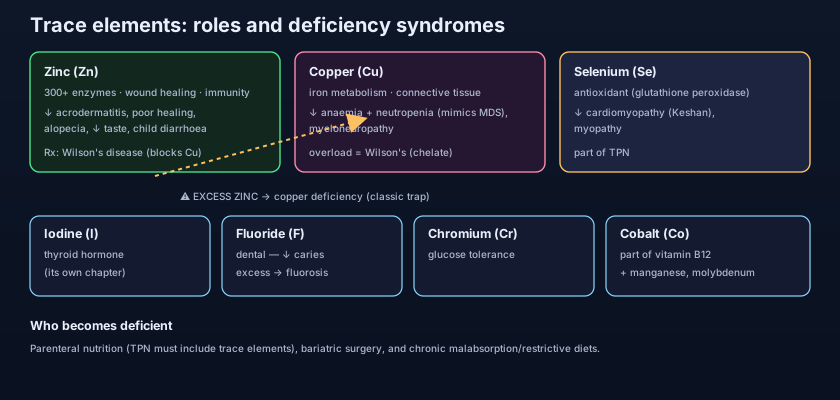
Zinc → poor wound healing, perioral/acral dermatitis, alopecia, loss of taste/smell, childhood diarrhoea and growth failure. Copper → iron-refractory anaemia + neutropenia (mimics myelodysplasia) and a myeloneuropathy; overload = Wilson's disease. Selenium → cardiomyopathy (Keshan disease) and myopathy. Chromium → impaired glucose tolerance. Fluoride → caries (too little) or fluorosis (too much). Cobalt → only via vitamin B12. Iodine → goitre and hypothyroidism (own chapter). The recurring cause behind most of these in hospital: long-term parenteral nutrition or bariatric surgery.
- Copper is essential for iron metabolism (ceruloplasmin) and connective tissue; deficiency gives an iron-refractory anaemia + neutropenia + myeloneuropathy.
- Copper deficiency can mimic myelodysplasia — check copper before diagnosing marrow failure.
- Wilson's disease = copper overload; treat by removal — chelators (penicillamine/trientine) plus zinc for maintenance.
- Selenium runs glutathione peroxidase (antioxidant); deficiency → cardiomyopathy (Keshan disease) and myopathy.
- Chromium → glucose tolerance; fluoride → teeth (caries vs fluorosis); cobalt → via B12; iodine → its own thyroid chapter.
- Long-term TPN must include a trace-element additive (zinc, copper, selenium, chromium, manganese) — omission causes deficiency.
- Chasing an unexplained anaemia and neutropenia with a bone-marrow work-up while missing that heavy zinc use (lozenges, denture cream, supplements) has caused copper deficiency.
- Starting or continuing long-term parenteral nutrition without a trace-element additive — the patient develops zinc, copper or selenium deficiency (Keshan-type cardiomyopathy) weeks in.
- Treating trace elements as harmless "tonics": high-dose zinc causes copper deficiency, and excess fluoride causes fluorosis while excess vitamin A/D are frankly toxic — more is not safer.
A 58-year-old man is investigated for a normocytic anaemia and neutropenia that a haematologist worried might be myelodysplasia. His gait has become subtly unsteady over months. He has used a denture-fixative cream heavily for two years and takes a daily zinc supplement. What is the most likely explanation?
- Trace elements are mg/µg enzyme cofactors; deficiency comes from malabsorption, GI losses, parenteral nutrition and bariatric surgery, so TPN must include a trace-element additive.
- Zinc runs hundreds of enzymes: deficiency → poor healing, perioral/acral dermatitis, alopecia, taste/smell loss, immune failure, childhood diarrhoea; it is also therapy in Wilson's disease and AREDS.
- Copper deficiency (often from excess zinc) mimics myelodysplasia — anaemia + neutropenia + myeloneuropathy; copper overload is Wilson's disease, treated with chelators plus zinc.
- Selenium is antioxidant (glutathione peroxidase) — deficiency causes Keshan-disease cardiomyopathy; chromium (glucose), fluoride (teeth), cobalt (B12) and iodine (thyroid, own chapter) round out the set.
- Rang & Dale's Pharmacology — Vitamins, minerals and trace elements.
- Katzung Basic & Clinical Pharmacology — Agents used in anaemias; trace elements and Wilson's disease.
- British National Formulary (BNF) — Zinc, trace element supplements, and penicillamine / trientine for Wilson's disease.
- ESPEN / ASPEN guidelines on clinical nutrition and parenteral nutrition (trace-element and micronutrient provision).
- World Health Organization — Zinc supplementation in the management of childhood diarrhoea.
- European Association for the Study of the Liver (EASL) Clinical Practice Guidelines: Wilson's disease.