
Thiamine and Wernicke's: The Vitamin You Give Before Glucose
Most vitamin deficiencies are slow, quiet, forgiving. Thiamine is not. A body store measured in a few weeks, a coenzyme sitting at the exact centre of how cells burn sugar, and a brain that runs on almost nothing but glucose — put those together and a small shortfall becomes a neurological emergency. Worse, the obvious first move in a collapsing patient — a bag of dextrose — can be the very thing that tips them over the edge. This is the vitamin whose whole story reduces to a single rule you can never afford to forget: thiamine before glucose.
A dishevelled man in his fifties is brought to the emergency department, confused and unsteady. He is a known heavy drinker who has eaten little for weeks. His blood glucose comes back low, and the reflex is immediate: hang a bag of dextrose. But the nurse who reaches for it first checks the drug chart — no thiamine has been given. She stops, draws up intravenous thiamine and runs it in before the sugar. It is not a formality. In a body scraped clean of thiamine, pushing glucose into starving cells forces them to try to burn it — and the last reserves of the coenzyme they need are consumed in minutes, tipping a borderline brain into Wernicke's encephalopathy. Give the vitamin first and you protect him. Give the sugar first and you may cause the very catastrophe you were trying to treat.
A vitamin is a coenzyme in disguise
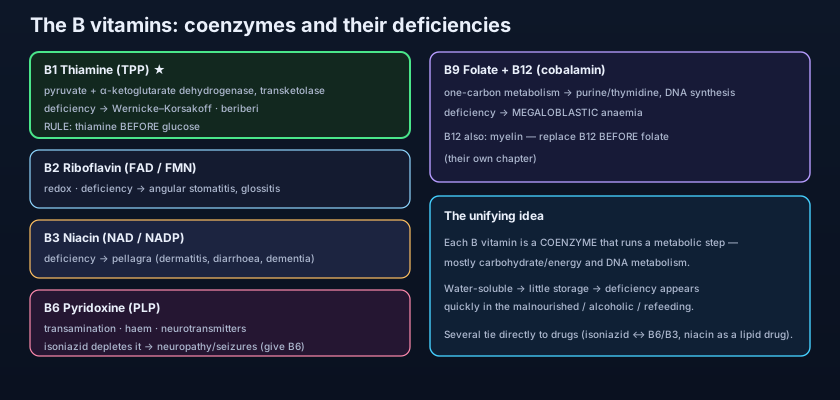
The B vitamins do not build tissue — they run the machinery that does. It helps to see the whole B group as a single idea: these are not structural nutrients but cofactors — small molecules that clip into enzymes and make them work. Without the cofactor, the enzyme is a lock with no key. Thiamine is the cleanest example. Inside the cell it is phosphorylated into thiamine pyrophosphate (TPP), and TPP is the working part of three pivotal enzymes of carbohydrate metabolism. The vitamin, in other words, is not the point — the coenzyme it becomes is. This same logic runs through the rest of the family, and the figure below lays out the whole set; here we follow thiamine, the lead example, all the way to the bedside.
Three enzymes, one fuel line
TPP sits on pyruvate dehydrogenase — the gateway that feeds glucose-derived pyruvate into the Krebs cycle; on alpha-ketoglutarate dehydrogenase — a key step inside the Krebs cycle itself; and on transketolase — the enzyme of the pentose phosphate pathway that generates the building blocks for nucleic acids and NADPH. The first two are the direct pipeline from sugar to ATP. Take TPP away and pyruvate cannot enter the cycle; it piles up and is diverted to lactate, so cellular energy production stalls just as the tank runs dry. The organ that feels this first and worst is the brain, which burns glucose almost exclusively and has little metabolic flexibility. A tissue this dependent on aerobic glucose metabolism cannot tolerate a broken TPP-dependent step for long — which is exactly why thiamine deficiency announces itself as a neurological disease.
Think of TPP as the spark plug in an engine. The fuel (glucose) can be flowing perfectly and the tank full, but without the spark plug the cylinder simply will not fire — the engine floods and stalls with fuel still pouring in. Now pump in extra fuel (a bag of dextrose) with the spark plug already worn to nothing, and you don't help the engine — you flood it completely. That is thiamine deficiency, and that is why glucose without thiamine makes things worse, not better.
Wernicke's encephalopathy: the neurological emergency
The classic triad is confusion, eye signs and ataxia — but you must not wait for all three. Acute thiamine deficiency in the brain produces Wernicke's encephalopathy, taught as a triad: an acute confusional state (global confusion, apathy, disorientation); ophthalmoplegia and nystagmus (weakness of the eye muscles and jerking eye movements); and ataxia (a broad-based, unsteady gait). The trap is that the full triad appears in only a minority of patients — most present incompletely, with just one or two features, and the diagnosis is missed precisely because the textbook picture is incomplete. Wernicke's is a clinical diagnosis and a medical emergency: the damage falls on structures around the third and fourth ventricles — the mammillary bodies, thalamus and periaqueductal grey. Treated promptly it is largely reversible. Left untreated it progresses to something that is not.
That irreversible endpoint is Korsakoff syndrome: a profound, permanent memory disorder. The patient loses the ability to lay down new memories (anterograde amnesia) and struggles to retrieve old ones, and — the signature feature — fills the gaps with confabulation, inventing plausible false memories without any intent to deceive. Wernicke and Korsakoff are two ends of one process (the Wernicke–Korsakoff syndrome): Wernicke's is the acute, treatable phase; Korsakoff's is the chronic scar left when treatment came too late. The gap between them is measured in hours of clinical decision-making — which is why the threshold to give thiamine is deliberately low. This whole story is picked up again in the Central Nervous System and Toxicology sections, in the chapter on alcohol and the ethanol-withdrawal syndromes.
- Thiamine becomes TPP, the coenzyme for pyruvate dehydrogenase, alpha-ketoglutarate dehydrogenase and transketolase.
- TPP is central to burning glucose for ATP; the brain, running on glucose, suffers first.
- Body stores last only a few weeks — deficiency develops fast.
- Wernicke's triad: confusion + ophthalmoplegia/nystagmus + ataxia — but it is usually incomplete.
- Untreated Wernicke's becomes irreversible Korsakoff psychosis: amnesia with confabulation.
- Wernicke's is a clinical, not a laboratory, diagnosis — treat on suspicion.
Beriberi: when the deficiency hits the body
Outside the brain, chronic thiamine deficiency causes beriberi, which comes in two classic forms. Dry beriberi is a symmetrical peripheral neuropathy: tingling, burning and weakness that begins in the feet and legs, with wasting and loss of reflexes — the nerves, like the brain, starved of the energy TPP unlocks. Wet beriberi is a cardiovascular disease: a high-output cardiac failure. Here the peripheral blood vessels dilate and the heart is driven to pump ever harder, until it fails with a paradoxically high cardiac output — the patient develops oedema, breathlessness and a dilated, failing heart. It is one of the few reversible causes of heart failure, and it connects directly to the Cardiovascular section, where high-output failure is otherwise a rarity. A fulminant cardiac form ("shoshin" beriberi) can kill within days and responds dramatically to thiamine.
Who is at risk — and why alcohol leads the list
Deficiency lives wherever intake, absorption and demand fall out of balance. Chronic alcohol use is the classic setting, and for several reasons at once: heavy drinkers often eat poorly, alcohol impairs thiamine absorption across the gut and its conversion to the active TPP form, and hepatic stores are depleted. But the risk is far wider. Any prolonged malnutrition or starvation qualifies, as does persistent vomiting — most notably hyperemesis gravidarum in pregnancy, a well-recognised and preventable cause of Wernicke's. Patients after bariatric surgery are increasingly important: reduced intake and altered absorption can precipitate deficiency months or years later. Critically ill and post-operative patients on prolonged intravenous fluids without vitamins are at risk, and so is anyone being refed after starvation — the crossover with the Refeeding-syndrome chapter, where thiamine must be replaced before feeding begins. The common thread is simple: low intake, poor absorption, or a sudden surge in metabolic demand for a coenzyme the body barely stocks.
Here is the rule that outranks everything else in this chapter: in an at-risk patient, give thiamine before — or at least with — any glucose or carbohydrate load. The reason is mechanistic, not ritual. A glucose infusion switches on carbohydrate metabolism, and that metabolism demands TPP at every step. In a thiamine-depleted patient there is no reserve, so the glucose load consumes the last traces of the coenzyme and can precipitate acute Wernicke's within hours. This is why intravenous thiamine (as Pabrinex) goes in before the dextrose in the confused alcoholic, and why thiamine is given before refeeding a starved patient. Thiamine is cheap, safe and forgiving; the disease it prevents is neither.
Treatment: cheap, safe, and urgent
For suspected Wernicke's, the treatment is prompt, high-dose parenteral thiamine — given intravenously or intramuscularly, because oral absorption is unreliable in exactly the patients who need it most and cannot keep pace with the deficit. In practice this is a B-vitamin preparation such as Pabrinex given several times a day for a few days, then continued as oral thiamine. The governing principle is a low threshold: if Wernicke's is even possible, treat. The downside of unnecessary thiamine is essentially nil — it is water-soluble and the excess is excreted — whereas the downside of withholding it is permanent brain damage. Prophylactic oral thiamine is also given to at-risk drinkers and malnourished patients to prevent the emergency ever arising. Beyond these classic syndromes, thiamine deficiency is worth remembering in unexplained lactic acidosis (pyruvate cannot enter the Krebs cycle and spills to lactate) and as a reversible contributor in some cases of heart failure.
Active form: thiamine pyrophosphate (TPP). Coenzyme for: pyruvate dehydrogenase, alpha-ketoglutarate dehydrogenase, transketolase. Deficiency states: Wernicke's encephalopathy → Korsakoff syndrome (CNS); dry beriberi (peripheral neuropathy); wet beriberi (high-output cardiac failure). Key at-risk groups: chronic alcohol use, malnutrition/starvation, hyperemesis gravidarum, post-bariatric surgery, refeeding. Treatment: parenteral thiamine (e.g. Pabrinex) for suspected Wernicke's, then oral. Golden rule: thiamine before glucose.
- Chronic alcohol use is the classic cause: poor intake plus impaired absorption, activation and storage.
- Other risks: malnutrition, hyperemesis gravidarum, bariatric surgery, and refeeding after starvation.
- Golden rule: thiamine before (or with) any glucose or carbohydrate load in an at-risk patient.
- Treat suspected Wernicke's with prompt high-dose parenteral thiamine (e.g. Pabrinex), then oral.
- Beriberi: dry = peripheral neuropathy; wet = reversible high-output heart failure.
- Consider thiamine in unexplained lactic acidosis and as a reversible factor in heart failure.
- Giving glucose (or a carbohydrate-rich feed) before thiamine in a malnourished or alcoholic patient — this can precipitate acute Wernicke's encephalopathy.
- Waiting for the full triad — or for a low blood level — before treating. Wernicke's is a clinical diagnosis, usually incomplete; delay causes permanent Korsakoff amnesia.
- Treating with oral thiamine when parenteral is needed, or forgetting to replace thiamine before starting a feed in a patient at risk of refeeding syndrome.
A confused, unsteady man with a long history of alcohol excess is brought to the emergency department. His capillary glucose is low. What is the single most important first step?
- Thiamine (B1) becomes TPP, the coenzyme for pyruvate and alpha-ketoglutarate dehydrogenase and transketolase — the core of glucose metabolism; the glucose-dependent brain fails first.
- Deficiency gives Wernicke's encephalopathy (confusion, ophthalmoplegia/nystagmus, ataxia — usually incomplete), which becomes irreversible Korsakoff amnesia with confabulation if untreated; and beriberi, dry (neuropathy) and wet (high-output heart failure).
- At-risk: chronic alcohol use, malnutrition, hyperemesis, bariatric surgery, refeeding. The one rule to memorise: give thiamine before glucose.
- Treat suspected Wernicke's on clinical suspicion with prompt high-dose parenteral thiamine — cheap, safe, and delay causes permanent damage.
- Rang & Dale's Pharmacology — Vitamins and the water-soluble B group.
- Katzung. Basic & Clinical Pharmacology — Vitamins & minerals.
- British National Formulary (BNF) — Thiamine and vitamin B preparations (Pabrinex).
- NICE guideline CG100 / CG115 — Alcohol-use disorders: prevention and management of Wernicke's encephalopathy.
- NICE guideline CG32 — Nutrition support in adults; refeeding and thiamine.
- Ganong's Review of Medical Physiology — Carbohydrate metabolism and thiamine-dependent enzymes.

