
Breast Cancer: How the Molecular Subtype Chooses the Treatment
Three women, three lumps that look identical on the mammogram, three completely different prescriptions — one leaves with a hormone tablet, one with an antibody infusion, one with chemotherapy. Nothing about the size or the shape sorted them. A pathologist's report on THREE receptors did. Learn to read those three receptors and you can predict, before a single drug is chosen, which road a breast cancer will travel.
Three women sit in the same waiting room, each holding the same news: a lump in the breast, confirmed cancer, similar size on the mammogram. To the eye, and even to the surgeon's hand, the three tumours are twins. Yet within two weeks their paths split completely. The first walks out with a small hormone tablet to take every morning. The second is booked for an antibody infusion given alongside chemotherapy. The third starts intensive chemotherapy straight away. No one flipped a coin. A pathologist quietly stained each tumour for three receptors — and that single report, more than the size or the stage, decided who got which treatment.
The three receptors that decide everything
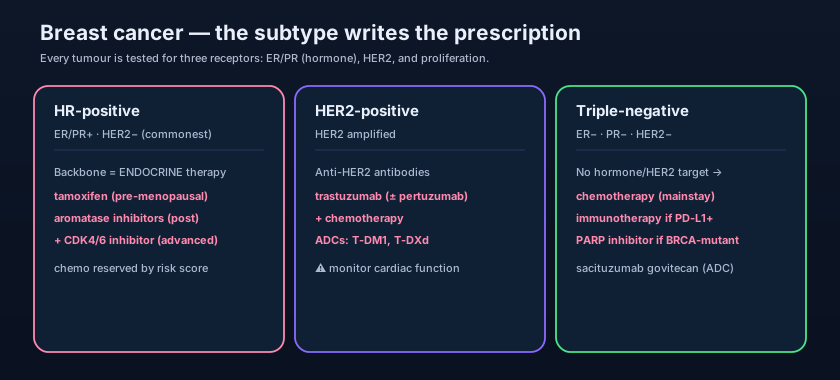
Every breast tumour is tested for the same three things. First, the hormone receptors (HR): the estrogen receptor (ER) and progesterone receptor (PR). If the cancer cells wear these receptors, estrogen feeds their growth — and that dependence is a target. Second, HER2 (human epidermal growth factor receptor 2), a growth-signal receptor that, when over-expressed, drives an aggressive but highly treatable cancer. Third, the proliferation rate (how fast the cells are dividing, often read as the Ki-67 index or the tumour grade). These three answers — ER/PR, HER2, and how fast it grows — sort breast cancer into a handful of molecular subtypes, and the subtype, not the organ, chooses the drug.
Reading those receptors is the job of precision oncology (see the Precision-oncology chapter): the same ER, HER2 and later BRCA tests that appear across cancers do their most decisive work here. Before we walk each subtype, hold one idea: the report doesn't just name the tumour, it hands you the treatment shortlist.
- Every breast tumour is tested for ER/PR (hormone receptors), HER2, and proliferation.
- These answers define the molecular SUBTYPE — the real driver of treatment.
- HR-positive → endocrine therapy; HER2-positive → anti-HER2 antibodies; triple-negative → chemotherapy.
- The same receptor tests are the precision-oncology tools used across cancers.
- Subtype, not tumour size, decides the drug road.
Road one — hormone-receptor positive (HR+/HER2−): starve it of estrogen
This is the commonest subtype — roughly two in three breast cancers. If the tumour is ER-positive, its growth depends on estrogen, so the backbone of treatment is endocrine (hormonal) therapy: take the estrogen signal away and the cancer stalls. The choice of endocrine drug depends on menopausal status. In a pre-menopausal woman the ovaries still make estrogen, so we use tamoxifen (a selective estrogen-receptor modulator that blocks ER in the breast), often with ovarian suppression. In a post-menopausal woman estrogen instead comes from converting androgens in fat via the enzyme aromatase, so we use an aromatase inhibitor (anastrozole, letrozole, exemestane) to shut that conversion down. The mechanisms live in the Breast-endocrine chapter — here the point is that the subtype UNLOCKS this whole class.
When HR+ disease is advanced or metastatic, endocrine therapy is combined with a CDK4/6 inhibitor — palbociclib, ribociclib or abemaciclib — an oral kinase inhibitor that blocks the cell-cycle engine (see the Kinase-inhibitors chapter). Adding it to an aromatase inhibitor or to fulvestrant markedly delays progression and is now standard first-line in advanced HR+/HER2− cancer. Chemotherapy is deliberately held back in early HR+ disease and used only when the risk is high — and gene-expression scores (like the 21-gene recurrence score) help decide exactly who needs it, sparing many women chemo they would not benefit from.
Aromatase inhibitors work by removing estrogen everywhere — including from bone, which needs estrogen to stay dense. So long-term aromatase-inhibitor therapy accelerates bone loss and fracture risk. The house rule: check bone density and give bone protection (calcium, vitamin D, and a bisphosphonate or denosumab when indicated) alongside an aromatase inhibitor. Tamoxifen, by contrast, is mildly PROTECTIVE of bone in post-menopausal women — a nice illustration that these drugs are not interchangeable.
Road two — HER2-positive: aim an antibody at the receptor
About one in five breast cancers over-expresses HER2. Left alone this is an aggressive subtype — but HER2 sits on the cell surface as an obvious target, and this is one of oncology's great success stories. The cornerstone is trastuzumab, a monoclonal antibody against HER2 (see the Monoclonal-antibodies chapter), given together with chemotherapy; adding a second antibody, pertuzumab, blocks HER2 even more completely and is standard in higher-risk and metastatic disease. What was once the worst prognosis became, with anti-HER2 therapy, one of the most treatable.
When HER2+ disease progresses, we escalate to antibody-drug conjugates (ADCs): T-DM1 (trastuzumab emtansine) and trastuzumab deruxtecan (T-DXd) fuse the HER2 antibody to a potent cytotoxic, delivering chemotherapy directly to the HER2-bearing cell like a guided missile. T-DXd in particular has become a powerful later-line option. But every drug in this road carries one shared warning: trastuzumab and its conjugates are cardiotoxic — they can weaken the heart muscle and drop the ejection fraction.
Trastuzumab cardiotoxicity is usually reversible if caught, but it becomes dangerous when the antibody is stacked with an anthracycline (like doxorubicin), which is itself cardiotoxic — the two together can seriously injure the heart. So regimens separate them in time and monitor cardiac function (ejection fraction) before and during therapy. The cardiotoxicity mechanisms live in the Cardiovascular section; here the rule is simply: never combine them casually, and always monitor the heart.
- HR+/HER2− (commonest): endocrine therapy is the backbone — tamoxifen (pre-menopausal) or an aromatase inhibitor (post-menopausal) ± ovarian suppression.
- Advanced HR+ disease adds a CDK4/6 inhibitor (palbociclib); chemo is risk-guided by gene-expression scores.
- HER2+: trastuzumab (± pertuzumab) + chemotherapy; ADCs (T-DM1, T-DXd) in later lines.
- Watch cardiotoxicity: never stack trastuzumab with an anthracycline unmonitored.
- Aromatase inhibitors thin bone — give bone protection; tamoxifen protects post-menopausal bone.
Road three — triple-negative (ER−/PR−/HER2−): no target, so hit hard
When all three receptors come back negative, both easy targets are gone. Triple-negative breast cancer (TNBC) has no hormone receptor to block and no HER2 to aim at, so endocrine therapy and anti-HER2 antibodies are both useless here. That leaves the oldest weapon as the mainstay: cytotoxic chemotherapy, typically an anthracycline (doxorubicin) plus a taxane (paclitaxel or docetaxel), often with a platinum agent (carboplatin) — the mechanisms are covered in the cytotoxic chapters. TNBC tends to be more aggressive, which is exactly why the treatment is more intensive. But "no receptor target" no longer means "no smart options": three newer targets have opened up.
First, immunotherapy: if the tumour expresses PD-L1, adding the checkpoint inhibitor pembrolizumab to chemotherapy improves outcomes. Second, PARP inhibitors: if the patient carries a germline BRCA mutation, drugs like olaparib or talazoparib exploit the tumour's broken DNA repair (see the Kinase-inhibitors chapter) — which is why BRCA testing is mandatory in TNBC. Third, an antibody-drug conjugate: sacituzumab govitecan targets the Trop-2 antigen and delivers a cytotoxic payload, now a standard option in pre-treated metastatic TNBC.
The shared road: surgery, radiotherapy, and timing
Drugs never travel alone. Most early breast cancers are treated with surgery (lumpectomy or mastectomy) and often radiotherapy — the local tools that remove and sterilize the tumour bed, and though they are not drug therapy they frame every regimen. What matters for the pharmacology is TIMING. Chemotherapy or targeted therapy given BEFORE surgery is neoadjuvant — it can shrink the tumour, allow breast-conserving surgery, and reveal how well the cancer responds. The same drugs given AFTER surgery are adjuvant — they mop up microscopic disease to prevent recurrence. HER2-positive and triple-negative tumours are commonly treated neoadjuvant; the response seen at surgery then guides what comes next.
- Giving endocrine therapy to a hormone-receptor-NEGATIVE tumour. No ER means no target — tamoxifen and aromatase inhibitors offer no benefit and only side effects.
- Forgetting to test HER2. Miss it and you miss trastuzumab — turning a highly treatable cancer back into an aggressive one.
- Stacking trastuzumab and an anthracycline without cardiac monitoring — a combination that can seriously damage the heart.
- Skipping BRCA testing in triple-negative disease. A germline BRCA mutation unlocks PARP inhibitors — a whole targeted option missed if never tested.
A post-menopausal woman has an ER-positive, PR-positive, HER2-negative early breast cancer. Which drug is the appropriate backbone of her systemic therapy?
- Three receptors — ER/PR, HER2, and proliferation — define the subtype, and the subtype chooses the drug.
- HR+/HER2− (commonest): endocrine therapy backbone (tamoxifen / aromatase inhibitor ± ovarian suppression), CDK4/6 inhibitor in advanced disease, chemo by risk score.
- HER2+: trastuzumab (± pertuzumab) + chemo, then ADCs (T-DM1, T-DXd) — watch cardiotoxicity.
- Triple-negative: chemotherapy mainstay + pembrolizumab (PD-L1+), PARP inhibitors (BRCA-mutant), or sacituzumab govitecan — always test BRCA.
- NCCN Clinical Practice Guidelines in Oncology — Breast Cancer (molecular subtypes, endocrine, HER2-targeted and triple-negative therapy).
- Cardoso F, et al. ESMO Clinical Practice Guidelines — Early and Metastatic Breast Cancer.
- Brunton LL, et al. Goodman & Gilman's The Pharmacological Basis of Therapeutics — Hormonal agents, HER2-targeted therapy & cytotoxics in breast cancer.
- Katzung BG. Basic & Clinical Pharmacology — Cancer chemotherapy: endocrine agents, monoclonal antibodies & targeted therapy.
- DeVita, Hellman & Rosenberg's Cancer: Principles & Practice of Oncology — Breast cancer subtypes and systemic treatment.