
Alkylating Agents and Platinum Drugs: Cross-Linking the DNA
These are the oldest and most brutal of the cytotoxics — drugs that don't wait for a cell to divide but attack its DNA directly, gluing the two strands together so it can never copy them again. But the same reactivity that kills the tumour scars the bladder, poisons the kidney, deafens the ear, and — years later — can seed a second cancer. To use them safely you have to give the antidote alongside the poison. This chapter is the story of that bargain.
A child sits in the infusion chair getting a high dose of cyclophosphamide for her lymphoma. But the nurse hangs TWO more bags beside the chemotherapy: litres of intravenous fluid, and a drug called MESNA. Neither of them fights the cancer. They are there for one reason only — to stop the chemotherapy's own toxic breakdown product from burning the lining of her bladder. It is a strange and elegant sight: we deliberately push fluids and an antidote at the same moment we push the poison. Understand WHY, and you understand the whole personality of the alkylating agents — ferociously reactive molecules that must be tamed even as they work.
The mechanism: gluing DNA shut
An alkylating agent does exactly what its name says. It attaches a reactive alkyl group onto DNA, most often onto the N7 position of guanine (Guanine). Many of these drugs are bifunctional — they carry two reactive arms — so a single molecule can grab a guanine on one strand and a guanine on the other, welding the two strands of the double helix together. This is a cross-link. A cross-linked DNA cannot unzip, so it cannot be replicated or transcribed; the cell trips its damage sensors and dies by apoptosis. Because the attack is on DNA that already exists, it does not need the cell to be dividing at that instant.
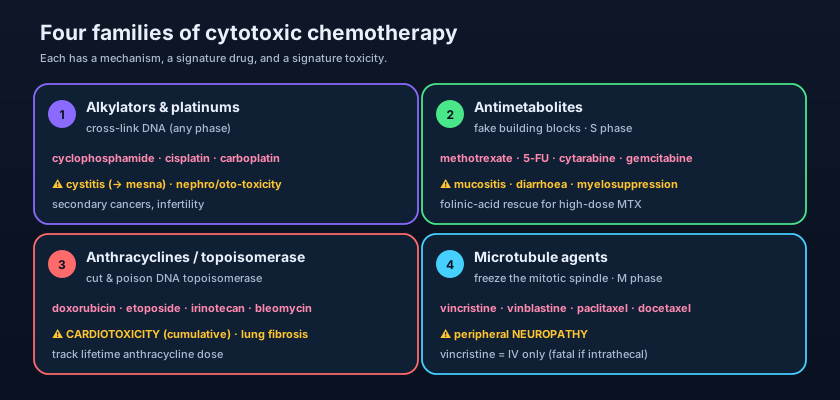
That last point is the defining property: alkylating agents are cell-cycle NON-specific. Unlike the antimetabolites (which strike only cells actively copying DNA in S phase), an alkylator can damage a resting cell too. The platinum drugs — cisplatin, carboplatin, oxaliplatin — are technically not classical alkylators, but they behave like them: the platinum atom forms covalent adducts and cross-links with DNA guanines, again jamming replication. So for exam purposes group them together as the DNA cross-linkers.
"Cell-cycle non-specific" is not just trivia — it has a clinical consequence. Because these drugs hit resting cells, their dose-response is roughly proportional to dose (log-kill), which is why alkylating agents are the backbone of high-dose regimens before bone-marrow transplant: crank the dose up and you kill more cells regardless of where they are in the cycle. The price is that normal resting stem cells are hit too.
Cyclophosphamide and ifosfamide: the poison with a built-in antidote
Cyclophosphamide is the most widely used alkylating agent, appearing everywhere from lymphomas and breast cancer to autoimmune disease. It is a prodrug: harmless as given, it is activated by the LIVER (cytochrome P450) into its cytotoxic metabolites. One of those metabolites is acrolein, a chemical irritant that is filtered into the urine and concentrates in the bladder — where it inflames and ulcerates the lining, causing haemorrhagic cystitis (bloody, painful urination that can become severe).
MESNA (2-mercaptoethane sulfonate) is given alongside cyclophosphamide and, especially, ifosfamide. It is concentrated in the urine and there its sulfhydryl (–SH) group binds and neutralizes acrolein before it can damage the bladder. Combined with aggressive hydration and frequent voiding to dilute and flush the urine, MESNA prevents the cystitis. Ifosfamide is a close cousin of cyclophosphamide with even MORE acrolein production (so MESNA is mandatory) plus a distinctive neurotoxicity (encephalopathy).
- Alkylating agents add alkyl groups to DNA guanine and CROSS-LINK the strands.
- They are cell-cycle NON-specific — they can hit resting cells too.
- Cyclophosphamide is a liver-activated prodrug; its metabolite acrolein causes haemorrhagic cystitis.
- MESNA + hydration prevent the cystitis; MESNA is mandatory with ifosfamide.
- Platinum drugs are not classical alkylators but act the same way — DNA adducts and cross-links.
The platinums: three cousins, three toxicity fingerprints
The three platinum drugs share a mechanism but differ sharply in what they poison. Cisplatin is the prototype and the most potent — but also the most toxic. Its signature is severe NEPHROTOXICITY (it directly injures the renal tubules), OTOTOXICITY (high-frequency hearing loss and tinnitus), a dose-limiting peripheral NEUROPATHY, and it is one of the most intensely emetogenic drugs in all of oncology. To use it safely you must give aggressive intravenous hydration (to protect the kidney) together with powerful antiemetics (a 5-HT3 blocker + a neurokinin-1 blocker + a steroid).
Carboplatin was designed to be gentler on the kidney and far less emetogenic than cisplatin — but the toxicity didn't vanish, it MOVED. Carboplatin's dose-limiting problem is MYELOSUPPRESSION, especially thrombocytopenia. Because its clearance is renal and predictable, it is not dosed by body surface area but by the Calvert formula, which targets a chosen area-under-the-curve (AUC) using the patient's kidney function (GFR). "Cisplatin poisons the kidney; carboplatin poisons the marrow" is the one-line contrast to memorize.
Oxaliplatin's fingerprint is a peculiar COLD-induced peripheral neuropathy: within hours of the infusion, touching anything cold — a cold drink, a metal doorknob, cold air — triggers painful tingling and even throat tightness. Patients are told to avoid cold. It causes little nephrotoxicity and is the platinum used in colorectal cancer as part of the FOLFOX regimen (with 5-fluorouracil and leucovorin).
The rest of the family: one drug, one association
A handful of other alkylators are worth knowing by their single most testable association. Busulfan is used to condition patients before bone-marrow transplant and is notorious for pulmonary FIBROSIS ("busulfan lung"). Melphalan is a mainstay of multiple MYELOMA. Temozolomide is an oral alkylator that crosses into the brain and is the standard partner of radiotherapy in GLIOBLASTOMA. Nitrosoureas (carmustine, lomustine) are highly lipid-soluble and cross the blood–brain barrier, so they too are used for brain tumours. Dacarbazine features in Hodgkin lymphoma (the ABVD regimen) and melanoma, and chlorambucil is a gentle oral agent for chronic lymphocytic leukaemia.
The class carries a shadow that outlives the treatment. Because they damage the DNA of NORMAL cells too, alkylating agents (and platinums) raise the long-term risk of SECONDARY malignancies — classically a treatment-related acute myeloid leukaemia years later — and they frequently cause INFERTILITY by destroying germ cells. This is why fertility counselling and sperm/egg banking are offered before treatment, especially in young patients like the child in our scene.
- Cisplatin: nephrotoxic, ototoxic, neuropathy, intensely emetogenic → needs hydration + strong antiemetics.
- Carboplatin: less nephro/emetic but MORE myelosuppressive; dosed by Calvert AUC formula.
- Oxaliplatin: cold-induced neuropathy; used in colorectal FOLFOX.
- Busulfan → lung fibrosis; melphalan → myeloma; temozolomide → glioblastoma (oral, CNS).
- Whole class: cell-cycle non-specific, risk of secondary malignancy and infertility.
- Giving cyclophosphamide or (especially) ifosfamide without MESNA and hydration — that is how you cause haemorrhagic cystitis.
- Forgetting that cisplatin needs pre-hydration to protect the kidneys; running it "dry" risks acute renal failure.
- Confusing carboplatin (myelosuppressive, AUC-dosed) with cisplatin (nephrotoxic, BSA-dosed) — they are not interchangeable.
- Assuming alkylators only work on dividing cells — they are cell-cycle non-specific and hit resting cells too.
A child receiving high-dose cyclophosphamide is co-administered MESNA and generous IV fluids. The primary purpose is to prevent:
- Alkylators & platinums cross-link DNA (guanine), are cell-cycle non-specific, and damage resting cells.
- Cyclophosphamide/ifosfamide → acrolein → haemorrhagic cystitis; prevented by MESNA + hydration.
- Cisplatin = nephro/oto-toxic + emetogenic (hydrate); carboplatin = myelosuppressive (AUC); oxaliplatin = cold neuropathy.
- The whole class carries a long-term risk of secondary malignancy and infertility.
- Katzung BG. Basic & Clinical Pharmacology — Cancer Chemotherapy: alkylating agents & platinum analogs.
- Brunton LL, et al. Goodman & Gilman's The Pharmacological Basis of Therapeutics — Cytotoxic agents: alkylating agents and the platinum coordination complexes.
- Whalen K. Lippincott Illustrated Reviews: Pharmacology — Anticancer drugs: alkylating agents & platinum coordination complexes.
- Rang HP, Dale MM, et al. Rang & Dale's Pharmacology — Anticancer drugs: agents acting directly on DNA.
- Chabner BA, Longo DL. Cancer Chemotherapy and Biotherapy: Principles and Practice — Alkylating agents & platinum compounds.