
Endocrine Therapy for Breast Cancer: Starving a Hormone-Driven Tumour
About seven in ten breast cancers carry oestrogen receptors — they don't just tolerate the hormone, they depend on it to grow. That single fact turns a cancer into a target we can hit without chemotherapy: block the oestrogen signal and the tumour stalls. But every lever we pull — a receptor blocker, an oestrogen-synthesis switch, an ovary shut down — carries its own price. This is the logic of denying a tumour the fuel it lives on.
A woman in her forties sits across from her oncologist reading a pathology report she barely understands, except for two words circled in ink: ER-positive. Her tumour's cells are studded with oestrogen receptors — thousands of tiny locks waiting for a hormone her own body makes every day. She braced herself for chemotherapy, the drips and the lost hair. Instead she is handed a small white tablet to take once a day. It will not poison her cells; it will quietly deny them the hormone they live on, and it may hold the cancer in check for years. The trade-off is written on the same page: a raised risk of blood clots, and a yearly watch on the lining of her womb.
Why the receptor is everything: a biomarker that picks the drug
Endocrine therapy only works if the tumour listens to hormones. Roughly 70% of breast cancers are hormone-receptor positive: their cells express the oestrogen receptor (ER) and often the progesterone receptor (PR). Oestrogen binds the ER, the complex switches on genes that drive the cancer cell to divide, and the tumour grows. So the receptor status, read off the biopsy by immunohistochemistry, is a predictive biomarker — it does not just describe the tumour, it decides the treatment. An ER-positive tumour is a valid target for hormone blockade; an ER-negative one is not, and endocrine drugs will do nothing for it. This is the same predictive-biomarker logic that runs through the whole Precision oncology chapter: test first, then treat.
Where does the oestrogen come from? In pre-menopausal women, the ovaries are the main factory, driven by the pituitary's LH and FSH. After menopause the ovaries fall silent, but oestrogen does not vanish — it is now made in peripheral tissues (fat, muscle, skin, and the tumour itself) by an enzyme called aromatase, which converts androgens into oestrogen. That single difference in the source of oestrogen — ovary versus aromatase — is why the SAME cancer is treated with different drugs before and after menopause. The oestrogen and aromatase physiology behind this lives in the Endocrine sex-hormones section.
- ~70% of breast cancers are hormone-receptor (ER/PR) positive and depend on oestrogen.
- ER status is a predictive biomarker — it decides whether endocrine therapy can work at all.
- Pre-menopause: ovaries are the main oestrogen source (driven by LH/FSH).
- Post-menopause: oestrogen comes from peripheral aromatase converting androgens.
- The oestrogen source dictates which drug class fits the patient.
SERMs: tamoxifen, a drug with two faces
The oldest and still central drug blocks the receptor itself. Tamoxifen is a selective oestrogen-receptor modulator (SERM). "Selective" and "modulator" are the whole point: it is not a pure blocker. In breast tissue it acts as an antagonist — it sits in the oestrogen receptor and blocks the growth signal. But in other tissues it behaves as an agonist, mimicking oestrogen: in bone (helpfully, preserving bone density) and in the uterus (unhelpfully, stimulating the endometrium). One molecule, opposite effects depending on the tissue. Tamoxifen is the mainstay of endocrine therapy especially in pre-menopausal women, because it blocks the receptor no matter where the oestrogen comes from — it does not care whether the ovary or aromatase is making it.
Tamoxifen's side effects read straight off its two faces. Blocking oestrogen in the breast and brain gives hot flushes. Its oestrogen-LIKE agonism in the uterus raises the risk of endometrial cancer, so any abnormal vaginal bleeding in a woman on tamoxifen must be investigated. And, like oestrogen itself, it is pro-thrombotic — it raises the risk of venous thromboembolism (VTE): deep vein thrombosis and pulmonary embolism. The VTE mechanism ties directly into the clotting cascade covered in the Cardiovascular section.
Tamoxifen is a prodrug: it is inactive until the liver enzyme CYP2D6 converts it into its potent active metabolite, endoxifen. This matters clinically. A woman who is a CYP2D6 poor metaboliser — genetically, or because she is taking a strong CYP2D6 INHIBITOR — makes less endoxifen and may get less benefit from the drug. The classic trap: prescribing a strong CYP2D6-inhibiting antidepressant such as paroxetine or fluoxetine to a woman on tamoxifen (often for the very hot flushes tamoxifen causes) can blunt its anticancer effect. Prefer an antidepressant that spares CYP2D6, like venlafaxine. This prodrug story is a headline example in the Pharmacodynamics individual-variation chapter.
Aromatase inhibitors: switching off the peripheral factory
The second great class attacks the supply instead of the receptor. Aromatase inhibitors (AIs) — anastrozole, letrozole (non-steroidal) and exemestane (steroidal) — block aromatase, the enzyme that makes oestrogen out of androgens in peripheral tissue. Cut off the enzyme and oestrogen levels collapse. But here is the crucial constraint: AIs only work where aromatase is the main source of oestrogen — that is, in post-menopausal women. They do nothing to the ovaries. Give an AI to a pre-menopausal woman and her active ovaries simply keep making oestrogen (and the low-oestrogen feedback may even push the ovaries to work harder). So AIs are for post-menopausal women, or for pre-menopausal women only when combined with ovarian suppression.
Because AIs drive oestrogen almost to zero everywhere, they cause the toxicities of oestrogen deprivation: accelerated bone loss leading to osteoporosis and fractures, and joint pain (arthralgia and stiffness) that is a common reason women stop the drug. So a patient starting an AI needs baseline and periodic bone-density (DEXA) monitoring and often calcium, vitamin D, and sometimes a bisphosphonate. Contrast this with tamoxifen, which PROTECTS bone via its agonist effect — the two mainstays have mirror-image bone profiles. Bone protection and osteoporosis management are covered in the Endocrine bone chapter.
- Tamoxifen (SERM): antagonist in breast, agonist in bone and uterus.
- Tamoxifen toxicities: hot flushes, VTE, endometrial cancer (uterine agonism).
- Tamoxifen is a CYP2D6 prodrug → avoid strong CYP2D6 inhibitors (paroxetine/fluoxetine).
- Aromatase inhibitors (anastrozole, letrozole, exemestane) block androgen→oestrogen conversion.
- AIs work only post-menopause (or with ovarian suppression); they don't touch ovaries.
- AI toxicities: osteoporosis/fractures and arthralgia — monitor bone density.
Shutting the ovary, degrading the receptor, and stopping the cell cycle
Three more tools complete the toolkit. First, ovarian suppression: in a pre-menopausal woman we can silence the ovaries with a GnRH (LHRH) agonist such as goserelin. Given continuously, it paradoxically shuts down the pituitary–gonadal axis (after a brief flare), so the ovaries stop making oestrogen — a reversible, medical menopause that then allows an AI to be used. Second, the SERD: fulvestrant is a selective oestrogen-receptor DEGRADER — instead of just blocking the receptor it triggers its destruction, removing the receptor entirely (a pure antagonist with no agonist face). Third, targeted add-ons: in advanced hormone-receptor-positive disease we pair endocrine therapy with a CDK4/6 inhibitor such as palbociclib, which blocks the cell-cycle machinery downstream and markedly improves control.
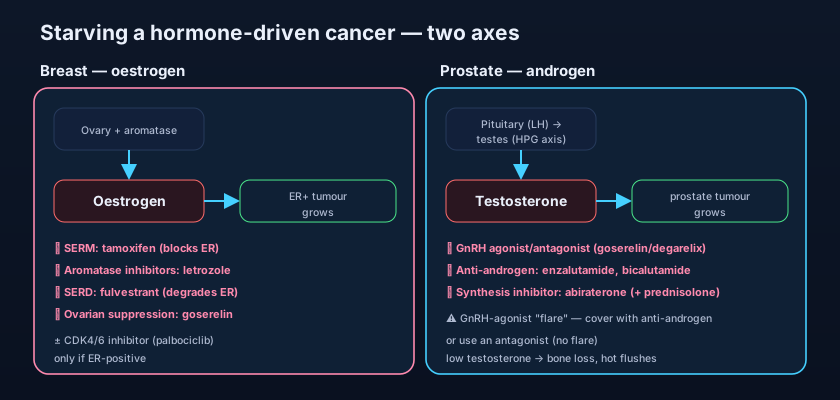
Notice the symmetry the figure captures. Breast cancer and prostate cancer are mirror images: one runs on oestrogen, the other on androgen (testosterone). In both, we treat by denying the tumour its driving hormone — either by blocking the receptor or by shutting down the hormone's production. The prostate side, where GnRH agonists and anti-androgens do to the androgen axis what our breast drugs do to the oestrogen axis, is the subject of the next chapter.
- Giving endocrine therapy in ER-NEGATIVE breast cancer. With no oestrogen receptor to block, there is no benefit — the tumour ignores the drug entirely.
- Using an aromatase inhibitor in a pre-menopausal woman WITHOUT ovarian suppression. Her active ovaries keep making oestrogen, so the AI cannot control it.
- Co-prescribing a strong CYP2D6-inhibitor antidepressant (paroxetine) with tamoxifen — it blocks conversion to active endoxifen and blunts the anticancer effect.
- Ignoring bone health on an AI, or dismissing new vaginal bleeding on tamoxifen — both are predictable, monitorable harms.
A 45-year-old PRE-menopausal woman with ER-positive breast cancer is prescribed anastrozole (an aromatase inhibitor) alone. Why is this inappropriate?
- ~70% of breast cancers are ER/PR positive; ER status is the biomarker that gates endocrine therapy.
- Tamoxifen (SERM): breast antagonist, uterus/bone agonist; watch VTE and endometrial cancer; CYP2D6 prodrug.
- Aromatase inhibitors block androgen→oestrogen conversion — post-menopause only; watch osteoporosis.
- Ovarian suppression (goserelin), SERD (fulvestrant) and CDK4/6 inhibitors (palbociclib) complete the toolkit.
- Breast (oestrogen) and prostate (androgen) are mirror-image hormone-driven cancers.
- Katzung BG. Basic & Clinical Pharmacology — Gonadal hormones & inhibitors; cancer chemotherapy: hormonal agents (SERMs, aromatase inhibitors, GnRH analogues).
- Brunton LL, et al. Goodman & Gilman's The Pharmacological Basis of Therapeutics — Estrogens, SERMs & antiestrogens; endocrine therapy of breast cancer.
- NCCN Clinical Practice Guidelines in Oncology — Breast Cancer: adjuvant and metastatic endocrine therapy.
- Whalen K. Lippincott Illustrated Reviews: Pharmacology — Anticancer drugs: hormones and hormone antagonists.
- Rang HP, Dale MM, et al. Rang & Dale's Pharmacology — Sex hormones & drugs used in cancer.