
CAR-T and Cellular Therapy: Reprogramming the Patient's Own T Cells
Every chemotherapy failed. The leukaemia kept coming back. So the team tried something that sounds like science fiction: they drew out the child's own T cells, rewrote their DNA in a lab so each one carried a receptor tuned to the cancer, grew them into an army, and gave them back. Within days the tumour was melting — and the child spiked a raging fever with crashing blood pressure. This is CAR-T: a living drug, its miracle and its signature storm.
A seven-year-old girl has survived every drug the ward could offer, and her leukaemia has survived them too — relapsing again and again. There is no next chemotherapy. So the team does something stranger: they connect her to a machine that separates out her white cells, sending back the rest of her blood. Her own T cells travel to a laboratory, where a disabled virus stitches a new gene into them — a receptor built to grip a marker on the cancer cells. The engineered cells multiply in flasks for days, then are frozen, shipped back, and, after a short course of chemo to clear space, dripped into her vein. They do not just circulate. They divide inside her, hunting. And on day three the storm arrives — 40°C fever, plunging blood pressure, gasping breaths. The team is calm: this is expected. They give one antibody, tocilizumab, and the storm quiets.
A living drug: what makes CAR-T different
Ordinary drugs are molecules; CAR-T is a cell. Chimeric antigen receptor T-cell therapy (CAR-T) takes the patient's own T lymphocytes and genetically engineers them to express a Chimeric Antigen Receptor (CAR) — a synthetic protein on the cell surface that recognises a chosen tumour marker and, when it binds, switches the T cell fully on. Because the infused cells are alive, they do what no pill can: they proliferate inside the body, persist, and can even provide long-term surveillance. This is why the field calls CAR-T a "living drug" — the dose expands itself.
The receptor is called "chimeric" because it is stitched together from parts of different origins: an outer antibody-derived fragment that recognises the antigen, fused to inner T-cell signalling domains that trigger activation and a co-stimulatory domain (such as CD28 or 4-1BB) that drives the cell to expand and survive. Cleverly, a CAR recognises its target directly, without needing the antigen to be presented on MHC — so tumours that hide by downregulating MHC cannot escape this way.
Contrast the two great immunotherapies in one line. Checkpoint inhibitors RELEASE the brakes on T cells the patient already has; CAR-T MANUFACTURES bespoke T cells with a brand-new targeting system. One unleashes an existing army; the other builds a custom one. (For the checkpoint side of the story, see the previous chapter on checkpoint inhibitors in this Immunotherapy section.)
The manufacturing journey: from vein to vein
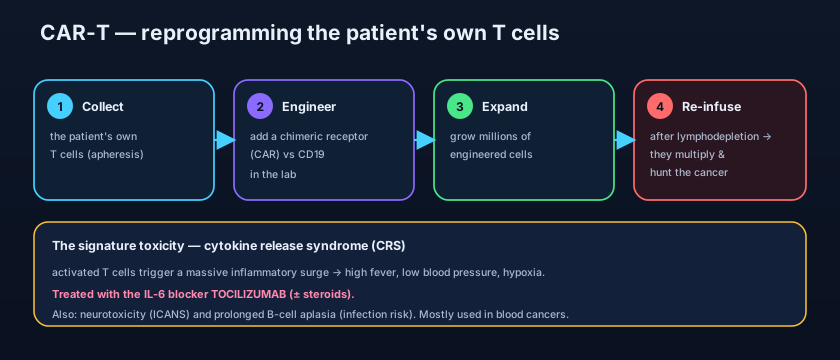
The process runs in five steps. First, COLLECTION: the patient's T cells are harvested by leukapheresis (apheresis), a machine filtering out white cells and returning the rest of the blood. Second, ENGINEERING: in the lab a viral vector inserts the CAR gene into those T cells. Third, EXPANSION: the engineered cells are grown into the millions over one to two weeks. Fourth, LYMPHODEPLETION: the patient receives a short course of chemotherapy (typically fludarabine plus cyclophosphamide) to clear existing lymphocytes and make room — this greatly improves how well the CAR-T cells engraft and expand. Fifth, RE-INFUSION: the cells are given back intravenously, where they find their target and multiply.
Where it works: relapsed B-cell cancers
CAR-T shines where nothing else is left. Its most dramatic results are in relapsed or refractory (r/r) B-cell malignancies. The classic target is CD19, a marker carried on nearly all B cells. CD19 CAR-T products treat B-cell acute lymphoblastic leukaemia (B-ALL) and large B-cell lymphoma, producing durable remissions in patients who had exhausted every other option. A second target, BCMA (B-cell maturation antigen), is used in multiple myeloma. So far the wins are overwhelmingly in blood cancers — these tumours float in accessible blood and marrow and carry clean, shared surface markers. (For the underlying diseases, see the blood-cancer chapters — leukaemia, lymphoma and myeloma — in the Haematology section.)
CD19 CAR-T: tisagenlecleucel (Kymriah) — approved for paediatric/young-adult B-ALL and large B-cell lymphoma; axicabtagene ciloleucel (Yescarta) — for large B-cell lymphoma. BCMA CAR-T for multiple myeloma: idecabtagene vicleucel (Abecma) and ciltacabtagene autoleucel (Carvykti). Each is manufactured individually for one patient — you cannot pull it off a shelf.
- CAR-T = the patient's own T cells engineered to express a chimeric antigen receptor.
- Five steps: collect (apheresis) → engineer → expand → lymphodeplete → re-infuse.
- CD19 is the classic target for B-ALL and large B-cell lymphoma; BCMA for myeloma.
- It is a "living drug": the infused cells proliferate and persist inside the body.
- Successes are mostly in blood cancers; solid tumours remain much harder.
The signature storm: CRS and ICANS
The very power of CAR-T — massive, self-amplifying T-cell activation — produces two toxicities almost unique to this class. Cytokine release syndrome (CRS) is a surge of inflammatory cytokines as the activated cells engage the tumour: high fever, hypotension, hypoxia, and in severe cases multi-organ dysfunction. It usually begins in the first days after infusion. The key mediator is interleukin-6 (IL-6), which gives us a precise antidote: tocilizumab, an anti-IL-6-receptor antibody, blunts CRS quickly — with corticosteroids added for severe or refractory cases. (Tocilizumab and IL-6 blockade also appear in the Inflammation section, where the same biology is turned against rheumatoid disease.)
The second toxicity is neurological: immune-effector-cell-associated neurotoxicity syndrome (ICANS) — confusion, difficulty finding words (aphasia), tremor, and in severe cases seizures or cerebral oedema. It may follow or accompany CRS and is graded and monitored closely. Importantly, ICANS often responds less well to tocilizumab (which penetrates the brain poorly) and is managed mainly with corticosteroids. A third, more predictable effect is B-cell aplasia: because CD19 sits on normal B cells too, CD19 CAR-T wipes them out along with the cancer — leaving low immunoglobulins and a lasting infection risk that may need immunoglobulin replacement.
Fever and hypotension days after infusion look exactly like septic shock — and the two can coexist. The difference matters: sepsis needs antibiotics and source control, while CRS needs tocilizumab (and sometimes steroids). Teams cover for infection AND give tocilizumab when CRS is likely, rather than waiting; missing the tocilizumab window lets a treatable syndrome escalate.
- CRS = inflammatory cytokine surge (fever, hypotension, hypoxia) days after infusion.
- IL-6 drives CRS → tocilizumab is the specific treatment, ± corticosteroids.
- ICANS = neurotoxicity (confusion, aphasia, seizures); managed mainly with steroids.
- B-cell aplasia follows CD19 CAR-T → low immunoglobulins and infection risk.
- CRS mimics sepsis — cover infection but do not miss the tocilizumab window.
The wider cellular landscape
CAR-T is one member of a growing family. Bispecific T-cell engagers (BiTEs), such as blinatumomab, are an off-the-shelf alternative: a single antibody molecule with two arms — one gripping CD19 on the tumour, the other CD3 on any passing T cell — physically bridging them so the patient's own T cells kill the cancer, no manufacturing required. They too can cause CRS. Cancer vaccines aim to prime the immune system against tumour antigens, and oncolytic viruses are engineered to infect and burst tumour cells while alerting immunity. CAR-T remains the most personalised — and most logistically demanding — of them all.
- Mistaking cytokine release syndrome for plain sepsis and missing the tocilizumab window. Cover infection, but treat likely CRS promptly.
- Forgetting that CD19 CAR-T causes prolonged B-cell aplasia — a real infection risk that may need immunoglobulin support.
- Expecting current CAR-T to work in solid tumours. Today its wins are overwhelmingly in blood cancers.
- Confusing CAR-T with checkpoint inhibitors. Checkpoint drugs release existing T cells; CAR-T manufactures new, retargeted ones.
A patient develops high fever and hypotension three days after CD19 CAR-T infusion. Which treatment specifically targets the driver of cytokine release syndrome?
- CAR-T re-engineers the patient's own T cells to target a tumour marker (classically CD19) — a self-expanding "living drug".
- Steps: collect (apheresis) → engineer the CAR → expand → lymphodeplete → re-infuse.
- Best results in relapsed B-cell cancers (B-ALL, large B-cell lymphoma; BCMA for myeloma); solid tumours remain hard.
- Signature toxicities: CRS (→ tocilizumab), ICANS (→ steroids), and B-cell aplasia (→ IVIG).
- DeVita VT, Lawrence TS, Rosenberg SA. DeVita, Hellman, and Rosenberg's Cancer: Principles & Practice of Oncology — Adoptive cell therapy & CAR-T cells.
- June CH, Sadelain M. Chimeric Antigen Receptor Therapy. N Engl J Med. 2018;379:64–73.
- Lee DW, et al. ASTCT Consensus Grading for Cytokine Release Syndrome and Neurologic Toxicity (ICANS). Biol Blood Marrow Transplant. 2019.
- Maude SL, et al. Tisagenlecleucel in Children and Young Adults with B-Cell Lymphoblastic Leukemia. N Engl J Med. 2018;378:439–448.
- Brudno JN, Kochenderfer JN. Recent advances in CAR T-cell toxicity: mechanisms, manifestations and management. Blood Rev. 2019.