
Immune Checkpoint Inhibitors: Taking the Brakes Off the Immune System
For decades chemotherapy fought cancer by poisoning it — attacking the tumour directly and, too often, the patient with it. Checkpoint inhibitors do something stranger and more elegant: they don't touch the tumour at all. They un-cuff the patient's own T cells and let the immune system finish the job. The result can be a durable remission in a disease that was, a few years earlier, a death sentence. The price is a new kind of toxicity — an immune system let off the leash — and learning to manage it is the whole art.
A 46-year-old woman is told she has metastatic melanoma — spread to the liver and lungs. A decade earlier this diagnosis carried a median survival measured in months. Instead of chemotherapy she is given an antibody, an infusion every few weeks, that does not attack her tumour at all. Two years on she is alive, scans clear, back at work. But the story has a shadow: six weeks into treatment she develops relentless watery diarrhoea and cramping — immune colitis. Her own T cells, released from their brakes, are now attacking her gut. She needs corticosteroids, not more of the drug. In one patient you see both faces of checkpoint blockade: the durable cure that chemotherapy could never give, and the price of an immune system finally let off the leash.
Why the immune system has brakes at all
A T cell is a loaded weapon, and loaded weapons need safeties. To attack, a T cell needs two signals: recognition of an antigen through its receptor, and a second "go" signal of co-stimulation. But the body also builds in "off" switches — checkpoints — to stop an activated T cell from running amok and attacking healthy tissue. These brakes are what prevent everyday autoimmunity. Two of them matter most in cancer therapy: CTLA-4, which dampens T cells early, in the lymph node where they are first primed; and PD-1, which shuts them down later, out in the tissues where they meet their target. Both exist for a good reason — they are the reason your immune system doesn't destroy you.
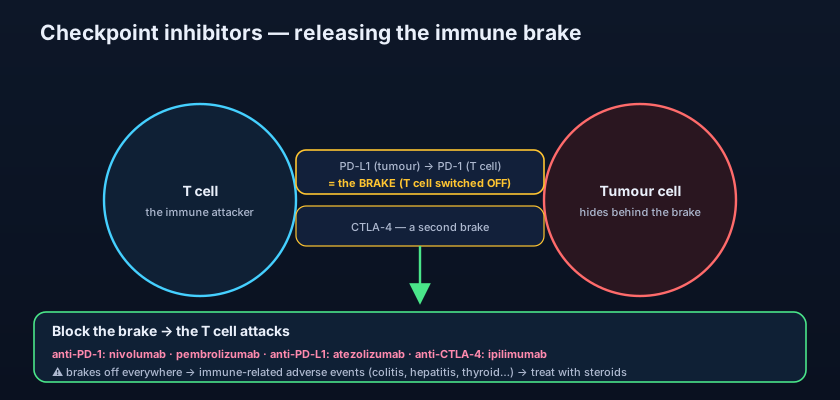
The key player is the PD-1 / PD-L1 pair. PD-1 sits on the T cell; its partner ligand PD-L1 sits on other cells. When PD-L1 grips PD-1, it is a handshake that means "stand down — I'm friendly." Healthy tissues display PD-L1 precisely to reassure passing T cells and avoid being attacked. It is an honest signal in a healthy body. The trouble begins when a tumour learns to forge it.
How tumours exploit the brakes
A cancer cell is, genetically, a mess — full of mutated proteins the immune system could recognize as foreign. So why doesn't it get destroyed? Because many tumours evolve a simple trick: they cover themselves in PD-L1. When a killer T cell finally reaches the tumour and engages it, the tumour's PD-L1 grips the T cell's PD-1 and delivers the "stand down" signal. The T cell, believing it has met a friendly, healthy cell, switches itself off — becomes "exhausted" — right at the moment it should be firing. The tumour has hijacked the body's own safety switch and pressed the brake on the very cells sent to kill it.
The whole logic reverses the old cancer-drug mindset. Chemotherapy asks "how do I poison the tumour?" Checkpoint blockade asks "how do I stop the tumour from silencing the immune cells that already recognize it?" The drug never kills a single cancer cell directly — it releases the T cell to do it. That is why responses can be so durable: a re-awakened immune system has memory, and can keep patrolling for years after the infusions stop.
The drugs: antibodies that block the brake
Every checkpoint inhibitor is a monoclonal antibody aimed at one of the brake's two ends. Block PD-1 on the T cell, or block PD-L1 on the tumour, and the "stand down" handshake can no longer form — the T cell stays switched on. Anti-PD-1 antibodies: nivolumab and pembrolizumab. Anti-PD-L1 antibodies: atezolizumab and durvalumab. Along a separate axis, anti-CTLA-4: ipilimumab, which releases the earlier brake in the lymph node. Because CTLA-4 and PD-1 act at different stages, blocking both at once (ipilimumab plus nivolumab) is more potent than either alone — and, predictably, more toxic. The combination trades a higher response rate for a much higher rate of serious immune side effects.
Anti-PD-1: nivolumab (Opdivo), pembrolizumab (Keytruda). Anti-PD-L1: atezolizumab (Tecentriq), durvalumab (Imfinzi). Anti-CTLA-4: ipilimumab (Yervoy). Pembrolizumab was the first drug ever approved by the FDA on a biomarker alone, regardless of where the tumour started — for any MSI-high / mismatch-repair-deficient solid tumour. Ipilimumab plus nivolumab is a standard combination for advanced melanoma and renal cell carcinoma when maximum potency is worth the added toxicity.
- Checkpoints (PD-1/PD-L1, CTLA-4) are normal brakes that prevent autoimmunity.
- Tumours over-express PD-L1 to press the PD-1 brake and switch off attacking T cells.
- Inhibitors are monoclonal antibodies that block the brake — they don't kill tumour cells directly.
- Anti-PD-1: nivolumab, pembrolizumab. Anti-PD-L1: atezolizumab, durvalumab. Anti-CTLA-4: ipilimumab.
- Combining CTLA-4 + PD-1 blockade is more potent but markedly more toxic.
- The hallmark benefit is a durable, sometimes long-lasting response — a true paradigm shift.
Where they work — and the biomarker that decides
Checkpoint inhibitors transformed the outlook in a growing list of cancers: metastatic melanoma (where the story began), non-small-cell lung cancer, renal cell (kidney) carcinoma, bladder (urothelial) cancer, head-and-neck squamous cancers, and classical Hodgkin lymphoma. But the deepest idea is tissue-agnostic therapy: for tumours that are MSI-high or mismatch-repair-deficient — a defect that leaves the cancer riddled with mutations and therefore highly visible to T cells — a checkpoint inhibitor can work regardless of which organ the cancer arose in. The biomarker, not the anatomy, decides. This links directly to the Precision oncology chapter, where MSI status and PD-L1 expression are read as predictive markers before therapy is chosen; and to the Skin cancer chapter, where melanoma remains the flagship success.
The distinctive price: immune-related adverse events
Release the brakes broadly, and the immune system can turn on normal organs too. These drugs don't sharpen the immune system only against the tumour — they lift a general safety and let self-tolerance slip everywhere. The result is a family of toxicities unlike anything in classical chemotherapy: immune-related adverse events (irAEs). Almost any organ can be attacked. The common patterns are colitis (diarrhoea), hepatitis (a rise in liver enzymes), pneumonitis (cough and breathlessness), and dermatitis (rash and itch). And a category students routinely under-appreciate: the endocrinopathies — thyroiditis, hypophysitis (inflammation of the pituitary), adrenal insufficiency, and even new-onset type 1 diabetes. These endocrine attacks connect to the Endocrine section, because a patient may present months later with nothing but fatigue that turns out to be an underactive thyroid or a failing pituitary.
The management is where checkpoint toxicity truly parts ways from chemotherapy — and where the exam questions live. A chemotherapy side effect (say, low blood counts) is usually handled by reducing the dose or delaying it. An irAE is not a dose problem; it is an autoimmune attack. So the response is fundamentally different: hold the drug and give corticosteroids (high-dose steroids, and for severe or steroid-refractory cases, stronger immunosuppression such as infliximab). You are not softening a toxic dose — you are calling off an immune assault. This links to the Inflammation section, where the same corticosteroid and immunosuppressant principles are taught in full. Two further quirks: irAEs can appear at any time — weeks to many months in, and sometimes even after the drug has been stopped, because the re-awakened immune response outlives the last infusion. And a paradox worth knowing: developing an irAE is often associated with a better tumour response, a sign the immune system is genuinely switched on.
- irAEs are autoimmune attacks on normal organs, not classical dose-dependent toxicity.
- Common targets: colitis, hepatitis, pneumonitis, dermatitis.
- Don't miss the endocrinopathies: thyroiditis, hypophysitis, adrenal insufficiency, type 1 diabetes.
- Management = hold the drug + corticosteroids (± stronger immunosuppression), not dose reduction.
- irAEs can appear late — months in, or even after stopping the drug.
- Managing an irAE like ordinary chemo toxicity — reducing the dose instead of stopping the drug and starting corticosteroids/immunosuppression.
- Missing subtle endocrinopathies: unexplained fatigue after a checkpoint inhibitor demands checking the thyroid, adrenal axis and pituitary.
- Assuming toxicity only occurs during treatment. irAEs can emerge weeks to months in — and even after the drug has been stopped.
A patient on nivolumab for metastatic melanoma develops profuse diarrhoea and abdominal cramps eight weeks into treatment. What is the most appropriate management?
- Checkpoints (PD-1/PD-L1, CTLA-4) are brakes preventing autoimmunity; tumours exploit them to switch off attacking T cells.
- Inhibitors are antibodies that block the brake — anti-PD-1 (nivolumab, pembrolizumab), anti-PD-L1 (atezolizumab, durvalumab), anti-CTLA-4 (ipilimumab) — releasing the T cell rather than killing the tumour directly.
- Used in melanoma, NSCLC, renal, bladder, head-and-neck, Hodgkin, and any MSI-high/MMR-deficient tumour — the biomarker, not the organ, decides.
- The signature toxicity is irAEs — colitis, hepatitis, pneumonitis, dermatitis, endocrinopathies — managed by holding the drug and giving corticosteroids, and they can appear late.
- DeVita, Hellman, and Rosenberg's Cancer: Principles & Practice of Oncology — Immunotherapy: immune checkpoint blockade.
- Ribas A, Wolchok JD. Cancer immunotherapy using checkpoint blockade. Science.
- Postow MA, Sidlow R, Hellmann MD. Immune-Related Adverse Events Associated with Immune Checkpoint Blockade. New England Journal of Medicine.
- Sharma P, Allison JP. The future of immune checkpoint therapy. Science.
- Brahmer JR, et al. Management of Immune-Related Adverse Events (ASCO/NCCN clinical practice guidelines).
- Le DT, et al. Mismatch repair deficiency predicts response to PD-1 blockade across tumour types. New England Journal of Medicine.

