
Chemotherapy Nausea and Vomiting: Blocking the Trigger Zones
A generation ago, the word "cisplatin" meant days of relentless vomiting — the side effect patients feared more than the cancer. Today the same patient often drives home comfortable. What changed isn't the chemotherapy; it's that we learned exactly WHICH triggers the drug pulls, and we now block every one of them BEFORE the infusion starts. This is the story of serotonin, substance P, the trigger zone, and the winning trio.
Two patients, thirty years apart, receive the same drug: cisplatin. The first, in the 1980s, is given nothing but the chemotherapy — within an hour she is retching, and she will keep retching, on and off, for four days. She dreads the next cycle so much that the sight of the hospital doorway makes her nauseated. The second patient, today, is given three small drugs BEFORE her infusion even begins — a serotonin blocker, a substance-P blocker, and a steroid. She feels a little tired that evening, eats a light dinner, and sleeps. Same poison, same body. The only difference is that we now know every door the chemotherapy would open — and we bolted them shut in advance.
Why chemotherapy makes you vomit: three triggers
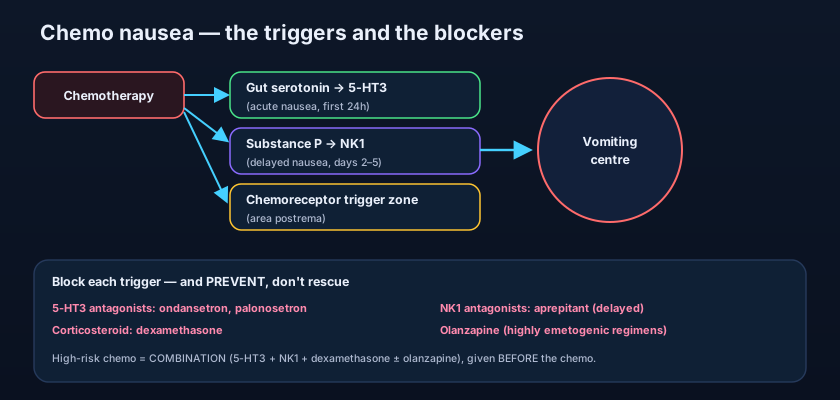
Vomiting is not one switch but a reflex with several inputs. The general anatomy of the vomiting reflex — the vomiting centre in the brainstem, the chemoreceptor trigger zone (CTZ), and the receptors that feed them — is covered in full in the Gastrointestinal (nausea & motility) section, so we won't rebuild it here. What matters for oncology is the specific way cytotoxic drugs pull those triggers. Chemotherapy damages the lining of the gut, and the injured cells spill out serotonin (5-HT). That serotonin lands on 5-HT3 receptors on the vagus nerve endings, which signal the vomiting centre — this is the dominant driver of ACUTE vomiting in the first hours.
The second trigger is the chemoreceptor trigger zone itself: sitting outside the blood-brain barrier, it samples the blood directly and detects the circulating cytotoxic drug and its by-products, sending its own alarm to the vomiting centre. The third — and the key to the WHOLE modern strategy — is substance P, a neuropeptide that acts on NK1 (neurokinin-1) receptors. Substance P is released more slowly and lasts longer, which is why it is the main driver of DELAYED nausea, the wave that arrives on days two to five when the serotonin storm has long passed.
Match the trigger to the timeline and the drug choices write themselves: serotonin (5-HT3) runs the ACUTE phase, substance P (NK1) runs the DELAYED phase. That is why a single 5-HT3 blocker on day one is not enough for high-risk chemo — it leaves the days-two-to-five substance-P window wide open. Cover both clocks, or delayed nausea walks right through.
Three kinds of CINV: acute, delayed, anticipatory
Oncologists split chemotherapy-induced nausea and vomiting (CINV) into three patterns because each is treated differently. ACUTE CINV appears within the first 24 hours and is mostly serotonin-driven. DELAYED CINV begins after the first day and peaks around days two to three, lasting up to five days — this is the substance-P and steroid territory. ANTICIPATORY CINV is the odd one out: it is a conditioned, learned response. A patient who vomited badly on the last cycle begins to feel sick BEFORE the next infusion — triggered by the smell of the clinic or the sight of the nurse, exactly like the first patient in our scene. Because it is learned, no receptor blocker fixes it well; it is treated with benzodiazepines (such as lorazepam) and behavioural techniques — and, above all, by preventing the vomiting that trains it in the first place.
- Chemo triggers vomiting via gut serotonin → 5-HT3, the CTZ, and substance P → NK1.
- Acute CINV (first 24 h) is mainly serotonin-driven.
- Delayed CINV (days 2–5) is mainly substance-P (NK1) driven.
- Anticipatory CINV is a conditioned response — treat with benzodiazepines and prevention.
- The full vomiting-reflex anatomy lives in the GI (nausea & motility) section.
Emetogenic risk: matching the shield to the threat
Not every chemotherapy is equally sickening. The single most important decision in CINV is grading the regimen's EMETOGENIC RISK — how likely it is to cause vomiting without prophylaxis — and matching the prevention to it. HIGH risk (over 90% would vomit untreated) includes cisplatin and the AC regimen (an anthracycline plus cyclophosphamide, common in breast cancer). MODERATE risk (30–90%) includes drugs like carboplatin and oxaliplatin. LOW risk (10–30%) includes agents such as paclitaxel, and MINIMAL risk (under 10%) includes drugs like vincristine and bleomycin. You escalate the antiemetic firepower to the tier: minimal-risk chemo may need nothing prophylactic, while high-risk chemo demands the full combination. Giving everyone the same regimen is the classic error — it under-treats cisplatin and over-treats bleomycin.
A patient on high-emetogenic cisplatin receives a four-drug prophylaxis: a 5-HT3 antagonist + an NK1 antagonist + dexamethasone + olanzapine, all started BEFORE the infusion. A patient on low-emetogenic paclitaxel may receive just a single agent (often dexamethasone or a 5-HT3 blocker) — or, for minimal-risk regimens, routine prophylaxis is not recommended at all. Same disease, different threat level, deliberately different shields.
The drug classes: one blocker for each door
Each antiemetic class plugs a specific trigger. 5-HT3 antagonists (ondansetron, granisetron, and the long-acting palonosetron) block the serotonin door and are the backbone of the acute phase — palonosetron's long half-life gives it some coverage into the delayed phase too. NK1 antagonists (aprepitant, and its IV pro-drug fosaprepitant) block the substance-P door and are what finally tamed DELAYED CINV. CORTICOSTEROIDS — dexamethasone above all — are a core antiemetic partner whose exact mechanism is uncertain but whose benefit across both phases is beyond doubt. OLANZAPINE, an antipsychotic that blocks multiple dopamine and serotonin receptors, adds a large extra measure of control and is now standard in highly emetogenic regimens. DOPAMINE antagonists (metoclopramide, prochlorperazine) and BENZODIAZEPINES (lorazepam, for the anticipatory type) round out the toolkit as adjuncts and rescue.
The 5-HT3 blockers are not free of cost: ondansetron prolongs the QT interval (a link to the Cardiovascular/arrhythmias section — caution with other QT-prolonging drugs and electrolyte disturbance) and commonly causes CONSTIPATION and headache. Dexamethasone is the same steroid that appears in the Endocrine and Inflammation sections — even short antiemetic courses can spike blood sugar and disturb sleep. Olanzapine's main trade-off is sedation. Knowing the side effects is what separates a safe regimen from a harmful one.
The winning strategy: prevent, don't rescue
Here is the single idea that transformed oncology comfort: for emetogenic chemotherapy you give the antiemetics PROPHYLACTICALLY — before the chemo starts — not as rescue after the patient is already vomiting. Once the reflex has fired it is far harder to stop, and every uncontrolled episode also trains the anticipatory response for next time. So for high-risk regimens the standard is a COMBINATION, started ahead of the infusion: a 5-HT3 antagonist + an NK1 antagonist + dexamethasone, with olanzapine added as the fourth agent for the most emetogenic regimens, and the steroid ± NK1 continued for several days to cover the delayed phase. Prevention, layered across both timelines, is why our second patient went home comfortable.
- Grade emetogenic risk first, then match the antiemetic regimen to the tier.
- 5-HT3 antagonists (ondansetron, palonosetron) anchor the acute phase; watch QT and constipation.
- NK1 antagonists (aprepitant/fosaprepitant) are the key to delayed CINV.
- Dexamethasone is a core partner; olanzapine adds control for highly emetogenic chemo.
- Give the combination PROPHYLACTICALLY, before the infusion — not as rescue.
- Continue steroid ± NK1 for days to cover the delayed window.
- Treating CINV as rescue instead of preventing it. Once the reflex fires it is far harder to control — give antiemetics before the chemo.
- Using one regimen for every chemo. The prophylaxis must be matched to the drug's emetogenic risk.
- Forgetting delayed nausea. Days two to five need NK1 and steroid cover, not just a day-one 5-HT3 blocker.
- Ignoring ondansetron's downsides — QT prolongation and constipation — especially with other QT drugs.
A patient starting high-emetogenic cisplatin is well on the day of infusion but develops significant nausea on days 3–4. Which mediator and drug class most specifically address this DELAYED phase?
- Chemo triggers vomiting through gut serotonin (5-HT3), the CTZ, and substance P (NK1).
- Acute (24 h) is serotonin-driven; delayed (days 2–5) is substance-P-driven; anticipatory is learned.
- Grade emetogenic risk and match the regimen — high risk gets 5-HT3 + NK1 + dexamethasone ± olanzapine.
- Give the combination PROPHYLACTICALLY, before the infusion; mind ondansetron's QT and constipation.
- Katzung BG. Basic & Clinical Pharmacology — Drugs used in nausea & vomiting; 5-HT3, NK1 antagonists and antiemetic combinations.
- Hesketh PJ, et al. Antiemetics: ASCO Guideline Update — J Clin Oncol.
- MASCC/ESMO Antiemetic Guidelines — Prevention of chemotherapy-induced nausea and vomiting.
- NCCN Clinical Practice Guidelines in Oncology — Antiemesis.
- Brunton LL, et al. Goodman & Gilman's The Pharmacological Basis of Therapeutics — Treatment of nausea and vomiting.