
Kinase Inhibitors in Solid Tumours: The Age of the '-nib'
For a century we chose cancer drugs by the ORGAN they came from — a lung drug for lung cancer, a breast drug for breast cancer. Then came a family of oral pills, almost all ending in '-nib', that ignore the organ and ask a different question: what is the exact mutation driving THIS tumour? Match the pill to the mutation and a tumour can melt away in weeks. Give the same pill without the mutation and nothing happens. This is targeted therapy — and it rewrote how we treat solid cancers.
Two patients sit in the same waiting room, both holding the same scan report: adenocarcinoma of the lung, same size, same stage. The oncologist puts them side by side and, to a bystander, they look identical. But a tissue biopsy was sent for molecular testing, and there the two diverge completely. One tumour carries an EGFR mutation; the other does not. The first patient is handed a single daily pill — no drip, no hair loss — and at the next scan the tumour has all but vanished. The second patient is handed the very same pill and it does nothing at all. Same organ, same picture, opposite outcome. In modern oncology it is no longer the tumour's ADDRESS that picks the drug — it is its GENOTYPE.
The paradigm: from a leukaemia pill to every organ
The whole idea was born in the blood, not a solid tumour. Chronic myeloid leukaemia (CML) is driven by a single abnormal fusion protein — BCR-ABL, a permanently switched-on tyrosine kinase (Tyrosine kinase). Imatinib (Imatinib), an oral small molecule, plugs into that kinase and shuts it off, turning a once-fatal leukaemia into a controllable chronic condition. That story — one driver, one drug, dramatic response — is the paradigm covered in the CML chapter of Hematology, and it is the template every solid-tumour drug below imitates. A kinase is simply an enzyme that adds a phosphate to switch a growth signal ON; a kinase inhibitor jams that switch. When a cancer depends on one such switch ("oncogene addiction"), blocking it can be devastatingly effective.
The suffix is a map. Small-molecule kinase inhibitors almost always end in "-nib" (from iNhIBitor): erlotinib, crizotinib, vemurafenib, sunitinib, palbociclib, olaparib. Contrast the monoclonal ANTIBODIES, which end in "-mab" (e.g., trastuzumab, cetuximab) and are large injected proteins, not oral pills. When you see "-nib" think: oral, small molecule, hits a kinase inside the cell.
EGFR inhibitors: the lung cancer pill
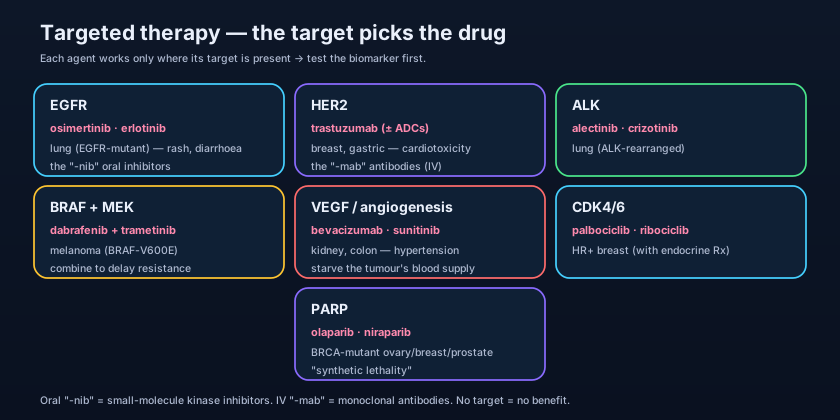
The first solid-tumour target to fall was EGFR — the epidermal growth factor receptor — in non-small-cell lung cancer (NSCLC). A subset of lung adenocarcinomas, especially in never-smokers and East Asian patients, carry activating EGFR mutations that leave the receptor's kinase permanently firing. Erlotinib (Erlotinib) and gefitinib (Gefitinib) block that kinase and produce rapid, often dramatic tumour shrinkage — but ONLY in the mutation-positive patients. Almost inevitably resistance emerges, most often through a second mutation, T790M, that blocks the drug from binding. The answer was a next-generation drug, osimertinib (Osimertinib), designed to overcome T790M; it is now the preferred first-line EGFR inhibitor and even crosses into the brain to treat metastases. The EGFR/ALK lung story is developed fully in the Lung cancer chapter.
EGFR is also expressed in normal skin and gut, so blocking it produces a class-defining acneiform (papulopustular) rash across the face and trunk, plus diarrhoea. Strikingly, in EGFR inhibitors the rash often signals that the drug is WORKING — patients who develop the rash tend to respond better. It is managed (topical/oral antibiotics, emollients), not a reason to stop. Diarrhoea is controlled with loperamide.
- EGFR-mutant NSCLC responds to erlotinib, gefitinib and osimertinib.
- T790M is the classic resistance mutation; osimertinib was built to cover it.
- Signature toxicities: acneiform rash and diarrhoea.
- The rash is a marker of response — manage it, don't automatically stop.
- No EGFR mutation = no benefit; the target must be confirmed first.
ALK inhibitors: a rarer driver, the same logic
A smaller slice of lung cancer runs on a different rearranged kinase. Around 3–5% of NSCLCs carry an ALK gene rearrangement (a fusion that activates the ALK kinase), again typically in younger never-smokers. Crizotinib (Crizotinib) was the first ALK inhibitor, but next-generation agents such as alectinib (Alectinib) give deeper, longer responses and much better control of brain metastases, so alectinib is now preferred first-line. The pattern is by now familiar: identify the driver by testing, block it with a matched pill, watch for the resistance mutation, and reach for a newer-generation inhibitor when it arrives.
BRAF + MEK: hitting one pathway at two points
About half of melanomas carry a BRAF V600E mutation — a single amino-acid change that locks the BRAF kinase ON, driving the MAPK growth pathway. BRAF inhibitors, vemurafenib (Vemurafenib) or dabrafenib (Dabrafenib), switch it back off with striking initial responses. But used alone, resistance appears quickly, because the tumour reactivates the pathway just downstream. The elegant solution is to block TWO points of the same pathway at once: a BRAF inhibitor plus a MEK inhibitor such as trametinib (Trametinib). Dabrafenib + trametinib together produce deeper, more durable responses and, paradoxically, FEWER skin side effects than the BRAF inhibitor alone. Note the target is BRAF V600E specifically — a BRAF wild-type tumour must never be given these drugs (in wild-type cells they can paradoxically ACTIVATE the pathway).
Why combine a BRAF and a MEK inhibitor when either could theoretically work? Blocking BRAF alone lets the pathway escape and, in BRAF-wild-type keratinocytes, can even switch it on — driving new squamous skin lesions. Adding a MEK inhibitor downstream closes that escape route: it deepens the anti-tumour effect AND suppresses the paradoxical skin toxicity. Combining to delay resistance is a recurring theme across this whole class.
Angiogenesis / VEGF-pathway TKIs: starving the tumour
A different strategy attacks not the tumour cell but its blood supply. A growing tumour must recruit new vessels — angiogenesis — driven largely by VEGF (vascular endothelial growth factor) signalling through its kinase receptors. A family of oral multi-target TKIs — sunitinib (Sunitinib), sorafenib (Sorafenib), pazopanib (Pazopanib) and lenvatinib (Lenvatinib) — block VEGF receptors (and often others), effectively starving the tumour of its new blood supply. They are workhorses in renal cell carcinoma, hepatocellular (liver) carcinoma, thyroid cancer and gastrointestinal stromal tumours (GIST). Because they are less "one-driver-specific" than the mutation-matched pills above, they are used more broadly, but they carry a characteristic toxicity profile that comes straight from interfering with normal blood vessels.
Because they disturb normal vasculature, VEGF-pathway TKIs classically cause HYPERTENSION (the most consistent effect — check the blood pressure at every visit), bleeding, a painful hand-foot skin reaction, proteinuria, and impaired wound healing (they are held before and after surgery). The hypertension links directly to the Cardiovascular section's antihypertensive management. Separately, GIST is worth remembering as the tumour that bridges two chapters: it is driven by an activating KIT mutation, and imatinib — the very CML drug — also blocks KIT, making it first-line for GIST (with sunitinib after resistance).
CDK4/6 and PARP: two more clever switches
Two further classes round out the core toolkit. CDK4/6 inhibitors — palbociclib (Palbociclib) and ribociclib (Ribociclib) — block the cyclin-dependent kinases that push a cell through the cell cycle. In hormone-receptor-positive (HR+) breast cancer they are added to endocrine (anti-oestrogen) therapy and markedly delay progression; their main toxicity is neutropenia. PARP inhibitors — olaparib (Olaparib) and niraparib (Niraparib) — are a beautiful piece of biology: they exploit "synthetic lethality." Cells have two ways to repair DNA. Tumours with a BRCA mutation have already lost one repair pathway; block the OTHER (PARP) with a drug, and the cancer cell — unable to fix its DNA by either route — dies, while normal cells with an intact BRCA survive. So PARP inhibitors are used precisely in BRCA-mutant ovarian, breast and prostate cancers. CDK4/6 in breast is expanded in the Breast chapters.
- VEGF-pathway TKIs (sunitinib, sorafenib, pazopanib, lenvatinib) starve angiogenesis in renal/liver/thyroid cancer and GIST.
- Their hallmark toxicity is hypertension, plus bleeding, hand-foot reaction and poor wound healing.
- GIST is driven by KIT — imatinib (the CML drug) is first-line for it.
- CDK4/6 inhibitors (palbociclib, ribociclib) + endocrine therapy in HR+ breast cancer; watch neutropenia.
- PARP inhibitors (olaparib, niraparib) use synthetic lethality in BRCA-mutant ovarian/breast/prostate cancer.
- BRAF+MEK (dabrafenib+trametinib) for BRAF V600E melanoma — combined to delay resistance.
Three themes that tie the whole class together
Forget the individual names for a moment and hold three ideas. First, a biomarker is mandatory: these drugs work ONLY in tumours that carry the matching driver, so the tumour must be tested first — the case for that testing is made in the Precision oncology chapter that follows. Second, resistance is the rule, not the exception: sooner or later the tumour mutates around the block (T790M for EGFR, downstream reactivation for BRAF), which is why we keep building next-generation and combination regimens. Third, watch the pharmacokinetics: many of these oral agents are metabolised by CYP3A4, so strong CYP3A4 inhibitors (azole antifungals, and grapefruit juice) raise drug levels and toxicity, while inducers (rifampicin, St John's wort) drop them below effect — the mechanism is detailed in the Pharmacokinetics/Metabolism chapter.
- Giving a targeted kinase inhibitor without confirming the target mutation. No biomarker means no benefit — an EGFR inhibitor in an EGFR-wild-type lung tumour simply does nothing.
- Ignoring CYP3A4 interactions. Grapefruit juice and azole antifungals can push levels into toxicity; enzyme inducers can render the drug useless.
- Dismissing (or over-reacting to) the EGFR-inhibitor rash. It often signals response — it should be managed and treated, not taken as a reason to stop the drug outright.
- Forgetting to check blood pressure on VEGF-pathway TKIs. Hypertension is their most consistent toxicity and needs active management, not observation.
A never-smoker with EGFR-mutant NSCLC responds to erlotinib, then progresses. Testing shows a new T790M mutation. The most appropriate next step is:
- "-nib" drugs are oral small-molecule kinase inhibitors that block one driver kinase in a molecularly-selected tumour — the imatinib/CML paradigm applied to solid cancers.
- Know the pairs: EGFR (erlotinib/osimertinib, +T790M) and ALK (alectinib) in lung; BRAF+MEK in melanoma; VEGF-TKIs in renal/liver/thyroid/GIST; CDK4/6 in HR+ breast; PARP in BRCA-mutant cancers.
- Signature toxicities: EGFR → acneiform rash + diarrhoea; VEGF-TKIs → hypertension, bleeding, hand-foot reaction; CDK4/6 → neutropenia.
- Three rules: no biomarker = no benefit; resistance mutations always emerge; beware CYP3A4 interactions (grapefruit, azoles).
- Katzung BG. Basic & Clinical Pharmacology — Cancer Chemotherapy: targeted small-molecule kinase inhibitors (EGFR, ALK, BRAF/MEK, VEGFR, CDK4/6, PARP).
- DeVita, Hellman, and Rosenberg's Cancer: Principles & Practice of Oncology — Molecularly targeted therapy and mechanisms of resistance in solid tumours.
- Brunton LL, et al. Goodman & Gilman's The Pharmacological Basis of Therapeutics — Protein kinase inhibitors and antiangiogenic agents.
- Soria J-C, et al. Osimertinib in untreated EGFR-mutated advanced NSCLC (FLAURA). N Engl J Med, 2018.
- Robert C, et al. Dabrafenib and trametinib in BRAF V600–mutant melanoma. N Engl J Med (COMBI trials).
- Long GV, et al.; and Farmer H, et al. Targeting the DNA repair defect in BRCA-mutant cells (synthetic lethality; PARP inhibition). Nature / NEJM reviews.