
Prostaglandin Analogues: The First-Line Glaucoma Drug
For a century glaucoma was fought by turning the tap down — drugs that told the eye to make less fluid. Prostaglandin analogues did something cleverer: they opened a second drain the eye had barely been using. One drop at bedtime lowers pressure more than any other single agent, with none of the heart-and-lung baggage of the old beta-blockers. The cost is almost entirely cosmetic — a redder eye, a darker iris, longer lashes — which is exactly why the same molecule that saves sight is also sold to grow eyelashes.
A 68-year-old man comes to the clinic because his optician found "high pressure" on a routine check. He has no symptoms — that is the point of glaucoma, it steals sight silently from the edges in. His intraocular pressure (IOP) is 28 mmHg in both eyes, the optic discs are cupped, and the visual field shows early loss he has never noticed. He asks, reasonably, whether the drops will be a nuisance: will he wheeze like he did on his old blood-pressure tablets, will he have to remember them three times a day? He is handed a single small bottle and told to use one drop in each eye at bedtime. A month later his pressure is 17. The only thing he has noticed is that his eyes look a little pinker in the mornings, and — his wife points out — his lashes have grown.
The problem: a drain that has silted up
Glaucoma is a plumbing disease before it is a nerve disease. The ciliary body secretes aqueous humour continuously into the front of the eye. That fluid must leave at the same rate it is made, and it drains by two routes: the conventional pathway (through the trabecular meshwork into Schlemm's canal — the main highway) and the uveoscleral pathway (seeping out through the ciliary muscle — a quiet back road). In primary open-angle glaucoma the trabecular meshwork becomes resistant, the fluid backs up, pressure rises, and the raised IOP slowly strangles the optic nerve. As the Glaucoma-overview chapter explains, lowering IOP is the only proven way to protect the nerve — so every drug class exists to do one of two things: open a drain, or turn down the tap. Prostaglandin analogues take the first road, and they take the road nobody else was using.
Mechanism: opening the back road
Prostaglandin analogues are synthetic mimics of prostaglandin F2-alpha (PGF2α). They bind the prostanoid FP receptor on the ciliary muscle. That binding switches on matrix metalloproteinases which remodel and loosen the extracellular matrix packed between the muscle bundles — in effect, they widen the spaces of the uveoscleral back road so far more fluid can seep out that way. Because they enhance outflow rather than suppress secretion, they work with the eye's own physiology instead of against it, and there is no ceiling from a tap that is already turned down. The result is the largest single-agent pressure drop of any topical class — roughly a quarter to a third off baseline IOP — from one drop a day. The eicosanoid pathway they hijack is the same one taught in the Inflammation section, where prostaglandins are the villains that must be suppressed; here, remarkably, a prostaglandin is the drug.
Imagine a sink filling faster than its plughole can cope. The old drugs (beta-blockers, carbonic anhydrase inhibitors) turn the tap down so less water arrives. Prostaglandin analogues do the opposite — they reach past the blocked plughole and open a second drain in the side of the basin that was always there, just too narrow to matter. Widen that back drain and the water pours away, no matter how fast the tap runs. That is why one bottle, once a night, outperforms the tap-turners.
The drugs, and why once-daily at night
Four molecules share one mechanism, given as one evening drop. The class is latanoprost, travoprost, bimatoprost and tafluprost. All are prodrugs or amides activated in the eye, all target the FP receptor, and all are dosed once daily in the evening — the long tissue action gives 24-hour cover from a single night-time drop, and dosing more often actually lowers efficacy (the receptors down-regulate). This once-a-day simplicity is a large part of why they became first-line: adherence to eye drops is dismal, and a single bedtime drop is the easiest regimen to keep. Tafluprost is available preservative-free, useful when the preservative benzalkonium chloride (BAK) irritates the ocular surface — a real problem for patients who will take these drops for the rest of their lives. Newer molecules push the mechanism further: latanoprostene bunod releases nitric oxide to also relax the trabecular meshwork (attacking both drains at once), and netarsudil is a Rho-kinase inhibitor that improves conventional outflow — the two are combined with latanoprost in fixed-combination bottles.
Latanoprost (Xalatan) — the original, often generic and cheapest. Travoprost (Travatan), bimatoprost (Lumigan), tafluprost (Saflutan, preservative-free). Bimatoprost is the strongest lash-grower, which is why the identical molecule is marketed as Latisse for eyelash hypotrichosis — the "side effect" repurposed as a cosmetic drug (see the Dermatology chapter). Fixed combinations bolt a prostaglandin analogue onto a second mechanism: latanoprost + netarsudil (Rocklatan), or latanoprostene bunod (Vyzulta) built as a single dual-action molecule.
- Prostaglandin analogues (latanoprost, travoprost, bimatoprost, tafluprost) are the first-line drug for open-angle glaucoma.
- They are FP-receptor agonists that increase UVEOSCLERAL outflow by remodelling the ciliary-body matrix.
- They give the greatest single-agent IOP reduction (~25–35%) of any topical class.
- Dosed once daily in the evening — simple adherence, and more frequent dosing paradoxically reduces effect.
- No systemic cardiopulmonary effects — ideal for the elderly, asthmatics, and those with heart block.
- Newer duals add a second mechanism: latanoprostene bunod (nitric oxide) and netarsudil (Rho-kinase).
Why they beat the old first-line: the systemic escape
For decades the default first drop was timolol, a topical beta-blocker that turns down aqueous secretion. It works — but a drop on the eye drains through the nasolacrimal duct into the nose and is absorbed straight into the bloodstream, bypassing the liver's first-pass metabolism. So topical timolol can cause exactly what a systemic beta-blocker causes: bronchospasm in an asthmatic, bradycardia and heart block, fatigue, masked hypoglycaemia. Prostaglandin analogues have essentially no systemic footprint — their adverse effects are all local, at the eye and lids. That single fact is why they displaced beta-blockers as first-line, especially in the very patients glaucoma is commonest in: the elderly, who so often also have asthma, COPD, or a slow heart. The Beta-blocker and CAI chapter covers why timolol is now usually the add-on, not the opener.
The price: local, cosmetic, and mostly not dangerous
The side effects are visible, which makes counselling more important than treating. Conjunctival hyperaemia — a red eye — is the commonest complaint and often settles with time. The three effects that must be counselled before the first drop are all pigment- and growth-related. First, permanent iris darkening: the drug increases melanin in iris stromal melanocytes, and in a mixed-colour (hazel or green-brown) iris this can turn it visibly, irreversibly brown — dramatic and permanent if only one eye is treated. Second, periocular skin darkening (hyperpigmentation of the lids), which usually fades if the drug is stopped. Third, hypertrichosis — the lashes grow longer, thicker, darker and more numerous. A subtler effect is prostaglandin-associated periorbitopathy (PAP): fat atrophy that deepens the upper lid sulcus and can make the eye look sunken, sometimes with a drooping lid. None of these threaten sight, but a patient who is not warned will stop the drops the day they notice their eyes changing colour. Two cautions do matter clinically: prostaglandin analogues can reactivate herpetic (HSV) keratitis, and they may worsen intraocular inflammation, so they are used cautiously in active uveitis and in patients with a history of dendritic keratitis.
The most famous "side effect" in ophthalmology became a blockbuster drug. When trials of latanoprost showed patients growing luxuriant lashes, the makers took bimatoprost — the strongest lash-grower of the class — and re-launched the identical molecule at a cosmetic dose as Latisse, applied to the lash line for hypotrichosis. So the same bottle chemistry that saves an optic nerve at the pharmacy counter is sold at the beauty counter to lengthen eyelashes. Remember it and you will never forget that prostaglandin analogues grow lashes.
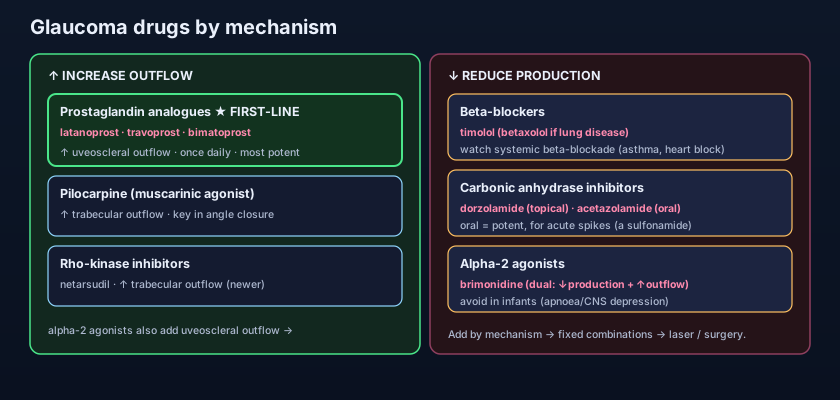
Read the ladder as a logic, not a list to memorize. The whole of glaucoma medical therapy hangs on the figure above. Start first-line with a prostaglandin analogue at night. If target pressure is not reached, add — do not swap — a drug from the other side of the ladder, so the two mechanisms stack: a beta-blocker or carbonic anhydrase inhibitor to reduce production, or an alpha-2 agonist (brimonidine) which does both a little. These add-on agents are the subject of the Beta-blocker/CAI and Alpha-agonist chapters. Pilocarpine, an old muscarinic agonist, pulls the trabecular meshwork open (conventional outflow) but is now rarely used chronically because of the small pupil and brow-ache. When two or three drops become a burden, fixed combinations put two mechanisms in one bottle to protect adherence. And when drops fail or pressure is dangerously high, the ladder ends in laser (selective laser trabeculoplasty) or surgery (trabeculectomy, drainage tubes, MIGS). One warning the ladder does not show: this is the open-angle ladder. Acute angle-closure is a different emergency with a different drug set — never assume a red, painful eye with high pressure just needs another glaucoma drop.
- Side effects are almost all local and cosmetic: conjunctival hyperaemia, iris darkening, lid skin darkening, lash growth.
- Iris darkening is PERMANENT (irreversible); most others fade after stopping the drug.
- Counsel the patient before the first drop — unwarned cosmetic change is the main reason people quit.
- Use with caution in active uveitis and a history of herpetic (HSV) keratitis, which they can reactivate.
- The ladder: first-line PGA → add a complementary-mechanism drop → fixed combinations → laser/surgery.
- This is the OPEN-ANGLE ladder — acute angle-closure is a separate emergency.
- Not warning the patient about iris darkening and lash growth, so they stop the drug the moment they notice — losing IOP control over a cosmetic change that was never explained.
- Prescribing a prostaglandin analogue in a patient with active or recurrent herpetic keratitis or uveitis without weighing the risk of reactivation and worsening inflammation.
- Treating a red, painful eye with a rock-hard high pressure as if it were open-angle glaucoma — that is acute angle-closure, an emergency needing pressure-lowering, pilocarpine and urgent referral, not just another nightly drop.
A 70-year-old man with well-controlled asthma is newly diagnosed with primary open-angle glaucoma and needs to start pressure-lowering drops. Which first-line agent is most appropriate, and why?
- Prostaglandin analogues (latanoprost, travoprost, bimatoprost, tafluprost) are first-line for open-angle glaucoma — FP-receptor agonists that increase uveoscleral outflow.
- They give the biggest single-agent IOP drop from one evening drop, with no systemic cardiopulmonary effects — ideal for the elderly and asthmatic.
- Side effects are local/cosmetic — conjunctival hyperaemia, permanent iris darkening, lid pigmentation, lash growth (bimatoprost is sold as Latisse for lashes) — so counsel before starting.
- The ladder: first-line PGA → add a complementary-mechanism drug (beta-blocker/CAI/alpha-agonist) → fixed combinations → laser/surgery, all for open-angle disease.
- Kanski's Clinical Ophthalmology: A Systematic Approach — Glaucoma: medical therapy.
- Bartlett & Jaanus, Clinical Ocular Pharmacology — Prostaglandin analogues and aqueous outflow drugs.
- AAO Basic and Clinical Science Course (BCSC), Section 10: Glaucoma — Medical management.
- Rang & Dale's Pharmacology — Ocular pharmacology; eicosanoids and prostaglandin analogues.
- European Glaucoma Society Terminology and Guidelines for Glaucoma (medical treatment algorithm).
- NICE Guideline NG81: Glaucoma — diagnosis and management (first-line prostaglandin analogues).