
Why the Same Dose Acts Differently: Individual Variation and Pharmacogenetics
You prescribe the exact same dose to two similar patients — and one gets no effect while the other is poisoned. This is not a mistake; it is biology. Two great forces pull drug response apart: the drug LEVEL differs (pharmacokinetics), or the SENSITIVITY at that level differs (pharmacodynamics). And underneath both sits the genome, quietly rewriting the dose–response curve one enzyme at a time. Learn the sources of variation and you stop treating "the average patient" — who does not exist — and start treating the person in front of you.
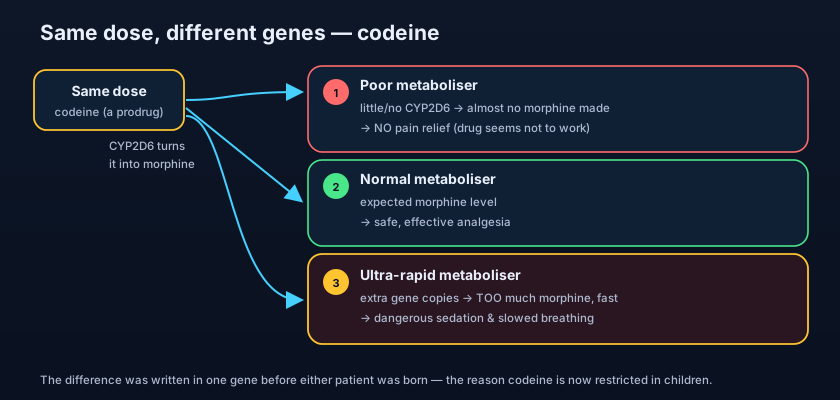
Two children, same age, same weight, both recovering from a tonsillectomy. Both are given the identical weight-based dose of codeine for pain. Hours later the first child is still crying — the medicine did nothing. The second child is worryingly drowsy, breathing slow and shallow, and needs urgent attention. Same drug, same dose, same milligrams per kilogram — opposite outcomes. Nothing was measured wrong. The difference was written before either child was born, in a single gene called CYP2D6. This exact tragedy, repeated in real children, is why codeine is now restricted after tonsillectomy in kids. This is the story of individual variation.
Two ways a dose goes wrong: level versus sensitivity
Every difference in drug response reduces to one of two questions. First: does the drug reach a different CONCENTRATION in this person? That is a pharmacokinetic cause — the body handles the drug differently (absorption, distribution, metabolism, excretion), so the level at the target rises or falls. Second: at the SAME concentration, does this person's tissue respond more or less? That is a pharmacodynamic cause — the target itself (receptors, physiology, disease) is more or less sensitive. Keep these two boxes separate and every confusing case sorts itself: either the level is off, or the sensitivity is off.
Pharmacokinetic sources: when the drug LEVEL differs
Start with the body's handling. Body size and composition matter: the same milligram dose spreads thinner in a large person and, for fat-soluble drugs, distributes very differently in an obese versus a lean body. Age is the classic extreme on both ends. Neonates have immature liver enzymes and immature kidneys, so they clear drugs slowly and can accumulate toxic levels — while the very elderly lose renal and hepatic reserve and clear drugs less efficiently too. Pregnancy shifts volume, blood flow and metabolism. Adherence (does the patient actually take it?) changes the real dose reaching the blood, and drug interactions can push a level up or down without anyone changing the prescription.
Organ function is the heavyweight of pharmacokinetic variation. Two organs clear most drugs: the kidney and the liver. In renal impairment, drugs eliminated by the kidney (and their active metabolites) accumulate — this is why we reduce or space out the dose of renally cleared drugs, and why some are avoided entirely when the kidneys fail. In hepatic impairment, drugs that depend on the liver for metabolism build up, and reduced first-pass extraction can suddenly raise the bioavailability of high-first-pass drugs. "Check the renal and hepatic function before you fix the dose" is not bureaucracy — it is the single most common reason a standard dose becomes an overdose. (This links straight to the Excretion and Kinetics chapters here.)
- PK causes change the drug LEVEL: absorption, distribution, metabolism, excretion.
- Body weight and composition change how far a fixed dose is diluted.
- Neonates (immature enzymes and kidneys) and the elderly (reduced clearance) sit at both extremes.
- Renal and hepatic impairment are the top reasons a normal dose accumulates to toxicity.
- Interactions, adherence and pregnancy all move the real concentration reaching the target.
Pharmacodynamic sources: when the SENSITIVITY differs
Now hold the concentration constant and vary the response. The number and sensitivity of receptors can differ — chronic exposure up- or down-regulates them, so a tolerant patient needs far more drug for the same effect. Disease states change the target: a hyperthyroid heart is exquisitely sensitive to catecholamines; asthmatic airways over-respond to constrictors. Physiological and electrolyte status tilts the response — low potassium magnifies digoxin toxicity, and acid–base shifts alter how drugs work at their targets. And beneath all of this lies genetics, which can reshape either the enzyme handling the drug (a PK effect) or the target responding to it (a PD effect). Genetics is where individual variation becomes destiny.
A clean way to tell the two apart at the bedside: if measuring the drug LEVEL explains the odd response (too high, too low), it is pharmacokinetic. If the level is textbook-normal yet the effect is not, the sensitivity has shifted — that is pharmacodynamic. Digoxin toxicity at a "normal" level because the potassium is low is the classic PD trap.
Pharmacogenetics: the dose written in the genes
Pharmacogenetics is the study of how inherited variation changes drug response. A single-letter change in one gene can transform an enzyme from fast to absent, or a target from tolerant to fragile. Populations often split into groups — poor, intermediate, extensive (normal), and ultra-rapid metabolisers — depending on how many working copies of a metabolizing enzyme they carry. The consequences are not subtle: for some drugs the difference between genotypes is the difference between no effect, a normal effect, and a lethal one. Return to the two tonsillectomy children and you now know their genotype was the hidden variable.
Codeine is a prodrug: it is nearly inactive until CYP2D6 converts it to morphine. Poor metabolisers (little or no CYP2D6) make almost no morphine and get little to no pain relief. Ultra-rapid metabolisers (extra gene copies) convert too much codeine to morphine and can reach dangerous, sedating, respiratory-depressing levels — the mechanism behind deaths in children and in breastfed infants of ultra-rapid mothers. Same dose, opposite ends of the CYP2D6 spectrum. (See the Metabolism / CYP chapter here for how prodrug activation works.)
Warfarin's dose requirement is famously unpredictable, and much of that is genetic. CYP2C9 variants slow warfarin metabolism (higher levels, higher bleeding risk), while VKORC1 variants change the sensitivity of warfarin's target enzyme. Carriers may need a much lower starting dose — genotype-guided dosing exists precisely because a "standard" warfarin dose can over-anticoagulate one patient and under-treat another.
Azathioprine and 6-mercaptopurine are inactivated in part by thiopurine methyltransferase (TPMT). Patients with low or absent TPMT cannot clear these drugs normally and accumulate toxic metabolites, risking severe, life-threatening myelosuppression (bone-marrow failure). TPMT is checked before starting these drugs so the dose can be reduced or the drug avoided. (This ties into the Inflammation and IBD sections where azathioprine is used.)
Suxamethonium (succinylcholine), a short-acting muscle relaxant, is normally broken down within minutes by plasma pseudocholinesterase (butyrylcholinesterase). Patients with an inherited deficiency of this enzyme cannot degrade it, so the paralysis — including of the breathing muscles — lasts far longer: prolonged apnoea after anaesthesia, requiring continued ventilation until it wears off. (See the anaesthetics / neuromuscular blocker material in the CNS and ANS chapters.)
Glucose-6-phosphate dehydrogenase (G6PD) protects red cells from oxidative stress. In G6PD deficiency, oxidant drugs trigger acute haemolysis (red-cell breakdown) — classic culprits include primaquine (and other antimalarials), sulfonamides, and nitrofurantoin. The patient's level of drug is perfectly normal; the red cells are simply defenceless. A pharmacodynamic genetic vulnerability, not a metabolic one.
Some severe drug reactions are tied to specific immune-system (HLA) types. HLA-B*57:01 carriers are at high risk of a serious abacavir hypersensitivity reaction — screening for the allele before starting abacavir has made this reaction largely preventable. HLA-B*15:02 (common in some Southeast Asian populations) predicts carbamazepine-induced Stevens–Johnson syndrome (SJS). Here the genetics predict an immune catastrophe, so we test first and avoid the drug in carriers.
- CYP2D6 poor metabolisers get no codeine analgesia; ultra-rapid ones make dangerous morphine.
- CYP2C9 + VKORC1 variants explain much of warfarin's dose unpredictability.
- Low TPMT → azathioprine / 6-MP toxicity (severe myelosuppression).
- Pseudocholinesterase deficiency → prolonged apnoea with suxamethonium.
- G6PD deficiency → haemolysis with oxidant drugs (primaquine, sulfonamides, nitrofurantoin).
- HLA-B*57:01 → abacavir hypersensitivity; HLA-B*15:02 → carbamazepine SJS.
The other modifiers: age, sex, disease, placebo and adherence
Genetics is dramatic, but the everyday modifiers move more prescriptions. Age changes both handling and sensitivity, which is why paediatric and geriatric doses are calculated separately, not scaled by guesswork. Sex can alter body composition, enzyme activity and average response. Disease in the target organ shifts sensitivity, and disease elsewhere (heart failure, thyroid disease) reshapes the whole response. Then there is the placebo effect — a genuine, measurable improvement from expectation and context that rides alongside every real drug effect. And adherence quietly underlies all of it: a drug not taken has zero bioavailability, and the effect of a half-taken course is not the effect studied in the trial.
- Assuming one standard dose fits everyone — the "average patient" is a statistical fiction, not a real person.
- Prescribing without checking renal and hepatic function, then blaming the drug when it accumulates.
- Forgetting that prodrugs (codeine, clopidogrel) NEED metabolic activation — a poor metaboliser gets no effect.
- Labelling a patient "non-compliant" for a failed response when the real cause is genetic (e.g., ultra-rapid or poor metaboliser).
Two children of identical weight receive the same codeine dose after tonsillectomy; one gets no pain relief while the other becomes dangerously sedated. The best explanation is:
- The same dose acts differently because either the drug LEVEL differs (PK) or the SENSITIVITY differs (PD).
- PK drivers: weight/composition, age extremes, renal and hepatic function, interactions, adherence, pregnancy.
- PD drivers: receptor number/sensitivity, disease, electrolyte status, and genetics.
- Pharmacogenetics decides all-or-nothing cases: CYP2D6/codeine, CYP2C9-VKORC1/warfarin, TPMT, pseudocholinesterase, G6PD, HLA alleles.
- Never assume one dose fits all — check organ function, remember prodrugs, and don't blame "non-compliance" for genetics.
- Rang HP, Dale MM, et al. Rang & Dale's Pharmacology — Individual variation, pharmacogenetics & idiosyncratic drug responses.
- Katzung BG. Basic & Clinical Pharmacology — Pharmacogenomics and factors modifying drug response.
- Brunton LL, et al. Goodman & Gilman's The Pharmacological Basis of Therapeutics — Pharmacogenetics and individualization of drug therapy.
- Whalen K. Lippincott Illustrated Reviews: Pharmacology — Sources of variation in drug response.
- Bertram G. Katzung & Trevor's Pharmacology Examination & Board Review — Pharmacogenetics high-yield associations (CYP2D6, TPMT, G6PD, pseudocholinesterase, HLA).