
Spare Receptors: Why a Fraction of Receptors Can Give a Full Effect
Here is a fact that feels wrong the first time you meet it: a tissue can reach its MAXIMUM response while most of its receptors sit empty. Occupy 10%, get 100% of the effect. The leftover receptors aren't broken or wasted — they are a reserve, and that reserve quietly explains why some tissues are exquisitely sensitive, why more receptors make an agonist more potent, and why an irreversible blocker can look harmless right up until it suddenly isn't. Let's meet the spare receptor.
Look closely at a single neuromuscular junction — the tiny gap where a motor nerve meets a muscle fibre. Each nerve impulse dumps a puff of acetylcholine onto a plate studded with nicotinic receptors. But the muscle carries FAR more of these receptors than any one contraction actually needs — a huge redundancy, a safety factor built into the wiring. It seems extravagant, until you see what it buys: you could lose a large fraction of those receptors and the muscle would still twitch faithfully, every time. That built-in surplus is the reason myasthenia gravis and curare-like drugs only fail transmission after a big chunk of receptors is gone — not at the first missing one. That surplus is the spare receptor, and this whole article lives inside that gap.
The core idea: full effect at fractional occupancy
Intuition says occupancy and response should march together — 50% occupied, 50% of the effect. In many tissues they don't. The maximal response (Emax) is reached when only a fraction of receptors are occupied; the rest are the reserve. These are the "spare" receptors — spare not in the sense of idle spectators, but in the sense of a spare tyre: kept in hand, functionally real, ready to be recruited. The word describes a relationship between binding and response, not a broken part of the cell.
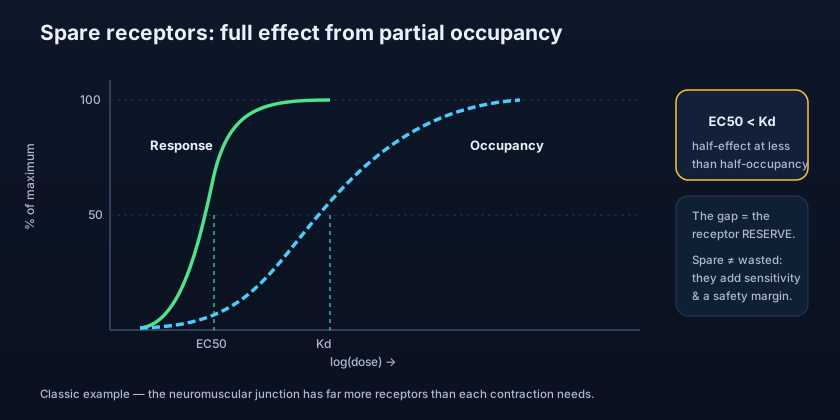
So how do you PROVE a reserve exists? You compare two curves for the same drug in the same tissue: the binding curve (how occupancy rises with concentration, governed by Kd, the concentration that occupies half the receptors) and the response curve (how effect rises with concentration, governed by EC50, the concentration giving half-maximal effect). If there are NO spare receptors, the two overlap: EC50 = Kd. But when a reserve exists, the response curve sits to the LEFT — EC50 is LESS than Kd. Half-maximal effect arrives at less than half-maximal occupancy. That single inequality, EC50 < Kd, is the fingerprint of a spare-receptor system.
Reverse it and you have an instant exam tool. If a question tells you EC50 is well below Kd, do not hesitate: that tissue has spare receptors. If EC50 equals Kd, it does not. The gap between the two curves IS the size of the reserve — the wider the leftward shift, the larger the spare pool.
Why do reserves exist? Amplification and brief contact
A reserve is not an accident; it falls naturally out of how receptors signal. The first source is signal AMPLIFICATION. When one occupied G-protein-coupled receptor activates many G-proteins, each of which drives an enzyme that spits out a flood of second messengers, a single binding event is multiplied enormously downstream (this is exactly the cascade told in the Second messengers chapter). Because the downstream machinery saturates long before every receptor is filled, the tissue hits Emax with plenty of receptors to spare. Catalytic and enzyme-linked receptors amplify the same way — one activated receptor phosphorylates many targets.
The second source is time, not amplification. Sometimes the ligand only touches each receptor BRIEFLY. Acetylcholine at the neuromuscular junction is the classic case: it is released in a fast pulse and destroyed within milliseconds by acetylcholinesterase, so no single receptor stays occupied for long. Yet transmission is utterly reliable. It works because there are so many receptors that even a short, low-occupancy contact across a large pool sums to a full response. Here the reserve is a reserve in TIME as much as in number — each receptor is used transiently, and the surplus guarantees the signal still gets through.
The endplate of a muscle fibre carries a large excess of nicotinic receptors — a well-known "margin of safety" for neuromuscular transmission. This is why a competitive (non-depolarising) blocker such as tubocurarine or rocuronium must occupy the great majority of receptors before the muscle weakens at all, and why myasthenia gravis (an autoimmune loss of receptors) can smoulder silently until enough are destroyed to eat through the reserve. The nicotinic system and its blockers are covered in depth in the Autonomic Nervous System section.
- Spare receptors = a maximal response (Emax) reached at fractional occupancy.
- Fingerprint of a reserve: EC50 < Kd (half-effect before half-occupancy).
- Amplification (GPCR cascades, catalytic receptors) creates a reserve downstream.
- Brief ligand contact (ACh at the NMJ) creates a reserve in time and number.
- The larger the reserve, the wider the leftward gap between response and binding curves.
What the reserve buys: sensitivity and potency
A reserve makes a tissue exquisitely sensitive. Because a small fraction of occupied receptors already delivers a big effect, even low agonist concentrations produce a meaningful response — the tissue reacts to whispers, not just shouts. This high sensitivity is the practical gift of the spare pool: it lets a hormone or transmitter present at tiny concentrations still command the cell. It also links directly to potency, the theme of the Affinity, efficacy and potency chapter: in a tissue with spare receptors, the agonist appears MORE potent (its response curve shifts left) than its raw binding affinity alone would predict.
Now a consequence that surprises students: potency depends on receptor NUMBER. If a tissue has spare receptors, adding MORE receptors makes the same agonist more potent — its EC50 falls further below Kd, because an even smaller occupied fraction now suffices for Emax. Conversely, removing some receptors (as long as you stay within the reserve) doesn't lower the ceiling; it just shifts the agonist's curve rightward, making it appear less potent. Occupancy affinity (Kd) is a fixed property of the drug-receptor pair, but the concentration-EFFECT relationship bends with how many receptors the tissue happens to carry.
The reserve as a buffer: irreversible antagonists
This is where the spare receptor earns its keep clinically. An irreversible antagonist binds and permanently takes receptors out of play. Watch what happens in a tissue WITH a reserve as you knock receptors out one batch at a time. At first, nothing dramatic: the agonist can still reach Emax, because the spare receptors step in to cover the loss. All you see is the agonist becoming less potent — its curve shifts right, exactly like a competitive antagonist. The reserve is acting as a BUFFER, absorbing the damage while protecting the maximal response.
But keep knocking receptors out. Once you have consumed the entire reserve, there are no more spares to recruit — and from that point on, every further receptor lost directly LOWERS Emax. The ceiling starts to fall. So an irreversible antagonist shows two phases in a spare-receptor tissue: first it only reduces potency (Emax preserved), then it depresses the maximum. This is precisely why a non-competitive irreversible blocker can "look competitive" at low doses — the tell-tale drop in Emax only appears once the reserve is exhausted.
Phenoxybenzamine, an irreversible alpha-adrenoceptor antagonist (used in phaeochromocytoma), demonstrates the two phases beautifully. At low doses it occupies part of the alpha-receptor pool; because a reserve exists, noradrenaline's curve simply shifts right — reduced potency, preserved maximum. Push the dose higher and enough receptors are permanently blocked to eat through the reserve, and now the maximal contractile response to noradrenaline falls. Same drug, two faces, decided entirely by whether the spare receptors have run out. This is the reasoning developed in the Types of antagonism chapter.
- A reserve gives high tissue sensitivity — small agonist concentrations still act.
- With spare receptors, agonist potency rises as receptor NUMBER rises.
- An irreversible antagonist first shifts the curve right (potency down, Emax kept).
- Only after the reserve is used up does further loss lower Emax.
- This two-phase pattern is why irreversible blockers can mimic competitive ones at low dose.
- Kd (affinity) is fixed by the drug-receptor pair; EC50 (potency) bends with receptor number.
- Thinking "spare" means useless or unused. Spare receptors are functionally vital — they provide the safety margin and the sensitivity.
- Assuming EC50 always equals Kd. They are equal only WITHOUT a reserve; with spare receptors EC50 < Kd.
- Expecting an irreversible antagonist to lower Emax immediately. In a spare-receptor tissue it first only reduces potency.
- Believing potency is a fixed property of the drug. In spare-receptor tissues potency changes with receptor number.
In a tissue with spare receptors, an agonist's EC50 (for response) compared with its Kd (for binding) is:
- Spare receptors: Emax is reached at fractional occupancy; the rest are a functional reserve.
- The fingerprint of a reserve is EC50 < Kd — half-effect before half-occupancy.
- Reserves come from downstream amplification and from brief ligand contact (ACh at the NMJ).
- A reserve grants sensitivity, makes potency depend on receptor number, and buffers an irreversible antagonist — first potency falls, then (once spares run out) Emax falls, as with phenoxybenzamine.
- Rang HP, Dale MM, et al. Rang & Dale's Pharmacology — Receptor reserve (spare receptors), agonist efficacy & irreversible antagonism.
- Katzung BG. Basic & Clinical Pharmacology — Drug receptors & pharmacodynamics: spare receptors, potency & the Kd/EC50 relationship.
- Brunton LL, et al. Goodman & Gilman's The Pharmacological Basis of Therapeutics — Receptor occupancy, signal amplification & spare receptors.
- Whalen K. Lippincott Illustrated Reviews: Pharmacology — Dose-response relationships, potency & efficacy.
- Bertram G. Katzung & Trevor's Pharmacology Examination & Board Review — Spare receptors & irreversible antagonists worked examples.