
Tolerance, Tachyphylaxis and Receptor Regulation: Why Effects Fade
A drug worked beautifully on day one — and by week two it barely moves the needle. The dose didn't change, the disease didn't change, so what did? The body did. Living systems fight back against anything that pushes them off balance: they hide receptors, unplug the wiring, run down their own supplies, or speed up the drug's destruction. Understand these four escape routes and you can predict which drugs will fade, why some must never be stopped abruptly, and why a simple 'drug holiday' can rescue a failing patch.
A 64-year-old woman with stable angina is started on a glyceryl trinitrate (nitroglycerin) patch — one patch, worn day and night, never removed. The first two days are wonderful: no chest tightness, she climbs her stairs freely. By Friday the pain creeps back exactly as before, as if the patch were empty. She checks — it's a fresh one. She rings the clinic, worried the drug has 'stopped working.' The nurse's answer is counter-intuitive: take the patch OFF for eight hours every night. Do less, and it works again. How can removing the drug restore the drug's effect? That paradox is the whole story of this lesson.
Two speeds of fading: tolerance vs tachyphylaxis
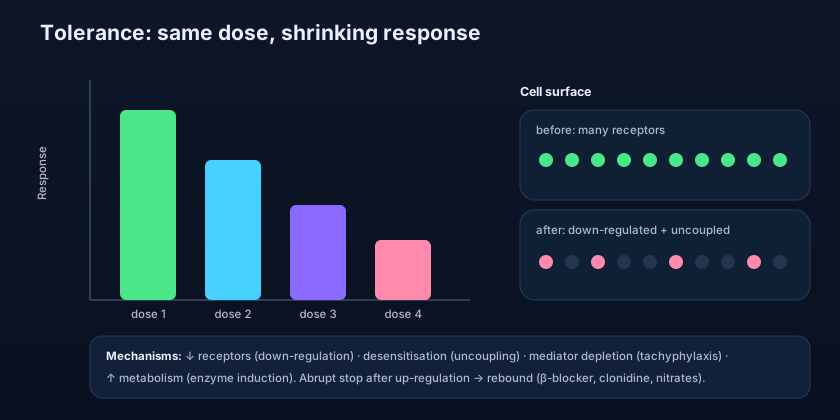
When a response weakens on repeated dosing, the first question is: how fast? Tolerance is the gradual kind — it develops over days to weeks of repeated exposure, and its hallmark is that you now need a HIGHER dose to get the effect the original dose used to give. Opioid analgesia is the classic example: a dose that controlled pain in week one may need to be doubled a month later. Tachyphylaxis is the rapid kind — a response that fades within minutes to hours, often after only a few doses, and giving more drug barely helps until the system recovers. Same endpoint (a shrinking effect), very different timescale, and — crucially — usually a different mechanism.
A quick mental test: if raising the dose still buys you more effect (just at a higher price), think tolerance. If piling on more drug does almost nothing for a while, think tachyphylaxis with a depleted or fully desensitised system — you can't squeeze water from a dry sponge no matter how hard you press.
Escape route 1 & 2: hiding the receptors and unplugging them
The receptor itself is the first battlefield. Faced with constant stimulation, a cell can do two distinct things. It can down-regulate — physically make fewer receptors, or internalise (pull inward) the ones on the surface, so there is simply less to stimulate; over days, the machinery to synthesise new receptors is also dialled down. Or it can desensitise (uncouple) — the receptor stays on the surface, present and countable, but it is disconnected from its downstream wiring. For G-protein-coupled receptors this happens fast: the activated receptor is phosphorylated (by GRKs), and β-arrestin is recruited to it, which both blocks G-protein coupling and drags the receptor into the cell. The receptor is there, but the phone line is cut.
Chronic morphine drives desensitisation and internalisation of the μ-opioid receptor, so equal doses give progressively less analgesia and the palliative-care dose climbs steadily over weeks. Importantly, tolerance to different opioid effects develops UNEVENLY — analgesia and euphoria fade markedly, but tolerance to constipation and (dangerously) to respiratory depression lags far behind. That mismatch is exactly why dose escalation in a non-tolerant person, or after a break, can be lethal.
- Down-regulation = FEWER receptors (made less / internalised) — the target shrinks.
- Desensitisation = receptor PRESENT but uncoupled from its signalling.
- GPCR desensitisation is fast: receptor phosphorylation + β-arrestin recruitment.
- Tolerance to different opioid effects develops at different rates — respiratory tolerance lags.
- Higher doses still work in receptor tolerance — they just cost more receptor occupancy.
Escape route 3: running the tank dry — mediator depletion
Some drugs don't act on receptors directly — they empty a store. This is the classic engine of tachyphylaxis. The indirectly-acting sympathomimetics — ephedrine, tyramine, amphetamine — don't stimulate adrenoceptors themselves; they enter the nerve terminal and force the release of stored noradrenaline. The catch is obvious once you see it: the store is finite. Each dose releases a little less because the vesicles haven't been refilled, and after a few closely-spaced doses the terminal is empty and the drug does almost nothing — no receptor is broken, there is simply no transmitter left to release. Rest and resynthesis restore the effect. This is why the response fades in minutes-to-hours, not weeks.
An athlete or a congested patient who redoses ephedrine repeatedly finds the decongestant and pressor effect shrinking fast within a single day — a textbook tachyphylaxis from noradrenaline depletion. Contrast this with a directly-acting agonist like phenylephrine, which stimulates the receptor itself and does NOT depend on stores, so it is far less prone to this rapid depletion-type fade.
Escape route 4: the drug speeds up its own destruction
Not all tolerance happens at the receptor — some is pure pharmacokinetics. In metabolic (pharmacokinetic) tolerance, the drug isn't less potent — there is simply less of it reaching the target, because the drug has revved up the very enzymes that clear it. Many drugs INDUCE hepatic cytochrome P450 enzymes: over one to two weeks the liver makes more enzyme, metabolises the drug faster, plasma levels for a given dose fall, and the effect wanes. Barbiturates, chronic alcohol and carbamazepine are the textbook self-inducers. The tell-tale difference from receptor tolerance is that the drug's measured blood level drops — and, dangerously, induction also accelerates the clearance of OTHER co-prescribed drugs. (We cover the CYP induction machinery in depth in the Metabolism chapter.)
A fifth, quieter mechanism completes the picture: physiological (homeostatic) counter-regulation. Here neither the receptor nor the drug level changes — instead an opposing body system pushes back. Give a drug that lowers blood pressure and the baroreflex raises heart rate and retains salt and water to defend the pressure; the net fall shrinks over days. The drug is still fully active at its own target; the body has simply recruited a rival pathway to cancel it.
- Mediator depletion (indirect sympathomimetics) is the classic cause of TACHYPHYLAXIS.
- Directly-acting agonists don't rely on stores, so they resist depletion-type fade.
- Metabolic tolerance = enzyme INDUCTION (barbiturates, alcohol, carbamazepine) → blood level FALLS.
- Enzyme induction also speeds clearance of OTHER co-prescribed drugs — an interaction risk.
- Homeostatic counter-regulation: an opposing reflex cancels the effect; drug & receptor unchanged.
The mirror image: up-regulation, rebound and withdrawal
If chronic stimulation hides receptors, chronic BLOCKADE does the opposite. Block a receptor for weeks and the cell, sensing under-stimulation, up-regulates — it builds MORE receptors and becomes supersensitive to its natural agonist. As long as the blocker is present, this is silent. But withdraw the antagonist abruptly and that swollen population of receptors is suddenly exposed to normal (or stress-elevated) transmitter levels with no brake — producing a rebound overshoot that can be worse than the original condition. The clinical rule that falls straight out of this: taper, don't stop.
Abrupt withdrawal of a β-blocker after chronic use exposes up-regulated β-receptors, causing rebound tachycardia, hypertension, and even angina or infarction in a cardiac patient. Suddenly stopping clonidine (which lowers sympathetic outflow) triggers rebound hypertension that can be severe. Long-term opioids and benzodiazepines, whose systems have adapted the opposite way, produce a florid withdrawal syndrome on abrupt cessation. In every case the fix is the same: reduce the dose gradually so the receptors can re-normalise.
Continuous nitrate exposure produces marked tolerance within 24 hours, so a round-the-clock GTN patch loses its anti-anginal effect by day's end — exactly our opening patient. The evidence-based fix isn't a bigger dose; it's a daily nitrate-free interval of 8–12 hours (typically overnight) during which the vascular system resensitises. Do less, on purpose, so the drug can work again. That is why the nurse told her to take the patch OFF each night.
Three words students blur: tolerance, dependence, addiction
These are separate phenomena that often coexist but must not be equated. Tolerance is a pharmacological adaptation: the SAME dose produces LESS effect (or you need more for the same effect) — the mechanisms above. Dependence is an adapted state revealed only on STOPPING: an abstinence (withdrawal) syndrome appears when the drug is removed, because the body has recalibrated around its presence. Addiction is a behavioural disorder: compulsive drug-seeking and use despite harm, driven by reward pathways. A patient on long-term opioids for cancer pain can be highly tolerant and physically dependent — needing escalating doses and suffering withdrawal if stopped — while being in no way addicted. Conflating the three leads to real harm, from under-treating pain to mislabelling patients.
- Chronic ANTAGONISM up-regulates receptors → supersensitivity → rebound on abrupt stop.
- β-blocker rebound (tachycardia/angina) and clonidine rebound hypertension — always taper.
- Nitrate tolerance needs a daily 8–12 h nitrate-free interval to resensitise.
- Tolerance = less effect per dose; Dependence = withdrawal on stopping; Addiction = compulsive use.
- A cancer-pain patient can be tolerant and dependent yet NOT addicted.
- Using 'tolerance', 'tachyphylaxis', 'dependence' and 'addiction' as if they were synonyms — they name four different phenomena.
- Assuming all tolerance is receptor-based. Some is purely metabolic (enzyme induction) — the blood level, not the receptor, has changed.
- Stopping a β-blocker or clonidine abruptly. Up-regulated receptors cause a dangerous rebound — these must be tapered.
- Fighting nitrate tolerance with a bigger dose instead of a nitrate-free interval — more drug just deepens the tolerance.
The rapid loss of effect seen when ephedrine is redosed repeatedly within a few hours is BEST explained by:
- Tolerance fades slowly (days–weeks, higher dose needed); tachyphylaxis fades fast (minutes–hours, few doses).
- Mechanisms: down-regulation, desensitisation (β-arrestin), mediator depletion, enzyme induction, and homeostatic counter-regulation.
- Chronic blockade up-regulates receptors → rebound on abrupt stop (β-blockers, clonidine); nitrates need a nitrate-free interval.
- Tolerance ≠ dependence ≠ addiction — a pain patient can be tolerant and dependent without being addicted.
- Rang HP, Dale MM, et al. Rang & Dale's Pharmacology — Desensitisation, tachyphylaxis, tolerance & receptor regulation.
- Katzung BG. Basic & Clinical Pharmacology — Drug receptors, down-/up-regulation, tolerance & tachyphylaxis.
- Brunton LL, et al. Goodman & Gilman's The Pharmacological Basis of Therapeutics — Receptor desensitisation & β-arrestin; tolerance and dependence.
- Whalen K. Lippincott Illustrated Reviews: Pharmacology — Tolerance, tachyphylaxis & nitrate-free interval.
- Katzung & Trevor's Pharmacology Examination & Board Review — Tolerance vs dependence vs addiction; rebound phenomena.

