
Therapeutic Index and the Margin of Safety: Which Drugs Need Monitoring
Two drugs can both "work." One you prescribe and forget; the other you check with a blood test every few weeks, because the dose that helps and the dose that harms sit almost on top of each other. That gap — wide or terrifyingly narrow — is the therapeutic index. This chapter turns the quantal curves you just met into the single most practical safety number in medicine, and shows you exactly which drugs earn a needle in the arm.
A 72-year-old woman with atrial fibrillation has been on warfarin for a year. She feels fine. Yet every few weeks she comes back to the clinic and pricks her finger for an INR test. Today the number reads 4.8 — too high. She hasn't changed her tablet; she simply started an antibiotic three days ago for a chest infection. That one interaction nudged her from "protected against a stroke" toward "at risk of a serious bleed." No dose was increased. The margin was just that thin. The whole reason she is tethered to a blood test is a single number: warfarin's therapeutic index is small.
From quantal curves to a safety ratio
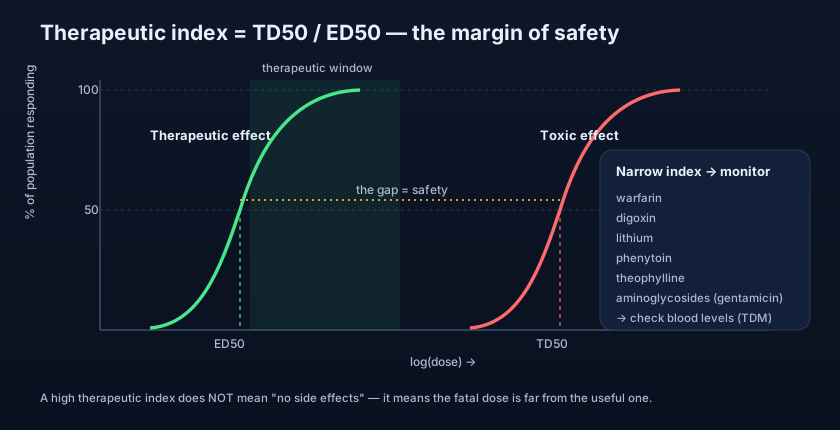
In the previous chapter you built two quantal curves. One plotted the cumulative fraction of a population showing the desired EFFECT as the dose rose; from it we read the ED50, the dose that is effective in 50% of individuals. A second, parallel curve plotted the fraction showing TOXICITY, giving the TD50 (the dose toxic in 50%) — or, in animal lethality studies, the LD50 (the dose lethal in 50%). The therapeutic index simply asks: how far apart are these two curves? It is their ratio.
In humans we write the therapeutic index (TI) as TD50 ÷ ED50; in animal experiments, where a lethal endpoint is measured, it is LD50 ÷ ED50. The reading is intuitive: the LARGER the ratio, the SAFER the drug, because the dangerous dose sits far above the useful one. A TI of 100 means you must give a hundred times the effective dose before half the population is harmed — a comfortable cushion. A TI of 2 or 3 means the toxic dose is barely double the effective one — walk carefully.
A high therapeutic index does NOT mean "no side effects." It means the DANGEROUS dose is far from the USEFUL one. Penicillin has a huge TI yet can still cause a rash or, rarely, anaphylaxis; the point is that its serious dose-related toxicity lies far above any dose you would ever prescribe. "Safe margin" and "free of adverse effects" are two different promises — the TI only makes the first.
The therapeutic window: where you aim to keep the patient
The therapeutic index is a ratio; the therapeutic window is a range. The therapeutic window (or therapeutic range) is the band of plasma concentration — or of dose — that lies above the minimum effective concentration but below the toxic threshold. Below the window the drug is useless; above it, dangerous. Between them is the target you steer for. For many drugs this window is generous and you never think about it. For a handful, it is a knife-edge, and keeping a patient inside it is the daily work of dosing.
Two forces set the width of that window in a real patient. First, the drug's intrinsic curves — how close its toxicity curve sits to its effect curve. Second, the patient's kinetics — how fast they clear the drug, which is where the previous PK chapters return. A window measured in the textbook can shrink dramatically in a person with failing kidneys or an interacting co-medication, because the SAME dose now produces a HIGHER concentration.
Why the index alone is imperfect: the certain safety factor
The TI is built from the MIDDLES of the two curves — the 50% points. But a patient is not the median patient, and the curves may not be neat parallel lines: they can overlap, and they can have different slopes. A drug with an average safety cushion but a very shallow, wide toxicity curve might already be harming the most sensitive individuals at doses that barely help the least sensitive. Comparing two midpoints can hide that danger at the edges.
So pharmacologists use a stricter, more honest measure. The certain safety factor (also called the margin of safety) is the ratio LD1 ÷ ED99 — the dose that is lethal (or toxic) in just 1% of the population divided by the dose effective in 99% of it. This compares the toxic curve's LOWEST realistic edge against the effect curve's HIGHEST realistic edge. If that ratio is still greater than 1, then a dose that helps almost everyone is still below the dose that harms even the most sensitive. It is a far harsher test than TD50/ED50, and it exposes drugs whose curves overlap.
- Therapeutic index (TI) = TD50/ED50 in humans, or LD50/ED50 in animal studies.
- A larger ratio = a safer drug; the toxic dose sits far above the effective one.
- The therapeutic window is a RANGE of concentration/dose; the TI is a RATIO.
- A high TI does not promise "no side effects" — only a wide margin to danger.
- The certain safety factor (LD1/ED99) is a stricter, real-world margin.
- Overlapping curves or different slopes make a bare TI misleading.
Narrow-therapeutic-index drugs: the ones that earn a blood test
A narrow-therapeutic-index (NTI) drug is one whose effective and toxic concentrations lie so close that a small change in dose, absorption, or clearance can tip a patient from ineffective straight to toxic. For these drugs, prescribing by dose alone is not enough — you must measure the actual plasma level and steer by it. That is therapeutic drug monitoring (TDM): checking blood concentrations at the right time (often the trough, just before the next dose, once the drug has reached steady state after roughly four to five half-lives) and adjusting accordingly.
Warfarin → monitor the INR (not a drug level, but the clotting effect). Digoxin → measure the serum digoxin level, and watch serum potassium, since low K⁺ worsens digoxin toxicity. Lithium → measure the serum lithium level, tightly (roughly 0.6–1.2 mmol/L). Phenytoin → serum level, with the twist that its kinetics are saturable, so a small dose rise can spike the level. Theophylline → serum level (narrow, arrhythmia and seizures above it). Aminoglycosides such as gentamicin → trough level to avoid kidney and ear toxicity; vancomycin → trough/AUC-guided level. Ciclosporin and tacrolimus → trough levels to balance rejection against toxicity. Several antiepileptics (e.g., carbamazepine, valproate) also fall here.
Now compare penicillin. Its therapeutic index is enormous: the dose that harms sits worlds above the dose that cures, so we do not draw routine blood levels for it. The same is broadly true of most standard antibiotics, paracetamol at normal doses, and many others. The lesson is sharp — TDM is not a courtesy we extend to every drug; it is reserved for the narrow few where the margin is genuinely dangerous.
Interactions and organ impairment shrink an already thin margin. This is where the woman in our scene fits. Warfarin's window is narrow to begin with; a new antibiotic that inhibits its metabolism, or a failing liver or kidney that slows clearance, pushes the plasma level up without any change in the prescribed dose. The same steady dose now lands higher on the toxicity curve. That is precisely why NTI drugs are re-checked after any new interacting medicine, and why doses are lowered in renal or hepatic impairment.
- NTI drugs: warfarin, digoxin, lithium, phenytoin, theophylline, aminoglycosides, vancomycin, ciclosporin, several antiepileptics.
- TDM means measuring the actual plasma level and dosing to it, not by dose alone.
- Sample at the right time — often the trough, and after steady state (~4–5 half-lives).
- Warfarin is monitored by effect (INR); digoxin, lithium, etc. by drug level.
- Interactions, renal or hepatic impairment, and age all narrow the real margin.
- Wide-index drugs (e.g., penicillin) need no routine levels.
- Reading "high therapeutic index" as "safe, no side effects." It only means the toxic dose is far from the effective one — adverse effects can still occur.
- Confusing the therapeutic index (a RATIO of two doses) with the therapeutic window (a RANGE of concentration you aim to stay within).
- Forgetting that drug interactions and renal/hepatic impairment shrink the effective margin, so a "stable" dose can suddenly become toxic.
- Sampling a drug level at the wrong time (before steady state, or at a peak instead of a trough) and misreading the result.
The therapeutic index of a drug is best defined as:
- Therapeutic index = TD50/ED50 (humans) or LD50/ED50 (animals); bigger ratio = safer drug.
- The therapeutic window is the concentration/dose RANGE you aim to keep the patient within.
- A high TI ≠ no side effects; overlapping curves make the certain safety factor (LD1/ED99) stricter.
- Narrow-index drugs (warfarin, digoxin, lithium, phenytoin, theophylline, aminoglycosides) need TDM; wide-index drugs like penicillin do not.
- Rang HP, Dale MM, et al. Rang & Dale's Pharmacology — Quantal dose–response, therapeutic index & margin of safety.
- Katzung BG. Basic & Clinical Pharmacology — Dose–response relationships, therapeutic index & therapeutic window.
- Whalen K. Lippincott Illustrated Reviews: Pharmacology — Therapeutic index & narrow-therapeutic-index drugs.
- Brunton LL, et al. Goodman & Gilman's The Pharmacological Basis of Therapeutics — Therapeutic drug monitoring & drug interactions.
- Bertram G. Katzung & Trevor's Pharmacology Examination & Board Review — Therapeutic index, certain safety factor (LD1/ED99).